

The Original Pumpkin Pie Looked A Lot Different Than The One We Know And Love Today
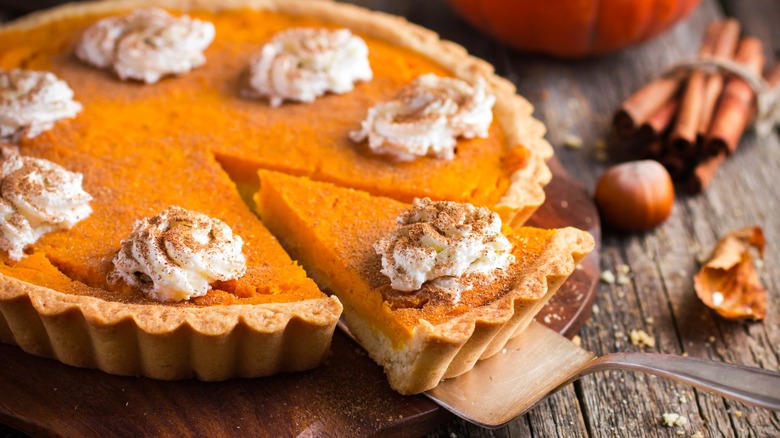
Many people today don't even bother making pumpkin pie at home given how accessible it is, but that hasn't always been the case. The beloved holiday staple has evolved over centuries to become the creamy comfort dessert folks can conveniently pick up at Costco and stick in the freezer so it's on hand whenever it's called for. Originally, it barely resembled a traditional pie as we know it, and it was made out of necessity as people used any ingredients available for sustenance rather than as a special holiday treat.
There wasn't actually just one "original" pumpkin pie. Medieval Europeans made a version which featured a thick, flavorless crust most people didn't even eat and in fact contained no pumpkin. The crust was essentially just a vessel for a pudding-like filling which was made with the innards of gourds. They switched to pumpkin filling once they were introduced through trade to the more flavorful squash, which is native to North America. Those pioneers of the now iconic Thanksgiving staple also added the combination of spices folks today would recognize as pumpkin pie spice.
Meanwhile, Native Americans were making a variation of the Thanksgiving classic without any crust at all. Instead, pumpkin shells were filled with milk and spices then roasted in a bed of hot coals. The resulting filling was creamy and the taste was a far cry from what we currently enjoy, but it's still a predecessor. European settlers in North America later mimicked the preparation method, sometimes adding honey for extra sweetness. Recipes eventually emerged in the 1600s that featured a baked crust containing the filling, but the pudding-like mixture still wasn't quite the same as it is today.
Pumpkin pie continued to evolve
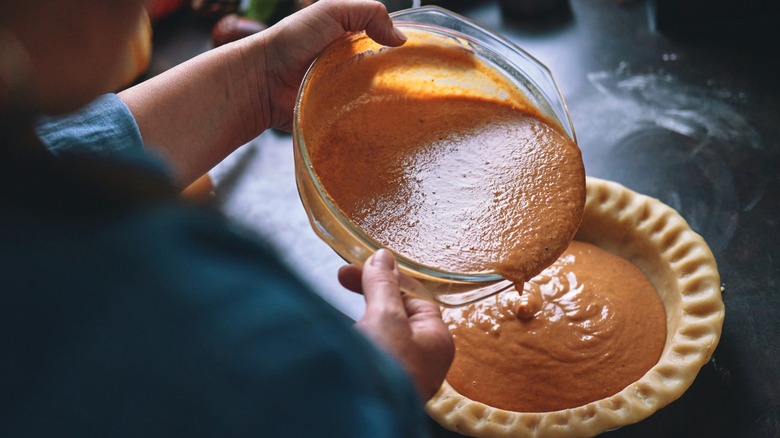
Pumpkin pie varied in appearance and taste for centuries, but the recipe started becoming more uniform in the 18th century. A flaky pie crust (that was actually eaten and enjoyed) became a staple, and makeshift pumpkin pie spice mixes that people associate with fall today were regularly featured in the filling. The dessert continued to gain popularity through the 19th century as it was frequently connected to harvest season and Thanksgiving, which became a national holiday in 1863.
Americans' adoration of the confection grew as various cookbooks and magazines began featuring recipes for pumpkin pie. Roasting and straining the pumpkin was still time-consuming, but cooks around the country were baking pies that were increasingly similar between households, albeit with slight differences in flavor and texture. In 1929, Libby's, a Chicago-based meat-canning business, changed the game when it came up with the idea to sell canned pumpkin puree. Now people could whip up the dessert in no time, and the texture of the filling became more consistent across different recipes.
When store-bought pie crusts became widely available, an extra layer of convenience was added to the dessert. Folks still like to put their own spin on the confection by adding a pinch of this and a dash of that to make their recipes stand apart from others, but hollowed-out pumpkin shells, inedible crusts, and gravy-like consistencies were officially a thing of the past.