

KFC Vs Popeyes: The Healthier Chicken Sandwich Might Surprise You
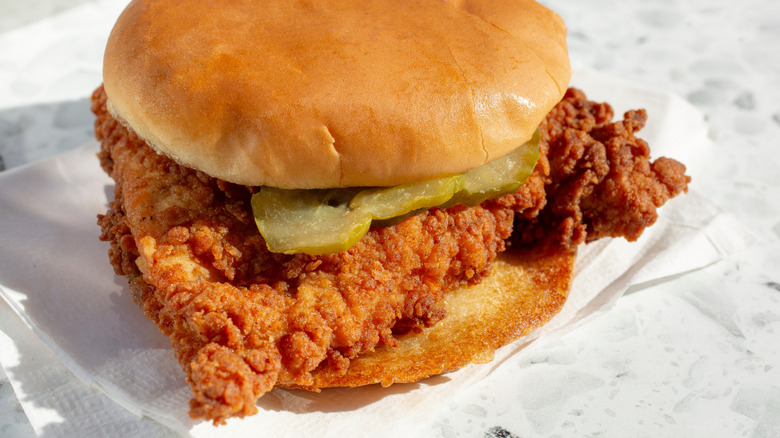
Popeyes started the fast food chicken sandwich wars. But now, the chain's classic sandwich is hardly the only player in the game. The Takeout's testers prefered Popeyes' chicken sandwich to Kentucky Fried Chicken's, taste-wise — but how do they compare on nutrition?
In some ways, the stats for KFC and Popeyes' classic chicken sandwiches are similar. In terms of ingredients, both include pickles and mayo. KFC's Classic Chicken Sandwich has 49 grams of carbohydrates to Popeyes' 50. Both contain 90 milligrams of cholesterol; both are low in sugar and fiber.
But KFC's sandwich also beats out Popeyes on several counts. KFC's sandwich contains slightly more protein (34 grams to Popeyes' 28) and slightly fewer calories (650 versus 700). Both are high in sodium, like many processed foods — but Popeyes' sandwich adds 180 milligrams to KFC's 1,260, for a total of 1,440.
The biggest difference? Fat. KFC's sandwich contains 35 total grams of fat to Popeyes' 42. That makes both sandwiches fairly fatty, but what really matters is the type of fat. KFC's sandwich contains just 4.5 grams of saturated fat, while Popeyes' contains 14 grams. Since the American Heart Association recommends eating no more than 13 grams per day for a 2,000-calorie diet, KFC's Classic Chicken Sandwich is the clear winner.
Admittedly, the American Heart Association's recommendation is on the conservative side. The U.S. dietary guidelines recommend keeping saturated fat to 10% of your daily calorie intake, or 22 grams. But the difference is still significant.
Should you trust fast food nutrition facts?

Okay, so KFC's Classic Chicken Sandwich beats Popeyes, health-wise. But can you trust those numbers? Well, maybe. Regardless of whether the nutrition facts are accurate or not, they can provide a general guideline.
Nutrition facts almost always contain inaccuracies. Manufacturing mistakes, cooking methods, and natural variations in the food can all change calorie counts — after all, no two chicken tendies are exactly the same. The U.S. Food and Drug Administration (FDA) gives restaurants and manufacturers a little wiggle room. Legally, calorie counts can be up to 20% off. One study found that, while restaurants' calorie counts were typically trustworthy, 19% of items contained at least 100 extra calories. For both KFC and Popeyes, 100-plus extra calories would still be within the FDA's 20% limit.
That said, just being aware of nutrition labels correlates with healthy practices. Another study found that Americans who rate their diets as "excellent" or "very good" are more likely to check the nutrition facts at fast food restaurants than customers who rated their diets "poor." And even with a little wiggle room, nutrition facts can provide helpful guidance.
However, eating a well-balanced diet doesn't necessarily mean obsessing over fat content and calorie counts. Nutrition labels can have a negative impact for people with eating disorders, and you can learn to balance your diet without checking labels. Remember, health is personal — no single diet will fit everyone's needs. Base your choices on your doctor's recommendations, not info from the internet.