

Wait, Can Pillsbury Biscuits Be Baked In The Microwave?
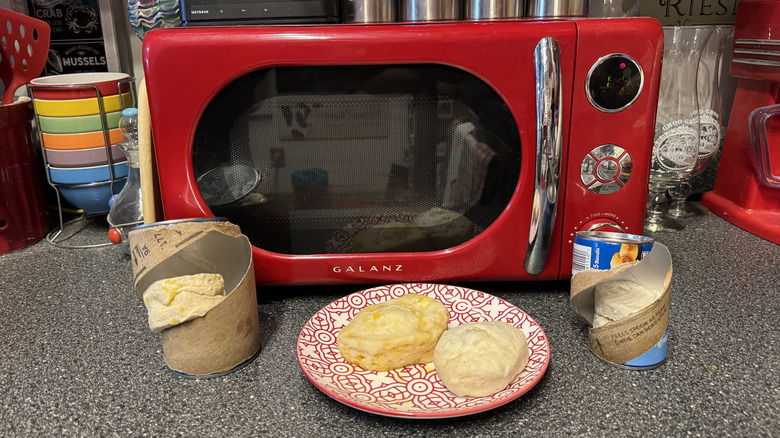
I don't cook. Like, ever. At least, not in the traditional sense. My stove and oven have been turned on fewer times than hell has frozen over in Phoenix. Friends who cook can't grasp this concept and ask how I manage to feed myself. But they clearly don't understand the true magic of the microwave. It's great for frozen dinners and giving reheated food a first-day taste, but you can also make eggs, cake, corn on the cob, nachos, rice, and yes, even biscuits in the microwave. Trust me, I've done it.
Though I'd read that biscuits couldn't be microwaved, I was determined to prove any naysayers wrong. Armed with two cans of Pillsbury biscuits — one regular-sized buttermilk, and one of the jumbo, butter-flavored Grands varieties — I started by microwaving a single smaller biscuit for 20 seconds. Then I flipped it over and put it back in for another 20 seconds. It came out perfectly edible, but spongey and a little dry. Not great.
So I tried the same with one of the Grands biscuits, with greater success. Because it was bigger, and perhaps thanks to the extra butter, it cooked less and wasn't quite as dry as its smaller counterpart. Still determined, I tried one more time with a smaller biscuit, this time microwaving it for a total of 30 seconds rather than 40. That seemed to be the sweet spot. Some might have thought it was bordering on doughy, but as someone who prefers things underbaked, it was perfect for me.
The verdict: The biscuits were tasty but, admittedly, not golden brown or flaky. Would the oven have done a better job? Yes. Does the microwave work in a pinch, especially for lazy cooks like me? Also yes.
The microwave vs the oven
Of course, not everyone is Team Microwave. And there are pluses and minuses to both methods of cooking. For biscuits and beyond, here's a comparison of these two appliances.
In a microwave, high-frequency electromagnetic waves go straight into your food and cause any water or fat molecules within it to vibrate and warm up. As those molecules are heated, so is your dinner, but that's why anything you stick in the microwave is prone to popping and even exploding.
Microwaves are more space-efficient than traditional ovens (and here are our suggestions for the best places to put them in your kitchen) heat food more quickly, cost less, and are easier to clean (unless your family members don't cover their sauce). On the downside, they can easily make food hard, dry, or sometimes chewy and soggy. They can't crisp or brown worth a darn, and space in them is limited, so cooking a whole turkey or a large pizza is out of the question — unless you opt to cook it a few pieces or a couple drumsticks and giblets at a time. However, not to be outdone by the ovens, some modern microwaves now have special crisping or convection features.
Ovens, on the other hand, are equipped with heating elements powered by gas or electricity. With their varied temperatures and larger size, ovens are more versatile. Plus, they can cook foods to be crisp and brown on the outside but still juicy or tender on the inside. If you have the patience to wait for an oven to heat up and cook (you could almost do a whole load of laundry in the time it can take just to preheat — and do you really need to preheat an oven? It depends), ovens do have certain advantages. A good, flaky, melt-in-your-mouth biscuit just the way the Doughboy intended is one of those perks.