

This AI Restaurant Trend Has Us Losing Our Appetites (Seriously, Stop)
When techno-evangelists talk about artificial intelligence, they talk about it like a natural resource. According to them, not using AI would be like living near a mighty river without fishing in it, or using it to irrigate your crops. (That's why Mississippi grows so much rice.) But that's not what AI is. AI is a product, or a series of products, designed by some of the wealthiest and most powerful corporations in history, and sold to us with the aggression of a drug dealer in a D.A.R.E. public service announcement. We're told that it can do anything, that it can make every task easier, that it's already here, and there's no point in resisting it. And maybe, to some extent, that's true. But when we see ugly, tasteless AI art used to advertise restaurants, we can't help but push back.
You probably know what we're talking about, even if you don't consciously recognize that it's AI. You may have seen a new burger restaurant open in your neighborhood (maybe one that sells regional hamburgers you need to try) with a logo that has a glossy, uncanny sheen, like a normal logo that has been polished and processed until it looks fake. Or you may have seen flyers with crowded, nigh-illegible graphic design, displaying pictures of food that resemble the results of an alien intelligence trying to recreate burgers from first principles. Maybe you were repulsed within seconds; maybe you stared with disgusted fascination for a moment. You probably didn't walk away hungry.
Using AI art for your restaurant shows contempt for your customers
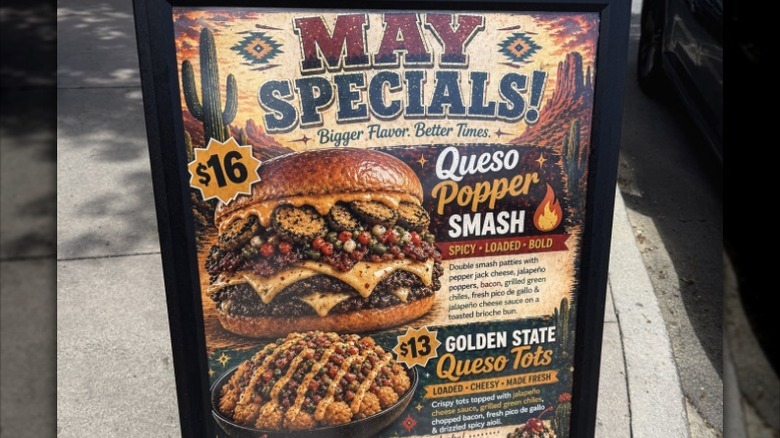
The first and most obvious problem is the fact that the results are usually ugly as sin. At their very best, the logos are forgettable amalgamations of cartoony ClipArt and generic sans-serif font; at their worst, they look like those hideous mobile ads for video games that steal your credit card information. And the less said about the posters, the better: You will see burgers that look like they're made from rotten meat, dumplings that bring to mind slimy alien embryos, and chicken nuggets that resemble throw pillows knitted from human flesh.
If you know how AI works, this may not be surprising to you. Although it's called "artificial intelligence," it doesn't really know anything the way you or I might. Instead, it gathers huge amounts of data and puts it together in a way that will most probably satisfy your request. By nature, it can't create anything new, which is why even the most polished AI art looks so bland and derivative; and, because it doesn't actually know what chicken nuggets are (or about its Ivy League history), it's liable to make terrible mistakes.
So why use it? The answer is obvious: Because it's cheap, and because a lot of people may not notice or care. But that doesn't change the truth, which is that using AI to advertise a restaurant displays contempt for its customers. If you walk past one of these logos or posters on the street, the very first thing you know about the restaurant is its willingness to cut corners. It announces, "I can't be bothered to pay someone to do this properly, and I don't care who notices the difference." Some first impression, huh?
What we lose when AI proliferates
The typical rebuttal is that artificial intelligence is constantly improving, and that there will come a day when it is completely indistinguishable from the genuine article. While the latter claim is debatable (if irrelevant to the monstrosities foisted upon us today), the former is not; the old tricks of identifying AI, like counting people's fingers, may no longer be reliable. Maybe there will come a time when graphic designers become obsolete, or a fussy, analog extravagance on par with commissioning someone to build a majestic grandfather clock for your restaurant. But if that's the case, what will we lose?
The sanctity of human expression is often used as a rebuttal against AI art; even Sam Altman pays lip service to it. But making a quick logo for a tourist trap seafood joint is a far cry from "The Starry Night," right? What does it matter if it's made with zero care rather than slightly-greater-than-zero care? Well, recall the last time you visited a gift shop on vacation. Remember the t-shirts, the coffee mugs, the magnets with off-color puns about crabs? They were kitschy, mercenary, and probably destined for a landfill at some point, but by a dint of human involvement, they had an animating spark; they were something, rather than nothing. But when the gift shop designs are made with AI (as so many are these days), there is no spark, no pleasant illusion: You are paying money for ugly ephemera that nobody even cared enough to create.
So it goes with AI restaurant logos and ads. Even if you only look at one for five seconds, you'll walk away with the nagging feeling that you've been ripped off — and you'll be right.