

How Long To Bake Lasagna For Perfect Results Every Time
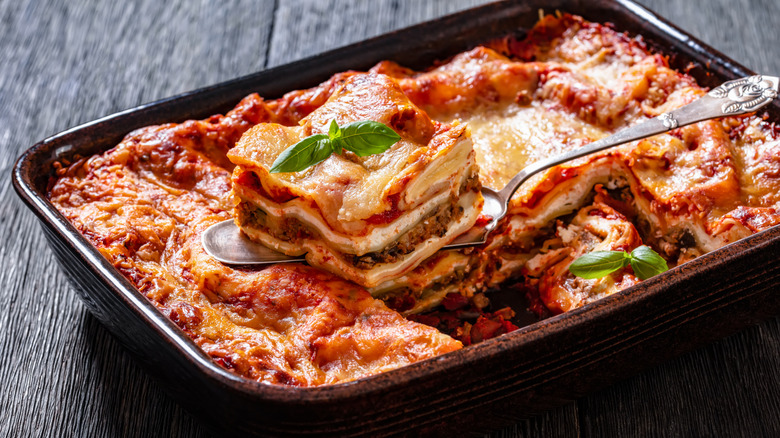
Cooking times for lasagna will vary depending on what recipe you're using. Jon Bon Jovi's Italian-inspired family recipe for eggplant lasagna bakes for over an hour, while a quick and easy skillet lasagna could be ready in less than half that time. Jasper J. Mirabile Jr., owner and eponym of Jasper's Italian Restaurant in Kansas City, Missouri, has some opinions on lasagna and was happy to share them with us. (He also regularly shares his thoughts on cooking on a local radio show called "Live! From Jaspers Kitchen.") "I think the standard cooking time would be for 50 minutes at 375 degrees Fahrenheit," Chef Mirabile opined. However, he said you also need to take the filling into account.
Whether you consider béchamel or ricotta to be the proper lasagna filling will depend on the region, since Northern Italy favors white sauce while Southern Italy prefers extra cheese. (It's all good, as long as you don't go with cottage cheese.) As Mirabile told us, the cooking time "depends on whether you're making a Tuscan lasagna or a Southern style lasagna because the more cheese you have, the longer it's going to take." For lasagna made with béchamel, he recommends covering and cooking it for 25 minutes. After this, he says to remove the cover and lower the heat to 350 degrees, then give it another 20 to 25 minutes in the oven. If you're making lasagna with ricotta and egg, it's better to cook it for a full 35 minutes covered, then uncover it but leave the heat at 375 degrees for another 20 minutes of cooking.
How can you tell if lasagna's cooked correctly?
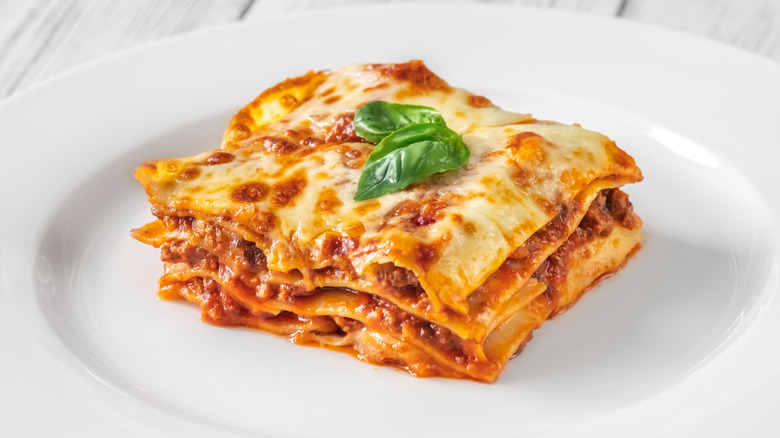
Undercooking a lasagna, unlike undercooking a chicken, probably won't make you sick, but it won't yield the best results either. "When you cut into the lasagna and it's very runny, then you know that it's not cooked enough. Also, if the pasta is chewy," Mirabile told us. One way to avoid these issues is to use a meat thermometer, since a properly cooked lasagna should reach an internal temperature of 165 degrees.
Don't leave the lasagna in the oven too long though, since this also won't turn out well. With ricotta-filled lasagna, Mirabile cautioned, "If the cheese rises and then gets overcooked, you'll see a lot of air bubbles in between and there's really no added flavor. It's just turned into a burnt mess." Of course, overcooked béchamel is also to be avoided and baking the noodles until they're leathery isn't recommended either. Toasted ravioli may have been a happy little accident, but lasagna jerky would just be unpleasant.
When lasagna comes out as it should it's a beautiful sight to behold. "You know the lasagna is just perfect when you cut into it and everything stays in place. The cheese is not runny, the sauce is not runny, and the pasta is cooked just perfectly," said Mirabile. As he sees it, it's okay if the top layer of noodles dries out just a bit: "There should be just a slight little crispy top, especially on the edges."