

Trader Joe's Honey Walnut Shrimp Vs Panda Express: Which Is Better?
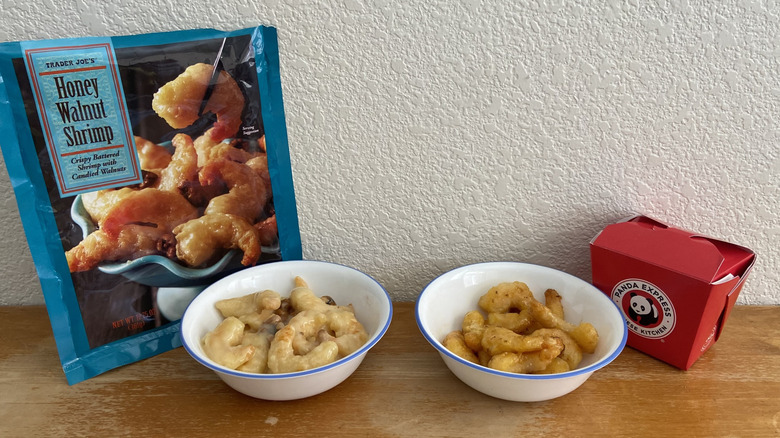
Welcome to Dupe Detective, a new column where I'll be reviewing a name brand food product's competitor product to find out how well it compares to, or even beats, the original.
Among the eight beloved items in the Trader Joe's Hall of Fame is the store's iconic Mandarin Orange Chicken. Of course, not just comparably but arguably more popular than that Trader Joe's product is Panda Express Orange Chicken, the pinnacle of junky Chinese-American takeout. Since one of the most successful Trader Joe's products is effectively a dupe of a dish at Panda Express, it's hardly surprising that the chain carries another dupe of a signature Panda Express menu item in its frozen Honey Walnut Shrimp.
Due to an excess of batter, oil, and sugar, Honey Walnut Shrimp ranks among the 11 unhealthiest items on the Panda Express menu. While that doesn't mean it's not delicious, it's at least fair to say there's room for improvement on the Panda Express formula. I picked up a bag of frozen Honey Walnut Shrimp from my local Trader Joe's, as well as a medium entree serving of Honey Walnut Shrimp from a nearby Panda Express to find out just how the Trader Joe's dupe stacks up against its name-brand inspiration. Ahead are my thoughts after trying both items, before my pick for which brand's Honey Walnut Shrimp is superior.
Taste test: Trader Joe's Honey Walnut Shrimp
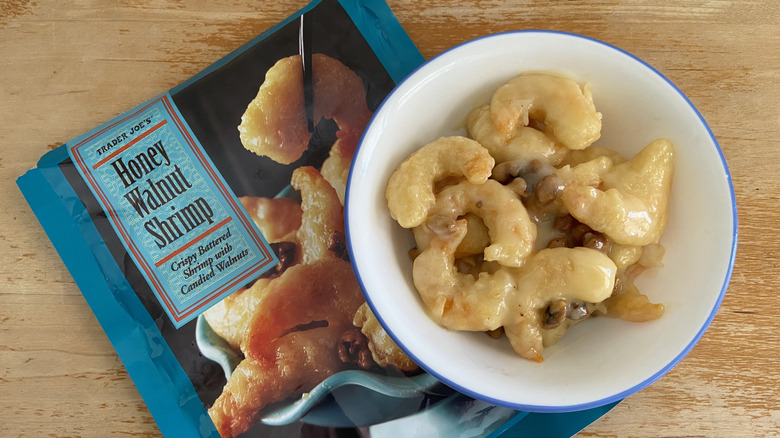
Visually, Trader Joe's Honey Walnut Shrimp sets itself apart from its most prominent American counterpart courtesy of its sauce. Whereas the Panda Express version of the dish features a light glaze that merely adheres to the outside of each individual piece of shrimp, Trader Joe's packages enough sauce in its Honey Walnut Shrimp bags to create a thick coating. Ahead of trying my Trader Joe's product, I read a descriptor of that sauce as akin to frosting on The Takeout's list of the 14 worst things you can buy at Trader Joe's according to Reddit. I like to think I do a good job of analyzing food with as little bias as possible, but I ended up finding that sauce cloyingly sweet and pretty dang close to either frosting or a sweet jam. Unsurprisingly, then, I was a little put off by it from the get-go.
Underlying the sweetness of my Honey Walnut Shrimp's amply apportioned sauce was a subtle but sharp umami, like that of parmesan cheese. That combination wasn't quite as strange as it sounds, but it wasn't ideal. Due to some otherwise bland shrimp, that flavor dominated. The included walnut pieces were small and hardly noticeable. Its breading, meanwhile, didn't stick to each piece of shrimp all that well, which may have just been an inevitability considering it was a prepackaged, frozen product.
Taste test: Panda Express Honey Walnut Shrimp
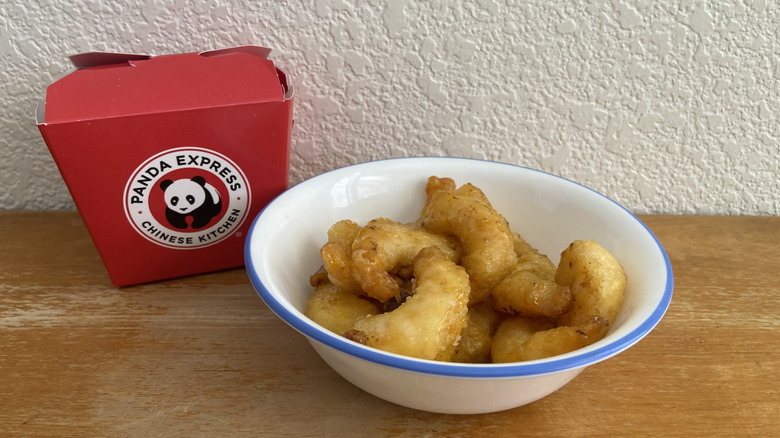
The quality that surprised me most about my Panda Express Honey Walnut Shrimp was how much it relied on the flavor of its shrimp meat, as opposed to its breading, walnuts, or glaze. While it's not entirely clear which meats Panda Express cooks from fresh and which it cooks from frozen, I found its shrimp satisfyingly firm and flavorful regardless. Foregrounding the flavor of shrimp, then, wasn't a bad thing when that component tasted quite a bit better than I was expecting from a fast food restaurant.
Its breading, meanwhile, felt to me like what Panda Express uses on its Orange Chicken. It was firm and soft in equal parts, each in exactly the way it should be. Perfecting breading is key to making sure homemade orange chicken stays crispy, and Panda Express has honed that technique on a mass scale. My Honey Walnut Shrimp's glaze tasted perfectly fine — it was a little syrupy and not overly sweet or salty, nicely complementing the perfectly breaded, quality shrimp, rather than overwhelming.
Finally, its walnuts were a little mealy but more interesting than plain walnuts thanks to the sweet honey glaze. Those walnuts didn't move the needle in one direction or another, but the bit of nutrition they contributed to the dish was nice, at least.
Final verdict: is the Trader Joe's dupe better or does the original reign supreme?
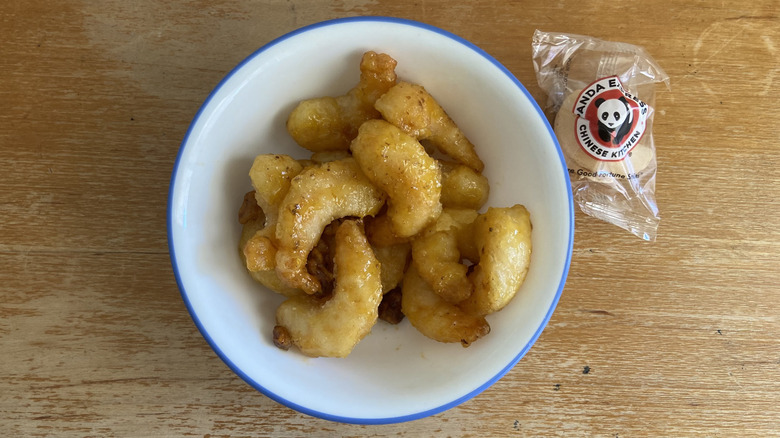
While Trader Joe's Honey Walnut Shrimp can safely be considered a dupe of a dish at Panda Express — especially considering one of the most popular Trader Joe's items is a Panda Express dupe — the two products are pretty wildly different interpretations of the same core idea. Whereas Panda Express' Honey Walnut Shrimp is subtle and balanced, the Trader Joe's version is bold and brash. It turned out that the relative restraint showed by Panda Express resulted in a much better experience.
There's really no better word to describe the Trader Joe's Honey Walnut Shrimp other than "weird." Extreme sweetness, sharp umami, bland shrimp, and limp breading do not add up to a very inspiring whole. Having to eat my fill for the sake of this article, I didn't necessarily find it terrible, but if asked by friends or family, I would recommend they stay away from the product in virtually any and all circumstances.
On the other hand, I enjoyed my Panda Express Honey Walnut Shrimp. While it wouldn't quite be my first pick for a Panda Express entree, I think, say, pescatarians would still find it a solid number-one option. In other words, I hope to never have to eat Trader Joe's Honey Walnut Shrimp again, while I might pick up the Panda Express version if I feel like changing up my usual order.
How do Trader Joe's and Panda Express' prices and nutritional content compare?
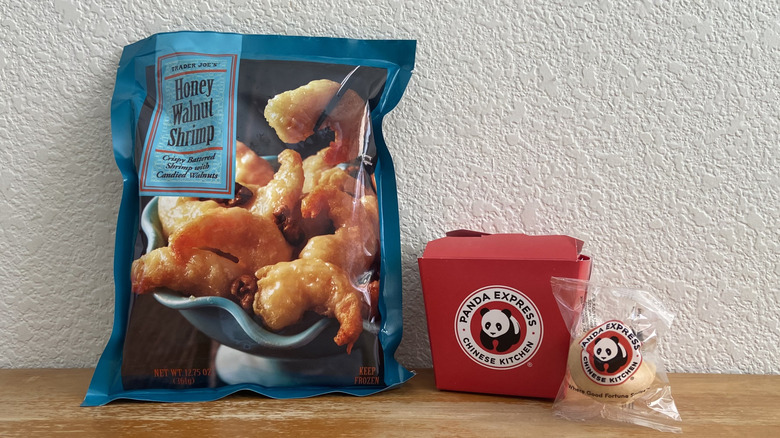
For the sake of best representing their values, I counted the number of individual shrimps in each Honey Walnut Shrimp: I got 17 from Trader Joe's and 14 in a medium entree at Panda Express. My local Trader Joe's sells its Honey Walnut Shrimp for $6.99, while that medium entree — which includes an upcharge due to the chain categorizing Honey Walnut Shrimp as "premium" — totaled $11.70. Trader Joe's, then, provided the best value-per-shrimp. Small and large premium entrees at my local Panda Express are $6.90 and $15.90 respectively.
Nutritionally, it's impossible to compare each product directly, because Trader Joe's measures one serving by weight, at 208 grams, whereas Panda Express considers one serving to be 4.39 ounces, measuring volume. With that said, that one serving of Trader Joe's Honey Walnut Shrimp totals 500 calories, 28 grams of fat, 8 grams of which is saturated fat, 125 milligrams of cholesterol, 670 milligrams of sodium, 22 grams of carbs, 2 grams of fiber, 26 grams of sugar, and 24 grams of protein.
Meanwhile, one serving of Panda Express Honey Walnut Shrimp equals 430 calories, 28 grams of fat, 4 grams of which is saturated fat, 70 milligrams of cholesterol, 700 milligrams of sodium, 32 grams of carbs, 1 grams of fiber, 9 grams of sugar, and 13 grams of protein. Those single servings of each product, then, are each advantageous by different metrics.
Methodology
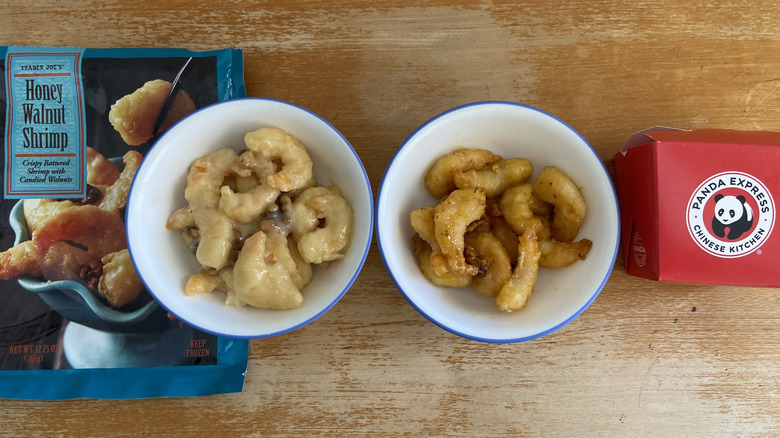
I had purchased my bag of Honey Walnut Shrimp from Trader Joe's days prior to trying it, so it was ready in my freezer well before I needed it. On the day I chose to try both products, I drove to my nearest Panda Express in the suburbs of Las Vegas and ordered a medium Honey Walnut Shrimp entree. While I typically like to try off-brand dupes before their name-brand equivalents, I had to sample the Panda Express product first in this case. I had some as soon as I got home, after quickly preheating the oven to prepare the frozen Honey Walnut Shrimp from Trader Joe's.
Once my Trader Joe's shrimp was ready, per the conventional oven instructions on its bag, I had some as soon as possible. Then I returned to the Panda Express shrimp and ended up alternating bites of the two to help solidify my overall thoughts. Neither Trader Joe's nor Panda Express had any indication my purchases were for the sake of an article and not my own enjoyment. All assessments are based entirely on this experience and not any past thoughts an either brand or product.