

You Wouldn't Recognize Medieval Lasagna If It Slapped You In The Face
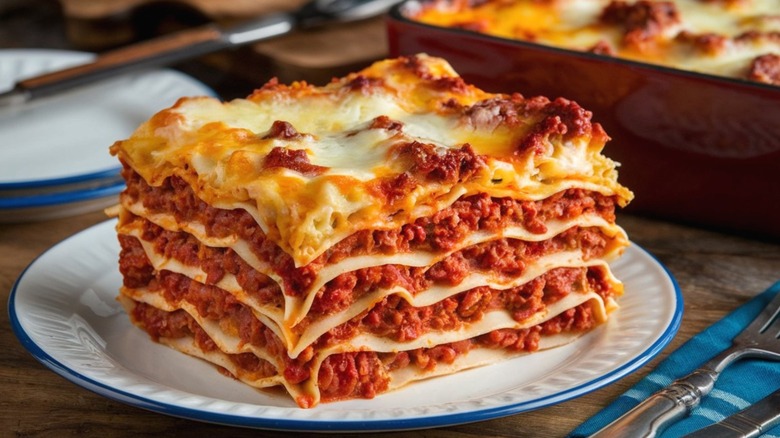
You probably have a pretty good idea of what lasagna looks like. There's sauce, then noodles, cheese (either bechamel or ricotta), meat, and more sauce, and on and on until the pan is filled. It's hard to imagine there's much room for innovation in the lasagna sphere, is there? Once the formula was established, however long ago it was, it must have stayed pretty much the same, right? Wrong! If you go back to lasagna's medieval iteration, you may not even recognize it as the same dish.
It makes sense when you think about it. What does every lasagna include these days? Tomato sauce. And tomatoes, a South American crop, weren't introduced to Europe until the Columbian Exchange that started in the 15th century. So when you take a look at the "Liber de Coquina" (or the "Book of Cookery"), which was written in 1300, you'll find that its recipe for lasagna doesn't include tomato sauce — or any other kind of sauce, for that matter. Instead, it was made of thin sheets of fermented, boiled dough, dusted with cheese and assorted seasonings, and eaten with a stick due to Europeans refusing to use forks for hundreds of years. (Lasagna on a stick — all you state fair recipe developers, start taking notes now.)
Lasagna may have originated in ancient Greece
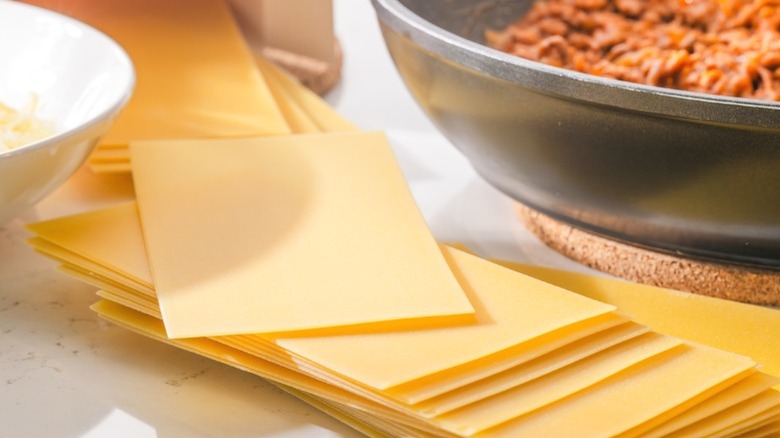
Although lasagna showed up in the "Liber de Coquina," the dish itself is a good deal older than that. As is often the case with food history, the exact origin of lasagna is hard to definitively pin down. (We can't even agree if french fries were French or Belgian, and those were invented after the printing press.) But the roots of something like lasagna can be found in ancient Greece and Rome, where the name itself may have originated.
The word "lasagna" may come from the Greek "laganon", a dish consisting of strips of flat dough. It may also come from the Roman word "lasanum," meaning "cooking pot". Whatever the case, these early versions were even further removed from what we consider lasagna today. There is some debate as to whether Greek laganon, also called "tracta" by the Romans, could even be considered pasta at all, and when something like lasagna first appeared in a Roman cookbook ("De Re Coquinaria," or "The Art of Cooking," by Marcus Gavius Aparicius), it called for cooking whatever meat was on hand with chicken broth and raisins, layered between "thin pancakes." We're sure your nonna would have conniptions if she heard someone call lasagna noodles "thin pancakes." But this was ancient Rome, so it's close enough for jazz, we say.