

This Little-Known Donut Chain Caused Jerry Springer-Level Family Drama With Dunkin'
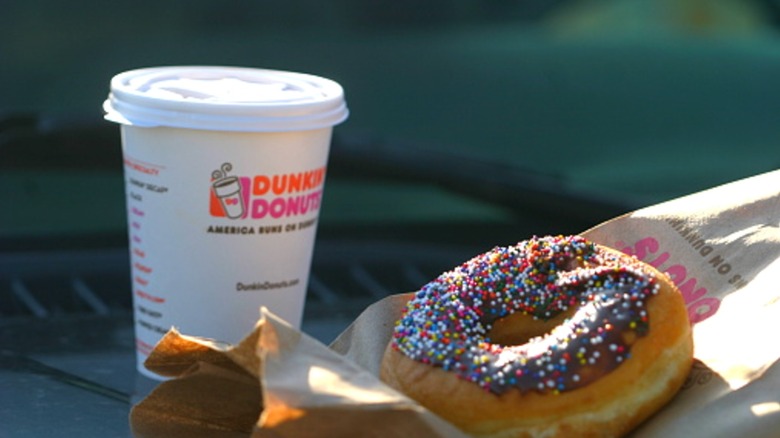
It's safe to say that Dunkin' is in a pretty good position as a company. It may be rivaled by Starbucks and other fast food restaurants for coffee, but as far as donut chains go, only Krispy Kreme (where you can get free donuts on your birthday) even comes close. Plus, it has the eternal loyalty of Ben Affleck, which is a nice bonus. But once upon a time, there was a Dunkin' competitor called Mister Donut — and what's more, it was born from a Dunkin' family feud. (It's still around today, but you won't find it in America.)
Back in 1955, Dunkin' founder Bill Rosenberg brought in his brother-in-law, Harry Winokur, to assist in the growth of the franchise. However, it quickly became apparent that they had two different philosophies: Rosenberg wanted to aggressively expand Dunkin' using the franchise model, while Winokur was strongly opposed to this tactic. After spending some time at loggerheads with each other, Winokur left and decided to start his own franchise, Mister Donut, with his son-in-law David Slater.
For a time, Mister Donut was Dunkin's primary competitor (this was when Krispy Kreme was largely confined to the Southeast), with hundreds of locations across America. But eventually, Mister Donut simply couldn't keep up. Dunkin' (or its parent company at the time, Allied-Lyon) bought it in 1990, converting all its American locations to more Dunkin' stores.
Mister Donut is big in Japan
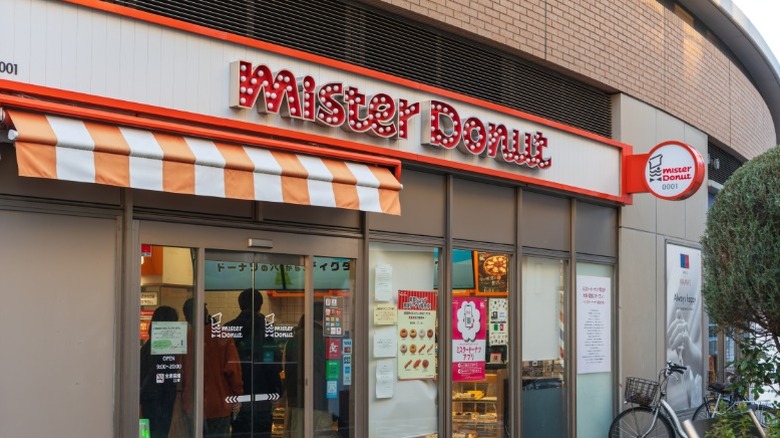
But while it might seem like Dunkin' won a decisive victory over its onetime rival, there is one part of the world where Mister Donut reigns supreme. The donut chain, which has only one location remaining in the United States, is the third most popular fast food franchise in Japan. (First and second place were McDonald's, which serves an unbeatable shrimp burger in Japan, and a Japanese franchise, MOS Burger.) In fact, Dunkin' had to leave the Japanese market in 1998 because Mister Donut was simply too popular.
Why did Mister Donut become such an institution in Japan? A lot of its success can be placed on the shoulders of Keji Chiba, the general manager of the Duskin Company, which operates Mister Donut. Although he was instructed to run Mister Donut identically to how it was run in America, he made a number of changes to the recipes and decor to suit Japanese tastes, reinventing the donut (previously seen as a childish snack) as an upscale yet affordable treat for trendy professionals, akin to the wares sold by the Seattle-style coffee shops that were spreading across America at the time. It's hard to argue with the results, even though it's now far removed from its Dunkin'-schism origins.