

The Unhinged Amount Of Chicken Everyone Is Eating Now Compared To The '60s
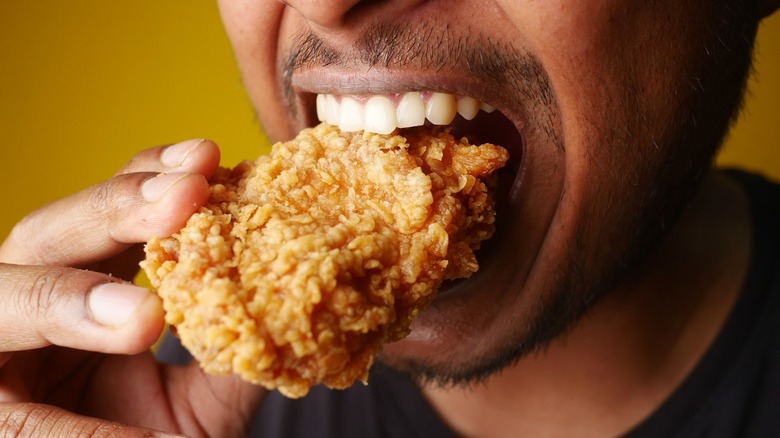
They say you are what you eat, and if that's true we're more chicken than ever today. A report from the Food and Agriculture Organization of the United Nations published this year broke down how poultry production and consumption has increased from 1961 to 2022, and the difference is pretty staggering. In 1961, an average of 6.6 pounds of poultry was produced per capita globally every year. Fast forward to 2022, and that number has ballooned to an extraordinary 37 pounds. (Poultry doesn't just mean chicken, but chicken is by far the biggest segment of this category.)
As the world population expands, it's reasonable to assume that food production would swell along with it, but commodities like dairy products and bovine meat haven't witnessed quite the same rate of growth in popularity, so why chicken? There are a few factors at play, but perhaps the most significant reason people are eating more chicken now than ever before is that chicken has never been cheaper to produce. Global regions where meat was once economically out of reach can now afford to produce and purchase poultry.
Chicken is cheap and packed with nutrients
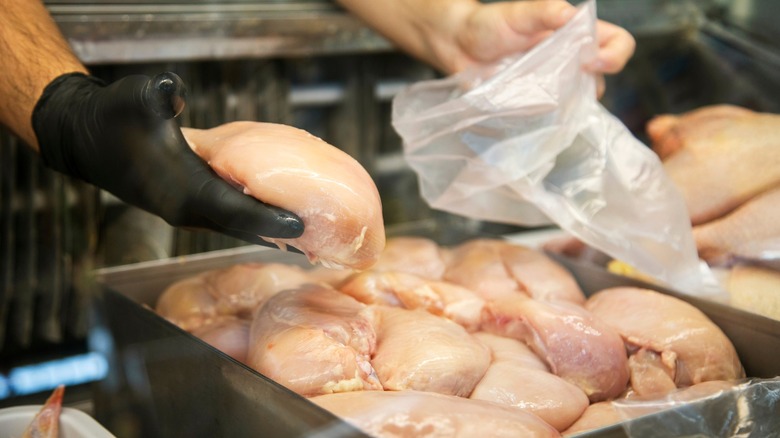
Here in the United States, the rise of chicken consumption can be partially attributed to the massive expansion of fast food chains selling cheap nuggets and spicy chicken sandwiches, as well as the perception that eating chicken is healthier than eating red meat. But the rate at which poultry consumption has grown in North America is nothing compared to how it has increased in other parts of the world. One reason this has occurred is a phenomenon called Bennett's Law. Essentially, as a region becomes more industrialized and its population grows alongside it, the demand for nutrient-dense food like meat rises.
China is a good example. It experienced tremendous economic success in the last century, and as a result meat has become more sought after. Today, China eats more chicken than any other country in the world. Brazil has likewise started to eat more meat in recent decades, and currently ranks third (just below the United States) in terms of global chicken consumption.
Theoretically, countries becoming more economically successful could lead to an increase in the amount of other proteins they eat, but chicken is cheaper to produce by far. You simply don't get as much bang for your buck feeding and raising steers and pigs as you do with chicken. Unless that changes in the future, it wouldn't be a stretch to assume that chicken consumption will continue to increase across the globe in the years to come.