

The Italian Way To Serve Meatballs Is Nothing Like The American Style
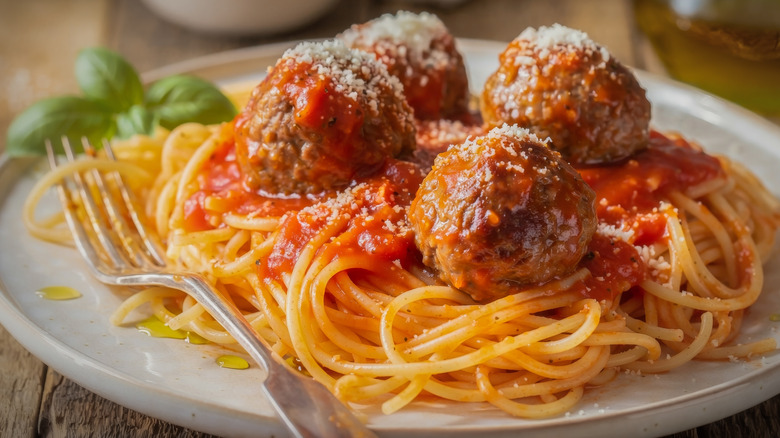
Nowadays it's closed and gone, but there used to be a little restaurant chain around New York City and Washington D.C. called The Meatball Shop. What made it stand out whenever I stopped by was that, instead of serving spaghetti and meatballs, the meatballs — and the meatballs alone — were the main attraction. You could order them with tomato sauce, parmesan, or pesto, and they'd give you a special cup with tender, flavorful meatballs that'd make nonna proud. Spaghetti or meatball subs were on the menu if you really wanted them, but I rarely saw them ordered. As it turns out, this is how meatballs are typically served in their native Italy, and it's nothing like American spaghetti and meatballs.
Spaghetti and meatballs are typically considered to be an Italian-American cuisine, not an Italian cuisine. This isn't to say that Italians don't eat meatballs with that specific pasta, because the dish has a long history, even if certain variations are old-school pasta dishes nobody eats anymore. Nowadays, a restaurant in Italy which serves spaghetti and meatballs may be catering to tourists; instead, you'll see more traditional styles of polpettes (the Italian word for meatballs), which are small meatballs served by themselves or with a side dish of meat or greens. A good meatball stands on its own, with no spaghetti required.
Italian meatballs are served without spaghetti
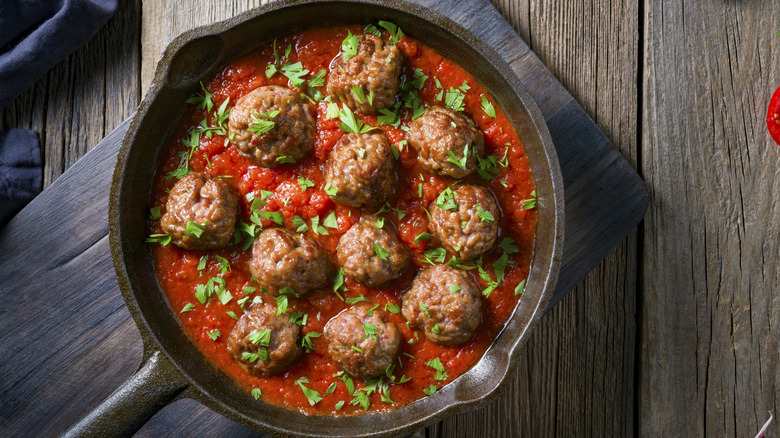
Regional cuisines can vary wildly across Italy, so there are a few different ways to approach polpettes if you want a more traditionally Italian style. Rather than pouring jarred marinara sauce over the finished meatballs, you might try braising the meatballs in tomato sauce or something like a white wine sauce. You can also prepare them completely without sauce at any stage, in which case you might consider baking some greens or garlic into the meatballs for flavor. If you serve the meatballs with bread, know that you're meant to use the bread to mop up any extra sauce.
Of course, meatballs are not unique to Italy, and you can find them in cultures worldwide from China to Sweden — though the Swedish government admits the country's signature meatballs are actually Turkish. However, spaghetti and meatballs as we know it likely sprung up from Italian immigrants in the United States: some versions of the story suggest it was adopted by immigrants who were eating cheap spaghetti back home, who were surprised to find meat was cheaper in the United States. Other versions suggest the dish came about because it's quick and easy to make, and Americans live a faster lifestyle with less time for fancy, communal meals. In any case, there are plenty of Italian critics who consider spaghetti and meatballs to be about as authentically Italian as pineapple pizza.