

How Your Garlic Confit Can Turn Out To Be Toxic
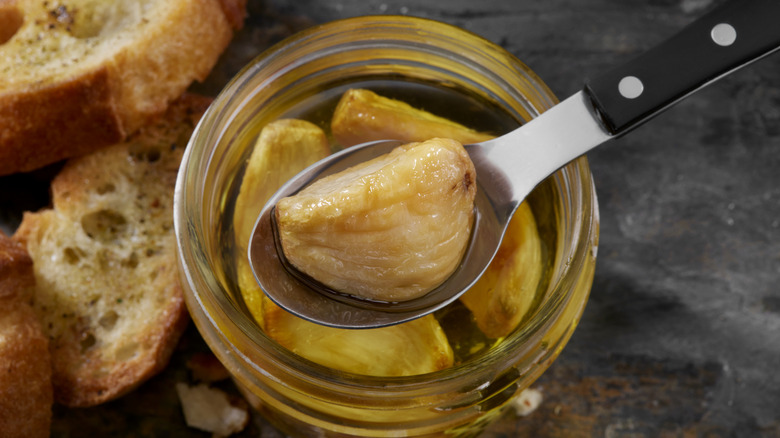
It is unsettling to think that the food you eat might actually harm you. And yet, there are a number of situations in which your favorite dish might also be a one-way trip to the hospital. We're not talking about cases in which risky behavior leads to sickness, like how eating raw flour is not okay because it can contain bacteria that causes food poisoning. No, this is more along the lines of "an ounce of prevention is worth a pound of cure." To that end, you cannot store garlic confit at room temperature because it will promote the growth of Clostridium botulinum, a bacteria that produces an extremely dangerous neurotoxin.
Garlic confit is made by cooking peeled garlic cloves in oil over low heat until they become lightly brown, soft, and deeply flavorful. They're one of the ingredients you should add to mashed potatoes (among other dishes), but they'll also be your ticket to the emergency room if not stored properly. According to a number of sources, the proper way to preserve your carefully curated garlic confit is in the refrigerator, and specifically at temperatures of 40 degrees Fahrenheit or below. It can remain in your fridge for seven days, after which it should be tossed out. If that sounds like overly cautious behavior, let us assure you that allowing garlic confit to become a mini-nature preserve for botulism — the potentially life-threatening illness caused by botulinum's neurotoxins — will make you wish you'd heeded the warning.
The danger of improperly stored garlic confit

Botulism is a serious illness and its symptoms are debilitating. These symptoms include nausea and vomiting, difficulty breathing, weakness, and paralysis. It can even result in death if not immediately treated. Botulism has been the cause of many canned recalls that affected millions, and yes, the same neurotoxin that causes botulism is also used in Botox (its ability to relax facial lines is due to its paralytic effects).
Foodborne botulism thrives in conditions with low oxygen (such as sealed containers) in addition to low amounts of sugar, salt, and acid. It also develops faster in specific temperatures, which is why the fridge is important. In short, the environment inside an improperly stored jar of garlic confit is a breeding ground. Cases of botulism generated by garlic confit are relatively rare, but studies have found that the bacteria does grow when garlic encased in oil is stored at room temperature.
The primary way to avoid becoming one of those rare cases is to keep your garlic confit in the fridge and dispose of it after a week. There's some debate as to the exact temperature, with some sources claiming 40 degrees is safe while others suggest 38 degrees and below is a better choice. Suffice it to say: You do not want to split hairs over botulism. If your fridge's temps aren't exact, then stick with the one week rule. "Better safe than sorry" may be a well-worn phrase, but in this case, it carries weight.