

5 Italian Food Myths You Need To Stop Believing
We may receive a commission on purchases made from links.
If you ask a group of gourmets which country has the best food, they may say France or Japan (Tokyo having the most Michelin stars of any city in the world). If you ask a group of regular people, though, they may just say Italy. Whether they're thinking of Italian American pizza and spaghetti bolognese or something more authentically Italian (whatever that means — we'll get to that in a moment), it's hard to go wrong with Italian food.
But there are a number of myths and misconceptions that have accrued over the years. That's probably true for any country's cuisine, like how people say that British food is boring and bland, or that the MSG in Chinese food made people sick (thankfully, MSG is no longer the bad guy), but they're worth correcting all the same. Nobody wants to be like Paulie Walnuts in that one episode of "The Sopranos," where he goes to Italy only to be perplexed at the lack of pasta in tomato sauce.
Myth: There is one, uniform Italian cuisine
You know how European tourists wildly underestimate how big America is, and think they can visit New York City, Disney World, and the Grand Canyon all in the same trip? Something like that happens with Italian cuisine whenever people assume they'll be able to eat any Italian dish they'd like anywhere in the country. But why can't they easily find a plate of ossobuco in Sicily, for instance, or tuna alla Ghiotta in the Alps? It's all Italian food, isn't it?
Well, something important to know about Italy is that, from around the fall of the Roman Empire to the Risorgimento of the 19th century, it wasn't one single country. Rather, it was a collection of smaller kingdoms and city-states unhappily sharing a peninsula. Those kingdoms often had very different cultures and environments from each other, which resulted in different cuisines: Compare the rustic, humble food of Tuscany to the rich, buttery dishes of Milan in Lombardy. This is all to say that Italian cuisine is not one single, monolithic thing, but a gestalt made up of various regional traditions.
Myth: All Italian food is steeped in tradition
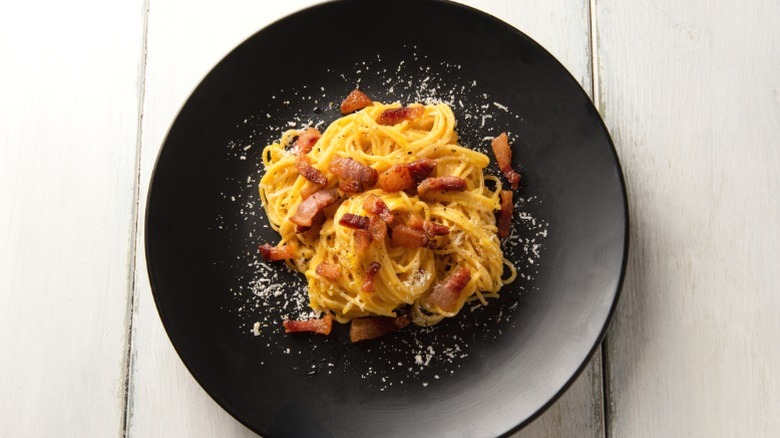
The popular image of Italian cooking is of a nonna, or grandmother, in her kitchen, whipping up sacred, traditional recipes that have been in the family for generations. (Don't let her catch you using bacon instead of pancetta in your carbonara!) But the truth is a little more complicated than a storybook illustration. Historians like Alberto Grandi, co-author of "Italian Cuisine Does Not Exist", have made the case that so-called "traditional" recipes like carbonara and tiramisu are 20th-century inventions seized upon by marketers and politicians to establish a national identity post-war. After all, most Italians did not have access to the rich ingredients for risotto or lasagna on a regular basis — why else would they leave Italy en masse for the prosperous Americas?
But it's easy to get carried away with that type of thinking. While the recipe for carbonara was not etched into a stone tablet by an ancient nonna but likely codified during World War II by American GIs making use of egg and bacon rations, there are older pasta dishes, like cacio e uova, that are very much like it. And even though Italian peasants obviously weren't eating like Stanley Tucci on an empty stomach, they weren't eating nothing but polenta, either: dishes like minestrone and panzanella have been around for hundreds if not thousands of years, albeit not necessarily in their current form. There's nuance, in other words.
Myth: Italians load up on carbs
When you close your eyes and imagine Italian cuisine, you're probably picturing a cornucopia of carbs: heavy forkfuls of pasta, platters of pizza, loaves of bread radiating steam fresh out of the oven. In our current, protein-obsessed zeitgeist, it's enough to make you wonder how Italians manage to avoid the pitfalls of a carb-heavy diet. Well, the answer is simple, if disappointing: Italians don't actually eat that many carbs.
For you, a trip to Italy is a chance to live life to the fullest and try as many things as possible, including all the different kinds of food. But the thing about Italy is that people actually live there, and locals don't eat like they're on vacation. While they do eat pasta, it's usually as a smaller course ahead of a main course of plain old meat and veggies. And Italy's pizza isn't the heavy, greasy kind you get in America that sits in your stomach like a rock: it's lighter and fresher, with a thin crust and minimal toppings. On top of that, Italians have a wide, varied cuisine that encompasses more nutritious foods than just the carb-heavy dishes we know and love. There's a reason why the Mediterranean diet is considered one of the best ways to live a long, healthy life, after all.
Myth: Italian food is laden with garlic and cheese
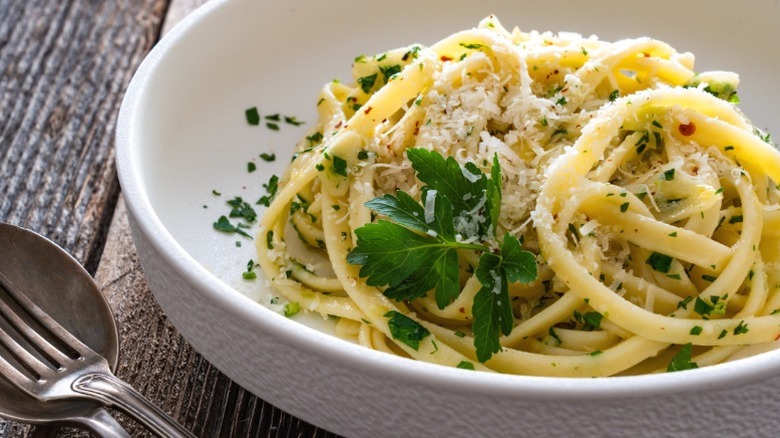
Ask contestants on "Family Feud" to name ingredients often used in Italian cooking, and you'll probably see "garlic" and "cheese" right at the top of the board. (Good answer! Good answer!) It's hard to imagine eating Italian food without a pungent bite of garlic or a tangy sprinkle of Parmigiano Reggiano. But believe it or not, garlic is used rather sparingly in Italian cuisine. It's more commonly used in southern Italy than northern Italy, but in any case, it has a reputation as a poor person's ingredient used to mask subpar ingredients. As it happens, most of the Italian immigrants who came to America were poor people from southern Italy, which explains why the ingredient proliferates in the U.S.
As for cheese, well, we're not going to say that Italians hate cheese, because that's obviously untrue. But they don't put it on absolutely everything, either. It's an ingredient to be used with care and discretion, not a general-purpose additive to keep in a shaker on your table. The guidelines for using cheese do allow for some nuance — contrary to popular belief, there is not a blanket ban on sprinkling cheese on seafood — but it's not something to just use willy-nilly.
Myth: Italian American food is a shameful degradation of true Italian cuisine
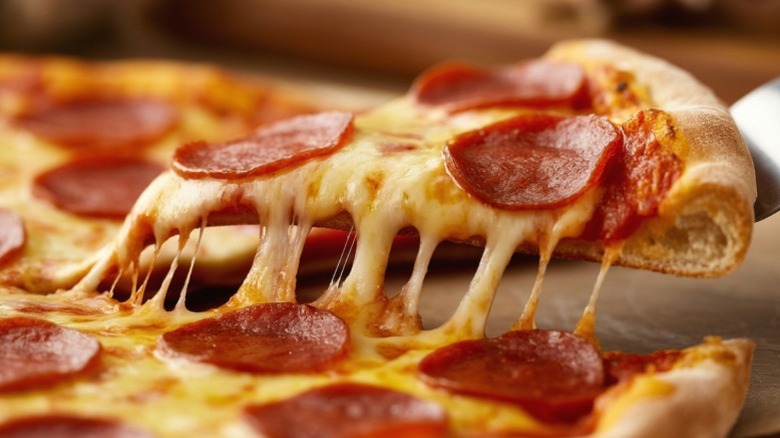
People are precious about authenticity in general, and especially when it comes to food. You've no doubt heard about all the ways Italian American food differs from Italian cuisine: Italians don't dip their bread in olive oil, they don't eat spaghetti and meatballs the way we know it, and they sure as heck don't eat chicken parmesan. Some people may look at the pizzas and pastas they grew up eating with a sense of betrayal, like when the chef from "Ratatouille" started a line of frozen dinners in his name. How dare they misrepresent the glorious nation of Italy this way? Who can we sue?
But here's the thing: those Italian American dishes weren't invented in a boardroom by a bunch of marketing executives looking to pull the wool over an innocent nation's eyes. They were invented in the kitchens of Italian immigrants, modifying existing recipes with the ingredients they had available. These recipes weren't authentic to Italy, because the setting wasn't Italy anymore, but America, where an abundance of meat — unheard of in the old country — and shelves full of canned tomatoes could be eaten at any time of year. Thus did the Italian American food tradition develop — not necessarily better than Italian cuisine, but certainly not worse.