

How To Free Pour Liquor Like A Bartender For Perfect Cocktails Every Time
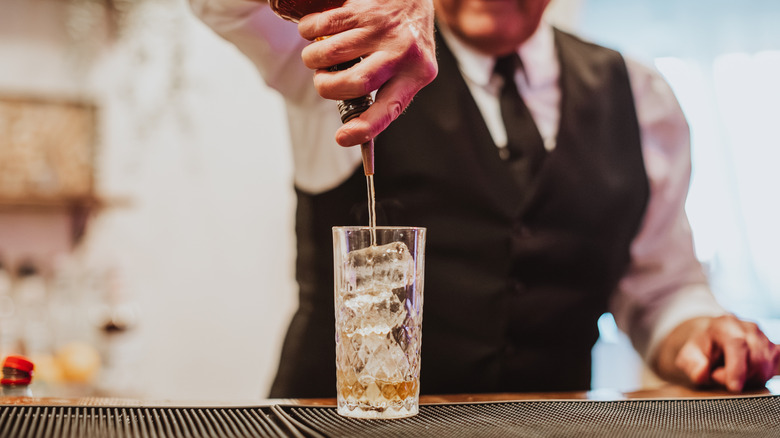
Typically, you'll notice the difference between a drink mixed by a bartender and one by a non-bartender friend. Cocktails often have precise, ideal ratios, which is why requesting a drink be made strong is pointless much of the time; bartenders know these ratios. But, while bartenders often measure out the amounts of gin, tonic, and so forth before mixing them, some experienced mixologists look like they're simply eyeballing the measurements, and the cocktails still come out perfect. They're not guessing when they do this: They're free pouring. We spoke to Yu Jiang Zhao, the founder of Kobayashi Bar, about how you might free pour liquor like a proper bartender.
The standard tool used by bartenders for making cocktails is a metal, double-sided measuring cup called a jigger. You can use it to get the ratios of spirits and mixers exactly right, but using and then properly rinsing the tool between drinks costs precious seconds while tending a busy bar. Instead, you free pour, which Zhao describes as a method for getting precise ratios without using a jigger or any measuring tools. As Zhao explains, "You count while pouring, and the count corresponds with the known quantity. For example, a four-count pour with a standard speed pourer means 1 ½ ounces — a typical pour." A speed pourer is a slender nozzle which fits into the top of standard bottles; its higher rate of pouring makes free pouring even faster (and less likely to result in a spill).
Practice free pouring cocktails without measuring
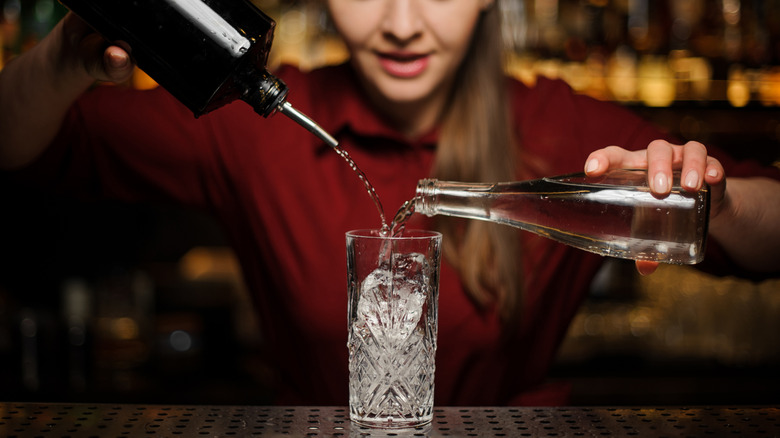
The best way to practice free pouring? "Fill an empty bottle with water, use a speed pourer, pour a four-count in a jigger, and check," says Yu Jiang Zhao, who adds that you should do this 50 more times to learn the technique. Ideal free pouring involves holding the bottle completely upside down and keeping your fingertips away from the nozzle. There's also a golden ratio which works for almost any cocktail (2:1:1), so it pays to commit those ratios to memory.
If you're worried about wasting liquor while you practice, start with water first (although the actual spirits and juices will feel different when pouring them). While you work on your timing, avoid some common mistakes Zhao has seen with free pouring. "[These include] rushing the count under pressure and tilting the bottle improperly," he notes. The latter will mess up your rate of pouring, which could slow you down or throw off your count.
You won't see free pouring at every bar, and you're more likely to see bartenders do it at a busy location rather than a quiet craft cocktail spot. "Measuring ingredients one by one with a jigger works perfectly fine during the day on a Monday, but takes twice the time on a Saturday at 11 p.m.," states Zhao. Naturally, this takes practice, but once you've got a steady pouring technique, it speeds up those cumbersome classic cocktails that bartenders hate making, like gin fizzes.