

Why Your Bread Collapses After Baking And How To Fix It Like A Pro

As any good baker can tell you, professional or otherwise, mistakes will be made when you first start baking bread. One common problem beginners run into is having bread come out of the oven collapsed in on itself, rather than looking full and delicious. Obviously, this is not the desired outcome, so we reached out to Amy Coyne, sourdough teacher, creator of Amy Bakes Bread, and author of "The Beginner's Guide to Sourdough."
"Typically when bread collapses, it's because of a couple of reasons," said Coyne. "The most common one I see with home bakers is overproofing." Because there's more than one way to arrive at a collapsed loaf of bread, you may need to tinker a bit before you realize exactly where your recipe is going wrong. Coyne pointed out three of the ways bread loaves can collapse: overproofing, underbaking, and poor gluten development.
Because Coyne said that overproofing is the most common cause, we'll start there. "If your dough is overproofed, it means it has risen too long and the structure has started to weaken," Coyne explained. "By the time it goes into the oven, it may look airy, but it doesn't have the strength to keep rising." When you're just starting to work with yeast, it's easy to make mistakes like this, so don't worry. You can simply reduce how long you let the dough proof and try again.
What to do if overproofing doesn't seem to be the problem
If you adjust how long the dough rises and nothing changes, it's time to check what else it could be. "Underbaking can also be a cause," Coyne continued, "though I tend to see this more in quick breads than yeast doughs." The cause for this is simple: "If the middle isn't baked through, the loaf can sink as it cools." To adjust, you'll want to make sure the oven is fully preheated first and then use a thermometer to check that the inside of the bread has reached a temperature of 190 to 200 degrees Fahrenheit (depending on the type of bread).
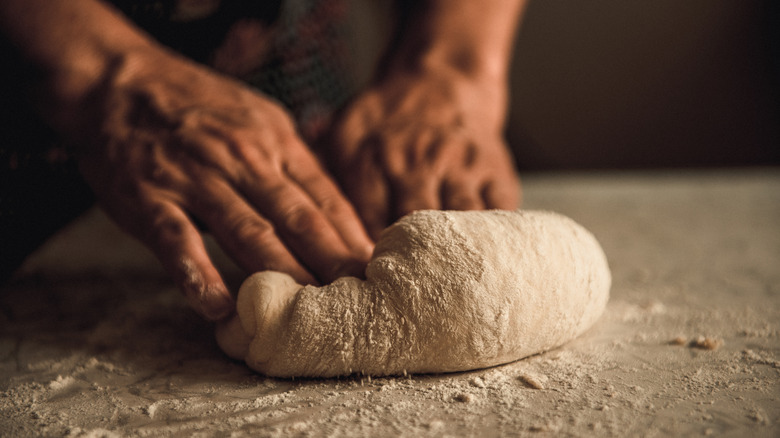
The last suspect Coyne pointed out was proper gluten development. "If you're working with an enriched dough, something with a lot of butter and eggs, if the gluten isn't developed properly, it won't have enough structure to rise and can cave in on itself." Knowing when the gluten is properly developed will take time and practice since bakers have to go by feel. There is a certain level of firmness that the bread dough needs to reach (and not go over) if you want it to bake right. Don't make the mistake of kneading bread dough too much or too little, since this is where the problem lies. If this is the culprit and you're struggling to get it right, keep at it. Take a moment to assess the characteristics of the dough and write them down in a notepad. When it's done, write down how the bread turned out. This way, you can fine-tune your technique like a pro.