

Not All Pork Chops Are The Same — Know This Before Cooking
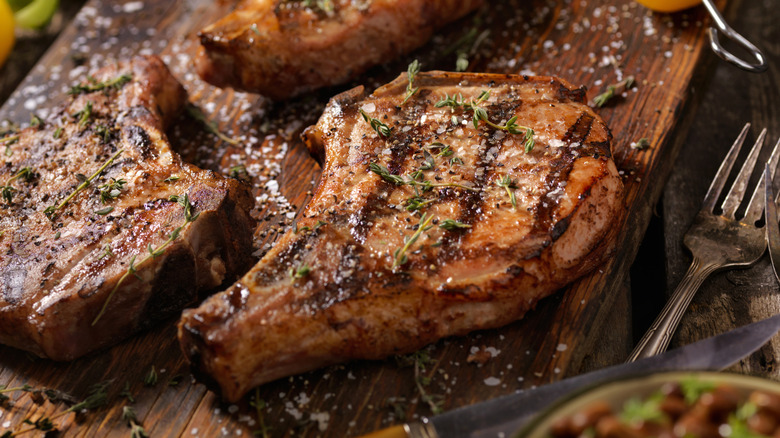
Despite the catch-all term, pork chops aren't all built the same. Go to the meat section in any grocery store and you'll find a whole variety of cuts with different names to them. And though a pork chop might seem like just a pork chop, the distinctions are important because they'll act as a guidepost on the best way to cook each. We spoke to Marissa Stevens, recipe developer and founder of Pinch and Swirl, about how she approaches different varieties of pork chops.
"The four cuts home cooks see most often are rib chops, center-cut loin chops, sirloin chops, and boneless loin chops," Stevens explains. "Rib chops have good fat marbling and a bone along one side. Center-cut loin chops are leaner, sometimes with a T-bone running through them. Sirloin chops come from the hip and have more connective tissue. Boneless loin chops are the most convenient and the easiest to ruin."
The type will be what guides you in terms of how to apply heat and the way you season the chops. Stevens says, "For stovetop searing, rib chops win. The fat and the bone give you more flavor, more moisture, and a bigger margin for error if your timing is slightly off. Center-cut loin chops work well too but need more attention. Sirloin chops are better for braising." One tip she has about boneless pork chops is that they can generally use a boost in flavor. "Boneless chops can work, but they need a head start. I dry-brine them with salt and herbs for about 15 minutes at room temperature before cooking to make up for what they're missing."
One characteristic to keep in mind is thickness
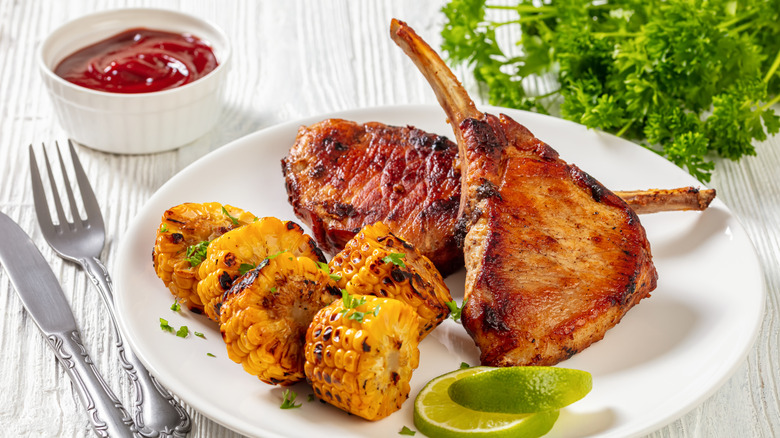
One characteristic of pork chops that can help guide you through the cooking process is how thick the pork chop is. "There's an easy rule of thumb: bone-in and at least an inch thick, and you're most of the way there," says Stevens. "Thick bone-in chops are forgiving enough that a thermometer and a five-minute rest will get you where you need to go almost every time. The thinner and boneless you go, the less room you have for error."
Meat thermometers are really the most accurate way to tell if your pork chops are cooked properly, so it's important to know how to use them. A thicker chop will be easier to probe (just avoid any bones, as they can throw off the reading), but a thin chop that's boneless will need the probe to be inserted horizontally to ensure you get an accurate temperature. Once you've mastered the sear on pork chops, all you really need to do is think about potential marinades and other little flavor upgrades, like Lidia Bastianich's choice of tangy pepperoncini.