

The Dish To Avoid At A Mexican Restaurant If You're Looking For A Traditional Meal
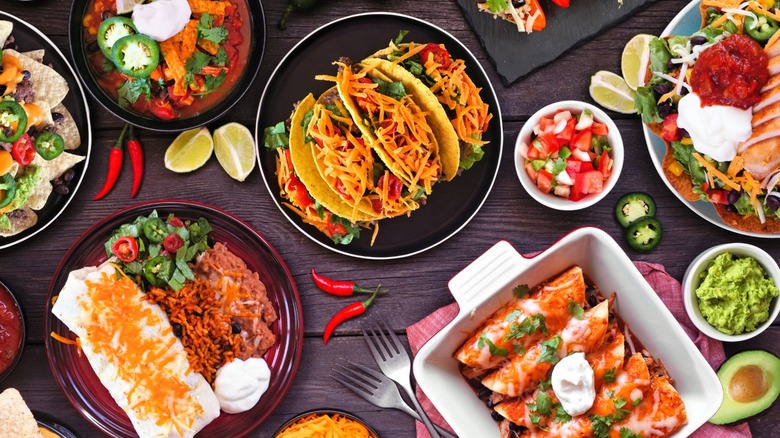
Authenticity is a funny thing. You've probably heard it said that the Chinese food we eat in America is far removed from the actual food people eat in China, and yet who among us would turn their nose up at a styrofoam container full of bourbon chicken in a food court mall? The same goes for Mexican food — whether a dish is authentically Mexican or a Tex-Mex fusion doesn't necessarily affect its deliciousness. But if you really want to try something traditional, "Mole Master" Geno Bahena, head chef of Manchamanteles, suggests you steer clear of Tex-Mex dishes like tacos or chimichangas when dining at a Mexican restaurant.
"Items like hard-shell ground-beef tacos, combination platters loaded with yellow cheese, and chimichangas tend to be more reflective of Tex-Mex cuisine than regional Mexican cooking," Bahena said. He also mentioned fajitas, those famously sizzlin' entrées beloved by many diners at casual Mexican chains — it turns out they were invented in Texas. "While grilled meats exist in Mexican cuisine, the sizzling skillet presentation with peppers and onions is more closely tied to Tex-Mex culture than to traditional cooking in Mexico," he said. Bear in mind, however, that "non-traditional" does not mean "bad" by any means, as Bahena himself will tell you: "These dishes aren't bad, but they're not the best representation of Mexico's incredibly diverse regional food traditions."
If you want tradition, keep an eye out for mole
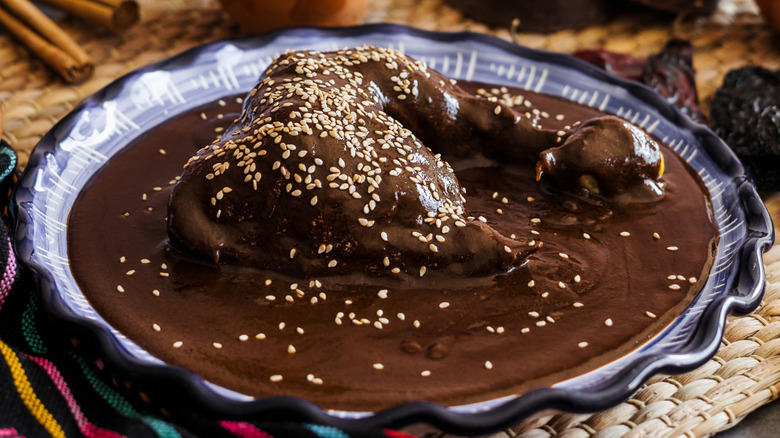
So what dishes might you want to try if you're after a more traditional Mexican experience? Geno Bahena has a suggestion, although he may be a tad partial — he is called the "Mole Master," after all. "My specialty, mole, especially varieties like mole poblano or mole negro, is one of Mexico's most celebrated sauces," said Bahena. "Made from a blend of chiles, spices, nuts, seeds, and sometimes chocolate, it's a labor-intensive dish that represents centuries of culinary tradition." (If the word sounds familiar, you may know it as the second half of "guacamole," which can be made easier with store-bought pico de gallo.)
There are other, somewhat less saucy options you can try. "Pozole is another great option, which is a hearty soup made with hominy and slow-cooked pork or chicken, garnished with shredded cabbage, radishes, lime, and oregano," Bahena said. He also suggested other dishes, like the culinary phenomenon, birria, and cochinita pibil (a slow-cooked pork dish from Yucatán). "When restaurants offer these dishes, it shows that the kitchen is drawing from regional Mexican traditions rather than focusing on Americanized staples," Bahena said.