

5 Ways Aldi Is So Efficient With Such Minimal Staff
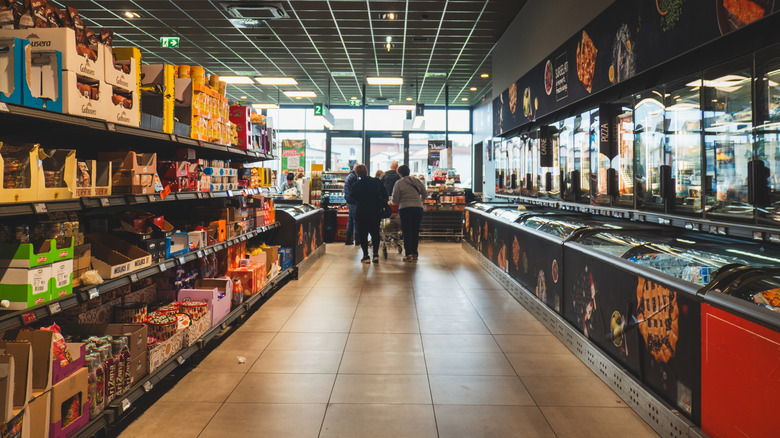
Aldi isn't the only grocery store I shop at, but it's by far the most enjoyable. From its budget buys in the Aisle of Shame to its unique product selection, I love it all. After all, where else are you going to get such a large selection of European chocolates and specialty sweets like the marzipan mousse cake that I can't wait to get my hands on? One thing that makes Aldi a little different than larger supermarket chains, however, is that it seems to be chronically short-staffed. The operative word being "seems." A Reddit user claiming to be an Aldi cashier shared that the stores are meant to function with a limited number of employees, even though "it can be maddening at times."
One reason for Aldi's minimalist approach to staffing is likely the budget — the fewer people it pays, the lower the overhead. To Aldi's credit, it passes some of the savings on to customers, since it's one of the cheaper grocery chains (especially if you discount those that charge membership fees and force you to buy in bulk). To compensate for the lack of workers, the store has implemented a number of policies to help operations run as smoothly as possible. These include a certain amount of self-services, like BYO bags and returning your cart to get your quarter back, but ringing up your purchases may not be among them. Select Aldi locations did introduce self-checkout lanes (not that I ever saw one), but some stores are already saying goodbye to them. The policies below, however, show no sign of being discontinued.
Aldi stores keep shorter hours
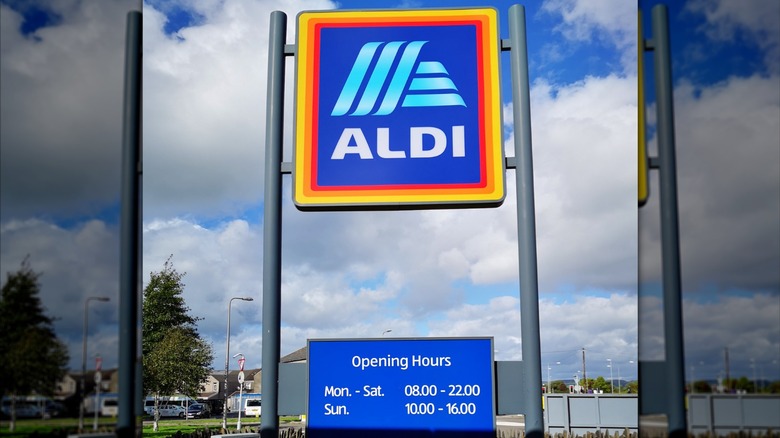
One of the ways Aldi is able to operate at peak efficiency with a smaller staff is by reducing the number of hours that the store is open. The Aldi I shop at most often is open from 9 a.m. to 8 p.m. for a total of 11 hours. This amounts to one full-time and one part-time shift, as opposed to the three full-time shifts it would take to cover a supermarket open 24 hours. (If any of these still exist, that is — many grocers that once offered round-the-clock shopping discontinued it during the pandemic and decided to keep to the shorter hours even after the lockdown was over.)
So how do shorter hours make Aldi's operations more efficient, apart from reducing the number of employees needed? For one thing, its shorter hours encompass the busiest ones — most people do their shopping on weekdays after work, so between 4 and 6 p.m., or on weekends during the middle of the day. For another, as some Aldi employees have shared, much of the restocking takes place between 5 or 6 a.m. and opening time, meaning that more employees are available to run registers or assist customers during store hours. Finally, there's a financial aspect to it, since night shift workers are often paid a premium to cover these less desirable working hours. By closing early, Aldi manages to avoid the extra expense without being unfair to its employees.
They're also smaller than average

Most supermarkets come in at 48,000 square feet, which is ... a lot. Unless I'm shopping in a store I've visited multiple times before, I may find myself wandering the aisles with no clue as to where I can find something simple like a bag of sugar. In the immortal words of The Clash, "I'm all lost in the supermarket, I can no longer shop happily ... " At Aldi, on the other hand, it's actually possible for me (the world's slowest shopper) to get in and out under an hour. Maybe even half an hour if I don't get too distracted by the Aisle of Shame. The reason why I can manage this feat is that the average Aldi is only about 20,000 square feet. Needless to say, fewer aisles require fewer people to stock them, which helps the stores operate with a lower number of employees.
This smaller size, of necessity, also limits the number and variety of products that Aldi carries. This can be either an upside or a downside, depending on how specific your needs are. If I want something specific like Tabasco sauce or a more specialized product like glacé cherries, I may have to shop elsewhere. On most basic stock-up trips, though, it's actually helpful not to have to sort through a dozen different brands of canned beans when I'm perfectly happy with the generic kind (and about 90% of what Aldi carries is its own private-label items). Fewer products also mean less hassle for the workers who keep the shelves filled.
Aldi customers have certain responsibilities
The upsides of Aldi include paying less, on average, than at a standard supermarket, as well as having a quicker in-and-out shopping experience. In exchange for this, however, there are certain things that you need to do for yourself. One of them is to remember to bring a quarter if you want to use a shopping cart. You're not technically renting it, since you do get your quarter back. (Or someone else's, if you've done the typical cart swap at checkout, loading up the one that's already there and leaving your empty cart in exchange.) Still, you need to earn that $0.25 by returning the cart to where you got it. Your doing so means that no employees have to be designated to pick up the carts from the parking lot, freeing them up for other chores and increasing efficiency.
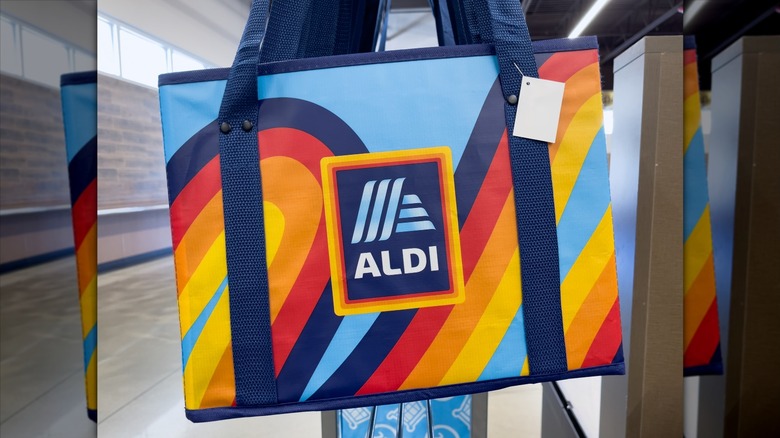
Yet another DIY aspect to Aldi is that you are supposed to bring your own bags, although the store will gladly sell you some if you forget. (You can also use any leftover cardboard shipping cartons for free.) BYO bags by themselves may not do much to reduce the employee workload, but they go hand-in-hand with something that does: You also bag your own groceries, which means that each checkout lane only needs one worker instead of two.
No time is wasted on fancy shelf displays
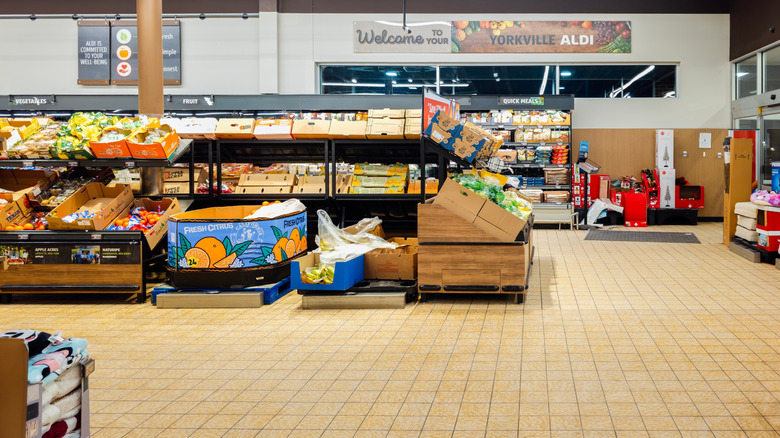
If you go to one of the more upscale supermarkets, your walk through the produce aisle may remind you of a trip to the tropics, with the fruits and vegetables being laid out in enticing displays and warm mist being squirted out into the atmosphere. (Some even play bird songs or other ambient noises.) At Aldi, however, you get a far more no-frills approach consisting of plain cardboard boxes displaying the produce in the same state it arrived. And it's not just the produce that gets the box treatment — as you walk through the aisles, you'll see a similar aesthetic at play from household essentials to snacks.
So why does Aldi display food in shipping boxes, shunning more elaborate arrangements like fancy end caps, pyramid piles, and colorful signs promoting a particular brand? (As we mentioned earlier, name brands are few and far between.) Again, it comes down to making the best use of their employees' time. All a worker needs to do is cut the box open and stack it on the appropriate shelf instead of taking the time to remove each individual box, bottle, or can. There's probably also a certain amount of savings involved in not needing all those produce section special effects, as well. Aldi claims to pass these savings along to the customers, and I, for one, find it to be a trade-off I'm more than willing to make.
Aldi stores make things convenient for cashiers
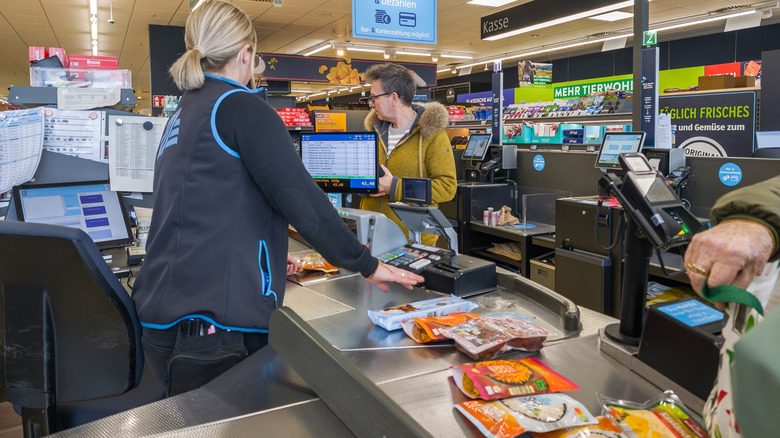
As Aldi has relatively few registers to service its numerous customers, you might imagine that the lines would move pretty slowly. In my experience, this is actually not the case. The chain prizes a speedy checkout experience, but it also seems to realize that you can't simply browbeat your workers into moving at superhuman speeds. Instead, it has instituted several policies meant to help speed things along, including using large barcodes (and multiple ones on each item) in order to make scanning them quick and easy. (Anyone who's ever had to play hunt the barcode at a self-checkout will appreciate the importance.)
Yet another way Aldi makes cashiers' lives just a little bit easier is by allowing them to sit in chairs as they work instead of making them stand for a full shift. Does the store do this out of the goodness of its corporate heart? Well, no, not entirely. It seems that seated cashiers, or at least those able to take a break between shoppers, are able to do the job faster. This makes the practice pretty much a win-win-win situation for employees, shoppers, and stockholders alike. (And one that other supermarkets should really consider adopting ... just saying.)