

You're Ruining Your Chopped Salad If This Tool Isn't Up To Snuff
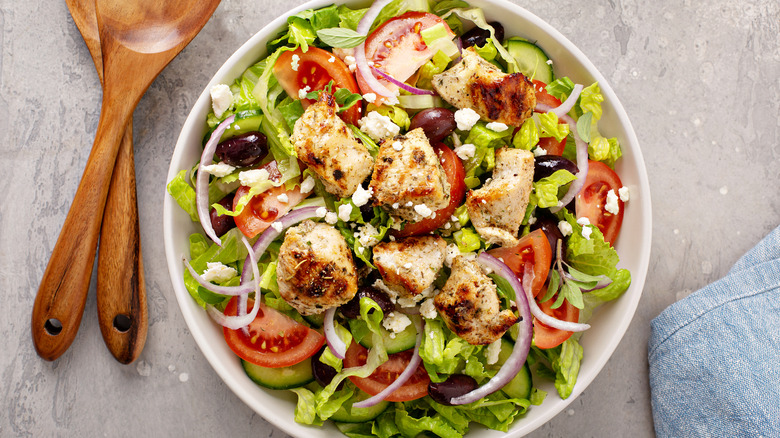
A chopped salad is more than lettuce, carrots, and dressing tossed onto a plate; it has a special place on salad menus because everything is finely cut into equal pieces and arranged with a deliberate eye for presentation. You get a lot of flexibility when it comes to your ingredients, but everything should be bite-sized. It's not surprising, then, that a chopped salad can be easy to mess up, and the big culprit may be the knife you used. We spoke to Jason Stern, the executive chef at Boone's, who explained that you should consider sharpening your kitchen knife before taking on a chopped salad.
According to Stern, "A dull knife doesn't slice; it smashes. Instead of gliding through with precision, a dull blade crushes and tears its way forward, bruising delicate ingredients like leafy greens, herbs, tomatoes, or soft fruits." Slicing veggies properly means using a rock and roll motion to cut tough, thick vegetables, which Stern describes as moving the knife forward and down at the same time, and it is much harder with a dull edge, and all you're left with is the brute force up-and-down stomps of your blunted knife. On top of that, a more rounded blade means your knife is more likely to slip while you chop.
A dull knife cannot precisely chop your salads
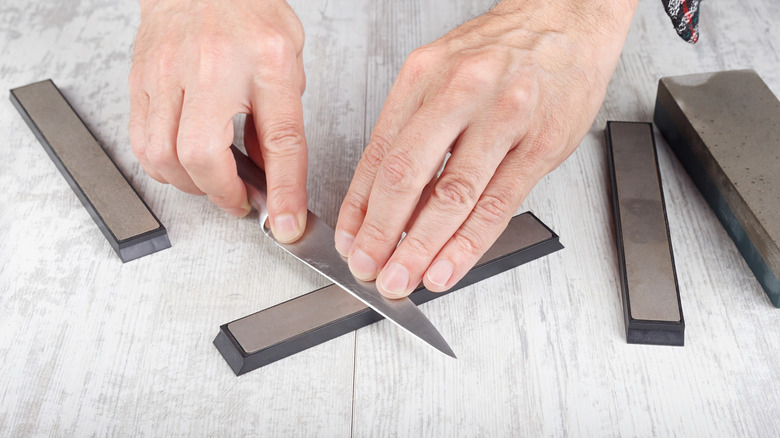
There's a bit of science behind why chopping with a dull knife creates a discolored salad instead of a proper green one. Jason Stern explained, "You can actually hear the difference between a 'slicing' and that of a distinct 'crunch.' What you hear is the cell walls being shattered, creating bruising. That bruising ruptures cell walls, accelerating oxidation, browning, and spoilage." Bruised veggies aren't spoiled or dangerous, but they're mushy and gross-looking. When you cut with a sharp blade, it's a surgical blow that doesn't damage the surrounding pieces of vegetables around the knife.
On that note, it might be worth buying a specific knife designed for chopping vegetables. Stern prefers a Japanese nakiri knife, a handheld knife resembling a small cleaver. When used right, the entire blade edge will touch the cutting board with every successful chop. Another good tool for a perfect chopped salad is the mezzaluna knife, a slightly odd-looking knife with two handles and a round crescent blade. In any case, you should probably be sharpening your knives more often; the minimum is once every few months if you're using them regularly, but once a week will really keep them sharp. Keep an eye on your knife blade before you take on a hefty root vegetable.