

12 Budget-Friendly Ways To Make A Great Steak Dinner
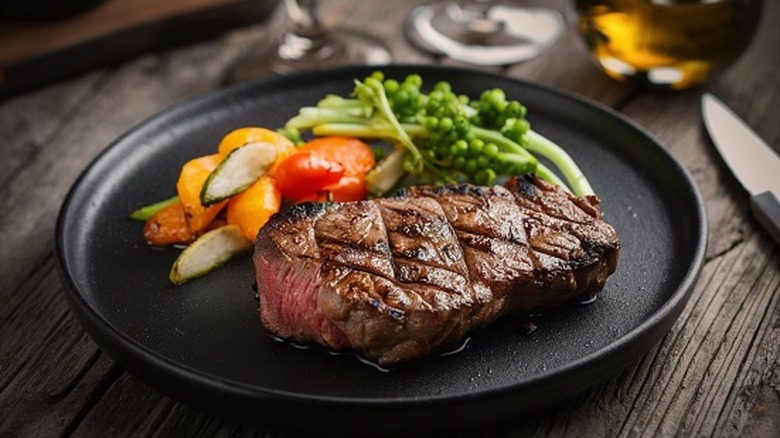
Going to a luxury steakhouse for dinner is nearly always an enjoyable experience. As soon as you walk in the door, the ambiance — from the music to the white tablecloths to the high level of service — lets you know this is going to be a meal to remember. You drink, you dine, you indulge. However, as wonderful as this meal might be, getting the bill at the end of the night isn't always quite as fun. Steakhouses can be pricey, even if you are doing your best to order money-saving menu items, skip dessert, or have one fewer glass of wine than you would have liked. So how can you recreate the steakhouse experience at home, for less?
You don't need a culinary background to turn out a great steak dinner in your own abode, on a budget. You just need to make some savvy decisions. We spoke with a few professional chefs with plenty of experience cooking up a great steak to get their expert tips, and we're also looking at some ways to broaden the meal beyond just that beefy entrée, so you get a dinner that's as close to the real deal as possible.
Choose the right cut of steak
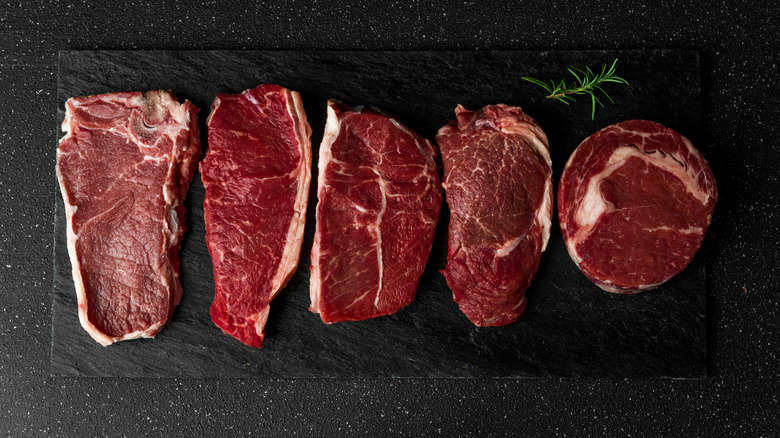
Recreating the steakhouse experience at home starts with picking the right cut of steak. However, don't worry. You don't have to drop big bucks at the butcher. Certain budget-friendly cuts of steak are more affordable but still offer a high level of quality if you treat them with the right care.
For example, Chef Carlo Mirarchi of Ezio's in Miami recommends buying a chuck blade steak, which he noted is affordable even if you spring for USDA Prime. Blade steaks have been growing in popularity as prices for other cuts of steak rise. Sourced from the shoulder area and sometimes also called a "chicken steak," blade steaks are flavorful and, with the right cooking method, tender.
Meanwhile, Chef Laurent Tourondel, culinary director of LT South Beach, told us: "My top three budget-friendly cuts for at-home cooks are skirt steak, top sirloin, and prime flank steak. They're all fantastic on the grill or roasted, each with its own texture and bite, and of course, they all have great flavor."
Just can't let go of the idea of filet mignon? Auguste Escoffier School of Culinary Arts lead instructor Chef Albert Schmid said that an eye of round makes a good substitute.
Cook your steak to the right temperature
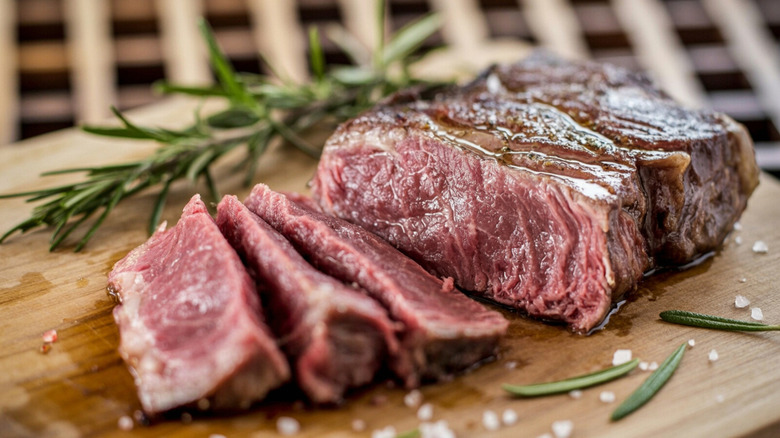
One of the worst ways to ruin any piece of meat is by cooking it at the wrong temperature. This is especially the case with more affordable cuts of meat that might not be as forgiving, or that might need a little more love in order to achieve true tenderness.
Both Chef Laurent Tourondel and Chef Carlo Mirarchi recommend cooking cuts like those discussed above to medium rare only. That, Tourondel said, is when they're going to be their juiciest and most tender.
So how do you know when your steak is medium-rare? If you're using a cooking thermometer, your steak is medium rare once the internal temperature reaches 130 to 140 degrees Fahrenheit. However, many cooks frown upon using a meat thermometer for steak, as they feel it unnecessarily creates a hole through which all those valuable juices could leak out. As such, they prefer to gauge steak doneness via touch. While it might take some practice to fine-tune this method, you can generally expect that, when you press into a medium-rare steak with your finger, it should have about as much give as either your cheek or the fleshy part of your thumb when you press your thumb and middle finger together.
Season appropriately
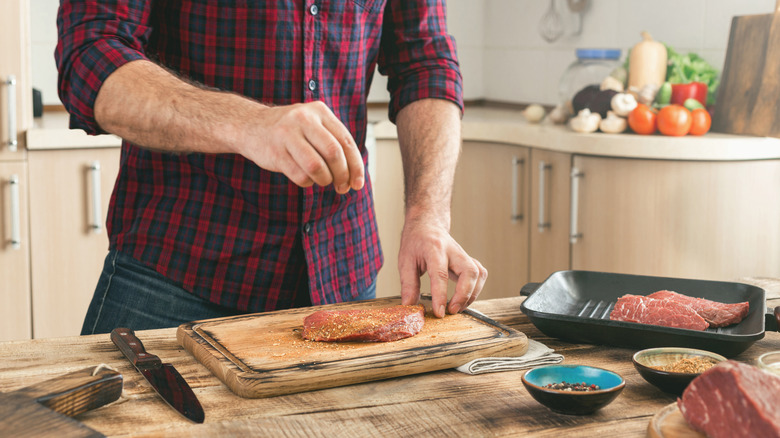
You might think that just because you're cooking more affordable cuts of beef, you really need to season them well in order to get an amazing flavor. However, this couldn't be further from the truth. Our experts advised that you keep things simple — really simple, with just salt and pepper.
Carlo Mirarchi said to season your steak with kosher salt before searing, and then to finish it with Maldon salt. What's the difference? While most kosher salt is merely coarser than your average table salt, Maldon salt is a specific brand of finishing sea salt that offers a unique, flaky texture. And don't be stingy with that salt, either. Laurent Tourondel said: "For restaurant-quality results at home, season generously — salt is key for flavor and a beautiful crust."
You want to time your seasoning correctly as well. Don't add the salt right before you put your steak in the pan. Instead, season the steak about 30 minutes to an hour before you cook it. According to Mirarchi, you need to let the steak come to room temperature before cooking anyway, so you've got the time.
Use high heat
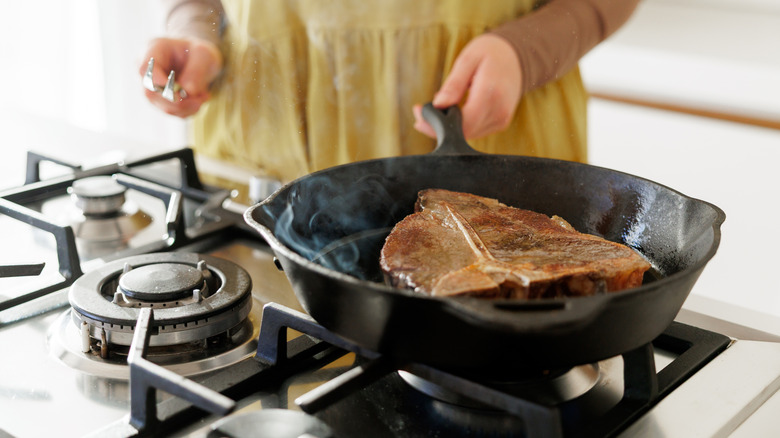
While some cheaper cuts of beef benefit from a low-and-slow cooking process (such as brisket, chuck, and short ribs, which are all beef cuts that should never be cooked to just medium rare), our experts said you want to use high heat when you're attempting to achieve steakhouse-level quality on a budget. As Albert Schmid said: "Crank [the] heat up! Make sure the pan or grill is very hot. You will know the pan is ready if you put a drop of water in the pan and it 'dances' on top of the surface and evaporates quickly. In a pan, you can add a little butter and olive oil. Once the pan is very hot, add the steak and sear on one side then flip and sear on the other."
Then, he suggested, transfer the steak to a grill that's been heated in advance. If you don't care for butter or olive oil, or don't have any on hand, Carlo Mirarchi said you can use a high-temperature neutral oil like avocado oil. Whatever fat you use, whether you stick to the pan or bring in a grill as well, make sure to rest the steak for between five and eight minutes before slicing.
Baste the steak
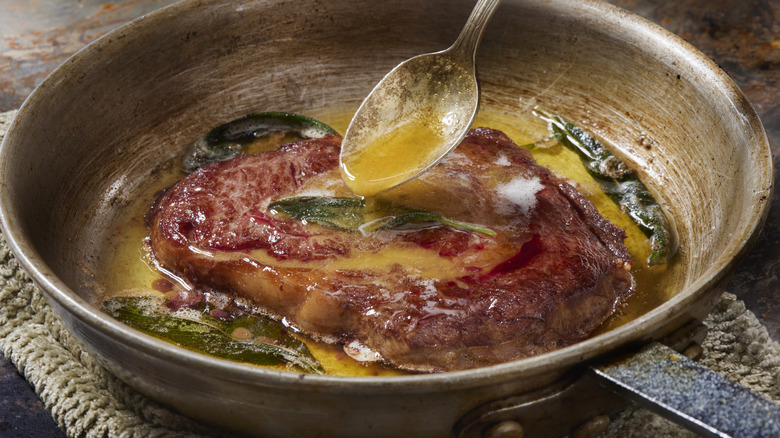
What's better than a steak-cooking tip from a professional chef? How about a steak-cooking tip from a professional chef's grandma that the chef still uses to this day? That's some advice you know you can rely on. As Laurent Tourondel told us: "One of my favorite techniques, passed down from my grandmother, is to baste the steak with butter, chopped garlic, and parsley after cooking. It adds incredible richness and aroma."
Basting a steak does more than just add extra flavor, though. It can also cut down on your cooking time by a not insignificant degree, while also ensuring that your steak presents an even, nicely colored crust. To butter-baste a steak, sear it first, as normal, and then add your butter and any extra aromatics, like Tourondel's garlic and parsley. You will continue flipping occasionally, and as the butter melts in the pan, tilt the pan forward so you can scoop it up and pour the melted butter over any spots of the steak that do not appear fully cooked. You will continue this process until the steak is your desired doneness. This won't just add flavor to your dinner, but it will also fill up your apartment and kitchen with the most delicious smell
Use compound butter
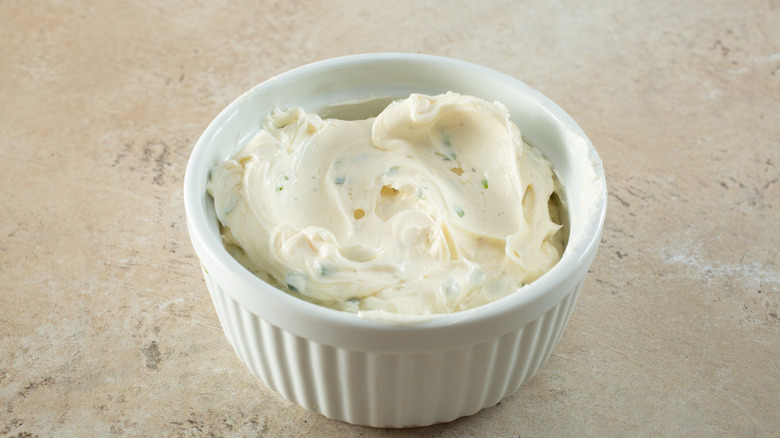
Compound butter comes in handy in so many dishes. It's a truly magical ingredient, one you should honestly have in your fridge at all times — and it's one that Albert Schmid recommended adding to your steak after it's finished and before serving.
"Before you serve the steak, make sure to add a compound butter to the top," he said. "A compound butter is butter with herbs and seasonings mixed in. This takes a little planning. The compound butter should be put together the day before you plan to cook the steaks. The compound butter should be at room temperature when placed on the very hot steak surface, so that it mostly melts before it gets to the table."
Compound butters can really be made with nearly anything you have on hand. Leftover herbs, whatever spice or seasoning mixes you have in your kitchen cabinets, finely chopped garlic or shallots, cheese, and more. Beyond using a compound butter on your steak when enjoying your steakhouse-style dinner at home, you can also use it on your bread, baked potatoes, and other sides.
Pick the right side dishes

Speaking of sides, it's important to pick the right side dishes for your steak dinner to recreate the steakhouse dining experience, but without overblowing your grocery budget. Then, make sure that those side dishes are cooked so that they're ready to be served at the same time that your steak is done, Albert Schmid recommended.
As you're mulling over your side dish options, avoid the pricey ones (sorry, lobster mac). Instead, pick the side dishes that utilize affordable ingredients, but give them steakhouse flair. For example, make steakhouse-style macaroni and cheese without lobster by trading typical elbow pasta for a more refined pasta such as cavatappi and bolstering your cheddar with cheeses such as Gruyere or Gouda. Pick out a big potato (steakhouse chain potatoes weigh in at about a pound each) and bake it in the oven (no microwaving!) before topping it decadently. Put together a wedge salad with blue cheese dressing. It's an old-school salad that's too overpriced in most restaurants, but when cooking at home, a head of iceberg lettuce is hardly a splurge.
Look for deals on steaks and shop smart
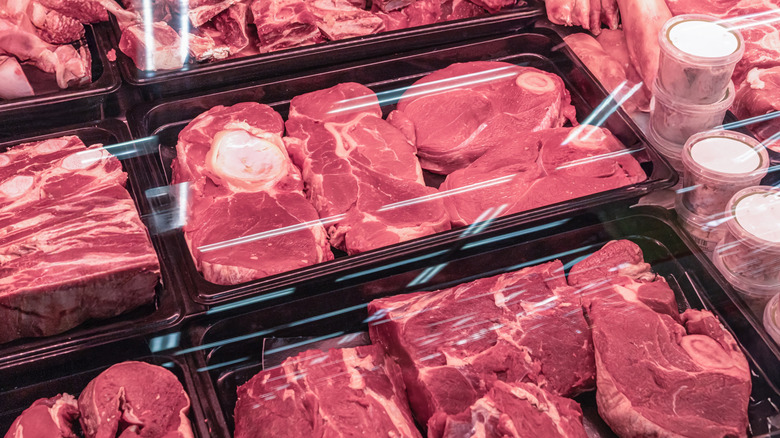
Of course, before you even get your steak home, your journey toward a budget-friendly dinner begins at the grocery store. While opting for the expert-recommended, more affordable cuts of steak can help stretch your dollars, so can looking for specific deals on steaks and shopping smart.
For example, keep an eye out for on-sale steaks, which you can find around holidays during which people may be more inclined to buy a steak at the grocery store, such as Valentine's Day or Christmas. Then, stock up. You can freeze steak simply in zip-top bags, or go the extra mile and use a vacuum sealer. Steaks will stay good in the freezer for up to a year. You can also buy steaks in bulk at stores like Costco, or buy larger cuts and then portion them into individual steaks yourself, for a lesser price per pound.
If you're worried that the steak on sale is of lesser quality or is close to going bad, don't be. While steaks may be marked down because they're nearing a "best by" or "sell by" date, it's worth noting that those dates are not USDA-monitored and are, instead, determined by the store. They also refer to quality, rather than actual food safety. The best way to tell if a clearance steak is still good or not is by smelling it; strong odors are an indication of spoilage.
Elevate your steak with a fancy-feeling sauce
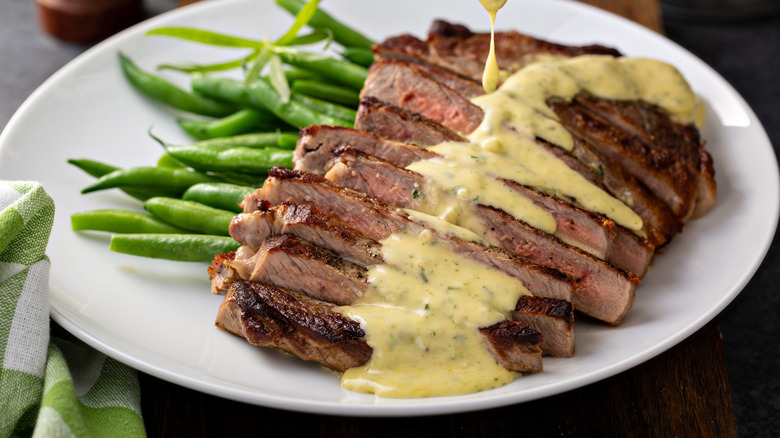
Many steakhouses adorn their steaks with an array of sauces, a step that many home cooks don't even bother with when preparing steak at home. However, doing so can elevate not only your steak but also the overall dining experience. Plus, it's not like making a fancy-feeling sauce will add that much to your grocery budget, so if you can take the time to make one, you'll be well rewarded.
There's a wide variety of sauces that you could potentially make to go alongside your steak, some of which come together with ingredients you may even already have on hand. For example, you could make a bordelaise sauce. It sounds impressive and very French, but literally all you need is butter, shallots, salt and pepper, red wine, and stock. Cook the shallots in the butter, add and reduce the wine, add and reduce the stock, strain out the shallots and season; then it is done. Béarnaise likewise works well with steak and its accompaniments and requires only vinegar, shallots, tarragon, eggs, water, oil, butter, and salt. Béarnaise does require a little more work, though, as you have to ensure the eggs don't overcook.
Use a marinade
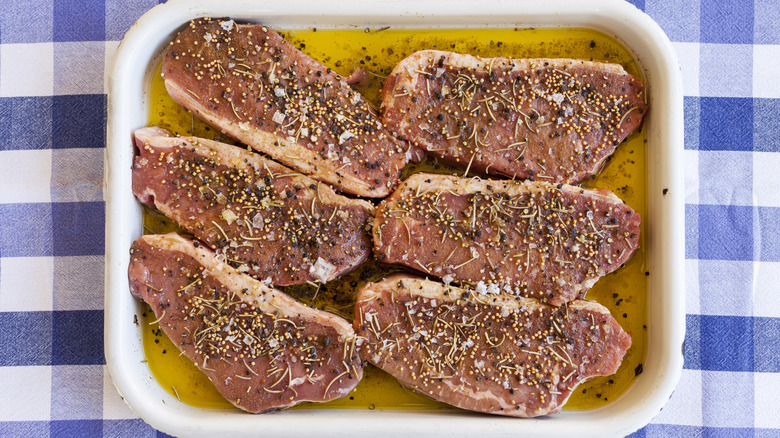
You may only think to use a marinade when you're cooking something that you're specifically worried will end up being tough or dry (like grilled chicken). When you're cooking steak, you probably assume that it'll be fine on its own. As long as you don't overcook it, it should remain moist and tender, right?
While that's often the case, a marinade can still come in handy when prepping a more affordable cut of steak (and, in fact, there are four specific cuts of steak you should always marinate before grilling: flat iron, sirloin, tri-tip, and skirt steak). In addition to moisture, a marinade can also add flavor, and it doesn't need to be complex. A mixture of oil, soy sauce, and your favorite herbs and seasonings will do the trick. If you don't have any soy sauce on hand, swap it out for Worcestershire sauce. Acids like lemon juice, meanwhile, can further help tenderize the beef.
You'll want to leave the steak in the marinade, in a zip-top bag or similar container, for more or less time depending on the cut and size. Thin steaks are often ready after a brief marinating session of a few hours. In contrast, a really thick cut might need to marinate overnight.
Pair your steak with a budget-friendly wine
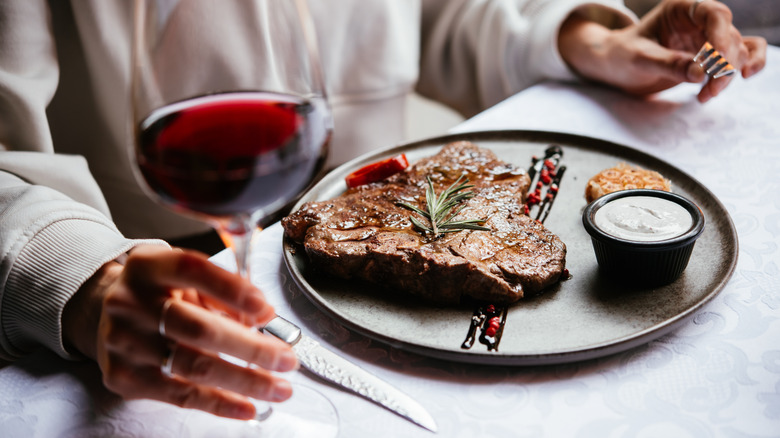
What's a trip to the steakhouse without a few drinks to enjoy alongside your meal? Wine is often the go-to in upscale environments, and no one can deny that a red wine and steak are a match made in heaven — but buying a bottle in the restaurant can be pricey, and then you're left with the choice of finishing the entire thing right there or lugging it home with you.
Well, none of this is a worry when you're putting together a budget-friendly steak dinner at home. You can find many an affordable wine at your local wine and spirits store, all of which will pair well with steak, and you can drink as much or as little as you like, before popping the bottle into the fridge for later imbibing.
If you're a wine newbie, you can probably get away with pairing any ol' red with your steak. A basic Cabernet Sauvignon can easily be had for less than $20 (or even $10). However, if you have a more refined palate, you may be more discerning. In that case, you'll want to pick your wine based not just on the fact that you're having steak; you'll also want to pair the wine based on the actual cut of steak, as well as the accompaniments, including sauces. Small distinctions, like the changes in texture and fat from cut to cut, as well as differing levels of acidity in sauces, can influence your wine-buying decisions.
Don't forget dessert

Lastly, every great steakhouse meal is capped off by a decadent, indulgent dessert, so don't forget that when you prep your budget-friendly steak dinner at home. You do not need to be a pastry chef to prepare an impressive dessert, and you do not need many expensive ingredients or much time.
Tiramisu? It requires no baking and is basically just layering ladyfingers and a mascarpone-based custard. For easier layering and even less work, just go straight to a trifle that incorporates pound cake or sponge cake, fresh fruit, and whipped cream. Arranged in a tall trifle dish, it'll both look and taste oh-so-elegant. And then panna cotta? If you can make Jell-O, you can make panna cotta. Lemon posset, meanwhile, requires only three ingredients — heavy cream, sugar, and lemon juice — and about 10 minutes. You could prepare it while you wait for your steak to come to room temperature before cooking or while you are waiting for the steak to rest after cooking.