

Beer Is Your Ticket To Eating More Salad — Here's How
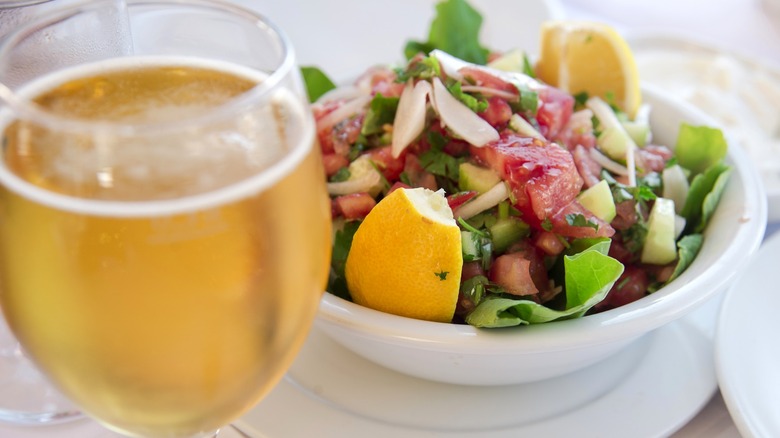
Let's get one thing straight from the get-go –- we're not talking about some kind of sacrificial trade-off where you forgo drinking a beer until you've eaten a salad. Rather, a bowl of greens becomes much more appealing with an appetizing dressing and beer is your secret weapon to achieving that. I'll admit, adding suds to salad dressing never crossed my mind. That is, until Jackie Abril-Carlile, a chef instructor at Auguste Escoffier School of Culinary Arts, gave us some insight into making salad dressing with beer. "Beer works well in scratch-made salad dressings and marinades," she said. "It can replace or supplement traditional acids such as vinegar."
But where to start? Abril-Carlile had a few recommendations beginning with a classic that's perfect for topping a Mediterranean salad. "For a balsamic-style vinaigrette, a darker, more robust beer helps carry flavor through the emulsion," Abril-Carlile said.
Once you've got the right brew in hand, making the dressing is really as simple as turning on a blender. "I create a permanent emulsion using a blender or food processor with Dijon mustard as the emulsifier," Abril-Carlile said. "Beer, vinegar (if used), herbs, spices, and mustard are blended first, followed by a slow stream of neutral oil such as canola." A slow, steady hand is crucial; otherwise, you risk breaking the dressing. As far as how much oil is needed, it depends. Tasting as you go will help you find the ratio you prefer. "While the general ratio is approximately one part liquid to three parts oil, flavor and texture guide the final balance."
More ways to incorporate beer into salad dressing
To cook with a beer, you have to know a beer. It's sadly an overlooked step that people skip when cooking with cold ones, but it's arguably the most important part of putting together something flavorsome, whether it's a stew or a salad dressing. The best kind of brew for cooking brats may not be ideal for a balanced vinaigrette, for example.
For those folks who aren't intimately familiar with various flavor profiles in beer, Abril-Carlile provided a couple more examples of how specific types can accentuate certain salad dressings. "Fruited sour beers make excellent bases for vinaigrettes, such as a guava sour for a summer salad," she said. "Golden ales or Kölsch beers work well in Italian or sweet chili dressings, providing mild acidity and subtle sweetness." Save your potent, malty suds like red and Scottish ales for a meat marinade.
If you're already acquainted with the flavor profiles of various brews, have some fun and experiment with what you think would taste good. Just keep your eyes on the prize. "The goal is for the beer flavor to be present but integrated, enhancing the dressing rather than overpowering it," Abril-Carlile said.
The thing is, what you think works may be wildly different from what someone else finds tasty, and that's fine. As long as you're happy with your creation, you've prevailed. "Ultimately, cooking with beer, like cooking with wine, is guided by personal preference," Abril-Carlile said. "The most important question is simply, 'Do I enjoy this?' While certain pairings may be more traditional or technically sound, taste remains subjective."