

2026 Olympians' Drink Of Choice Tastes Like 'Wood And Dijon Mustard'

Olympic athletes represent the world's peak performers in various sports, but reaching that level of efficiency doesn't happen by accident. They take extreme measures to get an edge on the competition, often involving a combination of taxing training regimens, the perfect performance wear, and special diets. At the 2026 Milano Cortina Winter Games, some athletes have taken to drinking broccoli to enhance their physical performance, but it's not as simple as tossing the veg in a blender as part of a complete morning smoothie.
The concoction Olympians favor is a 60-milliliter "shot" containing a concentrated dose of isothiocyanates (ITCs), a chemical compound group commonly found in cruciferous vegetables. Nomio, named after the company that produces it, isn't a drink to be sipped and enjoyed. It's taken straight down the hatch like a shot of whiskey because it supposedly doesn't appeal to most palates. The company adds sugar and lemon juice to make it more enticing, but as one of the three founders of Nomio, Emil Sjölander, told The Wall Street Journal, it still tastes oddly like "some combination of wood and Dijon mustard."
Even if you buy the best broccoli at your local grocery store, it would take six pounds of the veg to get the equivalent amount of ITC into your system that Nomio offers. The idea is that ITC helps reduce the sting of aching muscles during a workout, allowing athletes to push themselves harder during training and competitions. The question is, does broccoli juice work, or is this just some cruel joke Nomio is playing on Olympians?
The science behind Olympians drinking broccoli
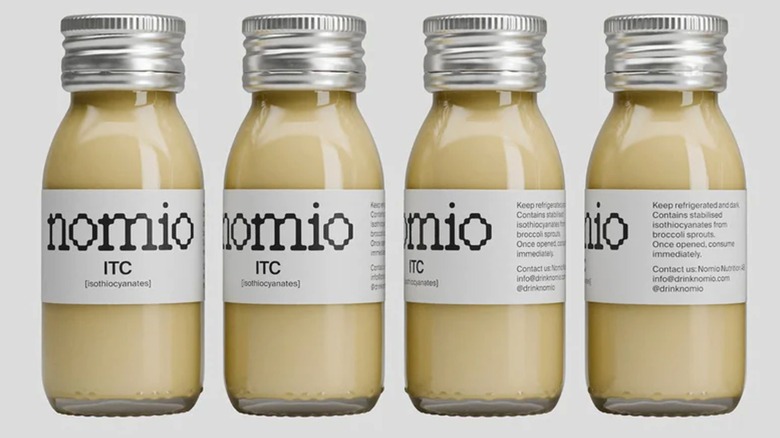
Nomio claims that ITCs can activate NRF2, a cellular pathway that helps the body recover from physical stress. Essentially, it allows athletes to push harder when competing or working out. However, while some elite athletes swear that ITC-infused Nomio helps them stay on top of their game, others aren't quite convinced.
Author of multiple sports performance books, Steve Magness, has indicated that while the idea may have some merit, there's no way to be sure that Nomio is anything more than a glorified placebo. "There's bio-plausibility, meaning there's been enough research where this is now a legitimate hypothesis," he told The Wall Street Journal. "The problem is, there's only been a handful of studies."
Still, that's not stopping Olympians from imbibing in hopes they will recover quickly from strenuous activities. The Swedish team behind Nomio is quite convinced that the drink is a revolutionary breakthrough for athletes worldwide, after spending years researching the relationship between ITCs and NRF2. Mincing may be a more nutritious way to eat broccoli, but given how much one would have to consume to acquire the same amount of ITC, it's probably best served as a drink you can throw back in a jiffy — even if it does taste like lumber and mustard.