

15 Of The Oldest Chain Restaurants Still Up And Running In The US
There are over 142,000 chain restaurant businesses in America. Chains, be they fast food, casual dining, fast-casual, or quick-service, are anything but exclusive to the United States. That said, they are an indelible part of the country's food history and way of life, and some have created and popularized the most defining foods and drinks of these shores, including burgers, hot dogs, pizza, sandwiches, soda, and milk shakes, to name a few.
A number of these seminal businesses, some of whom are rooted in the very early years of the twentieth century, are very much alive and kicking, albeit as mid-level, yet relatively numerous, regional chains. These sleek, modern, cookie-cutter storefronts permeating our highways, service roads, main streets, and downtowns belie often humble, sometimes eccentric, grainy black-and-white origins. Let's take a dive into the history books to find the 15 oldest chain restaurants that are still up and running in the U.S.
Yoshinoya
When we think of the origins of the oldest franchised restaurants in the United States, we often look to either the big cities, like New York, LA, or Chicago, or the fast-food-fertile Midwest. Rarely do we look overseas. Why would we? Our iconic American chain restaurants are just so, well, iconically American. But, minds are made to be blown. The eldest still-existing chain in the U.S. is indeed ancient. And, not from Kansas, Washington, or Massachusetts, but a historic land: Japan.
Yoshinoya, the transpacific rice and noodle bowl giant, has over a hundred locations in this country, all in California. The first Yoshinoya opened back in 1899 in a fish market in Tokyo, feeding famished, hard-working fishermen. Destroyed by an earthquake in 1923, they immediately opened one in Japan's most celebrated (and oldest) fish market, Tsukiji. Two years after establishing its hundredth Japanese location, the first stateside Yoshinoya was brought to Los Angeles in 1979. Famous for its teriyaki chicken bowl, the chain now boasts over 2,000 restaurants around the world.
Amato's
Back in 1902 on the docks of Portland, Maine, Giovanni Amato may very well have invented the Italian sandwich. What began as a cart rolling along the piers turned into a full-fledged storefront on India Street — a one-time thriving working-class thoroughfare. By 1930, Amato's was making 1,500 sandwiches daily, selling them for just 15 cents a pop. In the early seventies, Dominic Reali, an Italian expat who worked at the original store for years, took over the business. Off it multiplied.
To this day, it's a successful New England-based chain, with over 50 locations from Vermont down to Rhode Island. Its signature eat is the original Maine Italian Sandwich. This sandwich boasts ham, cheese, pickles, peppers, and black olives on a soft roll dressed with salt, pepper, and oil. All told, it's not only the first of its kind, it's still one of the Italian subs you need to feast on before you die.
A & W
Its long-time ubiquity on the American fast food landscape has made it feel like everybody has a local one. Indeed, there are nearly 500 A & W locations dotted throughout the U.S., with almost 400 cities across 35 states boasting at least one. But the burger-and-soda chain has origins that go pretty far back — before things like the NFL existed, or movies with sound, or even, as A & W itself likes to point out, sliced bread.
Roy Allen and Frank Wright ("A" and "W", respectively) opened the first location in Lodi, California in the summer of 1919. It was, appropriately, a root beer stand, a soft drink with which A & W would forever be entwined (as well as forever rivaled). Success came pretty quickly for the initialized partners, and A & W started franchising back in 1926, way before most of the famous chains were even a twinkle in their founders' eyes. Today, A & W and its pioneering root beer is still thriving and still ornamenting our many roadsides.
Nathan's
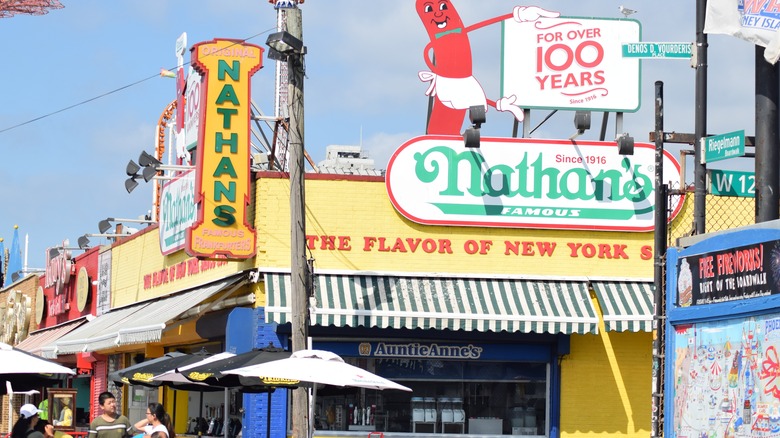
Every Fourth of July, 40,000 crazed and sun-drenched spectators squeeze in beside the Coney Island boardwalk to witness a premiere American sporting event — Nathan's Hot Dog Eating Contest. This is a sweaty, messy, scarf-fest super-tradition that celebrates the holy hot dog at what many believe is the true cathedral of the wiener: Nathan's Famous.
The story of this Brooklyn icon being born is an oft-told one. In 1916, Nathan Handwerker and his hot dog-whisperer wife Ida opened their own stand on Surf Avenue, to rival his former employer, Feltman's Restaurant. Handwerker sold his hot dogs for half the price Charles Feltman did, which initially backfired because people questioned the quality. In time, he overtook his nemesis and soared into legendary status. Outside of the world-famous stand, Nathan's would eventually franchise.
Today, it still has dozens of locations up and down the east coast and the brandis one of the staple hot dog offerings in supermarkets nationwide. In 2026, the famous hot dog brand was sold to Chinese-owned food processing conglomerate Smithfield Foods in a major deal, so the brand, and its forever home, probably won't be going anywhere anytime soon.
White Castle
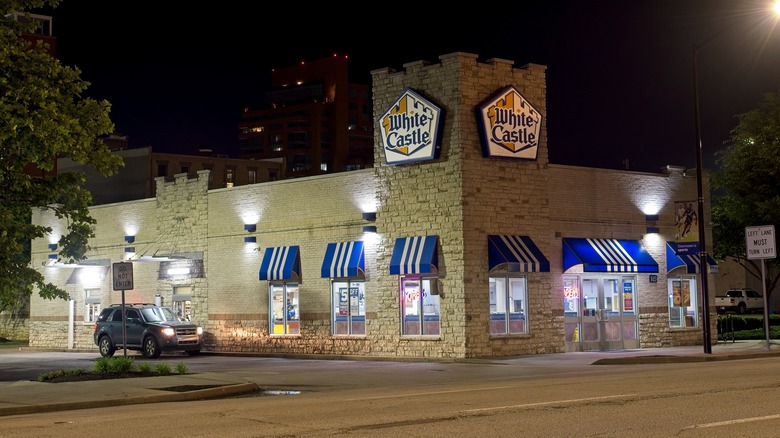
Once dubbed the most influential burger of all time (beating out the Big Mac, the Whopper, and the In-N-Out burger on the same list) and considered the quintessential American fast food restaurant, White Castle needs no introduction. Its famous two-inch slider, middled by its patented five-hole patty, still remains the foundation-piece of its almost 350 locations in the U.S. across 15 states (Illinois has the most, by the way, with 58).
White Castle flipped its first burger in Wichita, Kansas in 1921. (Wichita might be the unofficial home of iconic franchise origins, as it also hosted the genesis of Pizza Hut, among other popular regional chains.) It was an insurance salesman, Billy Ingram, and a cook, Walt Anderson, who came together to open the very first White Castle at the Americana-friendly intersection of First Street and Main Street. The chain refers to its devoted fanbase as "Cravers." There's even a Craver Hall of Fame dedicated to the cream of the burger-devouring crop. Safe to say it's a longstanding love affair.
Rosati's Chicago Pizza
Less than ten years after Chicago saw the most infamous sporting controversy in American history — the 1919 Black Sox scandal — and only two years before the 1929 stock market crash, an Italian family transplanted from the east coast to open a Windy City pizza icon that's still going strong a hundred years on. Founder Sam Rosati would boil the century of success of Rosati's Chicago Pizza down to one pithy, personal phrase: "Give the people what they want." It's worked.
With over 60 current locations coast-to-coast, each specializing in deep-dish, Chicago-style pizza, it's interesting that the Rosati family's restaurant roots are actually in New York City. It was there, during the late 19th century, that Sam Rosati's dad was serving out Italian food to very happy eaters. Upon the move to Chicago, they brought that penchant for customer satisfaction and helped define a legendary pizza city's pie. It wasn't until 1970, however, that other Rosati's branches began to open, all helmed by members of the family. This continued over the decades, and by the mid-90s, a landmark fifth generation of Rosati's had opened an establishment.
Krystal
White Castle's slider legacy is substantial. So much so that it's even inspired another one of the oldest chain restaurants in America. Eleven years after White Castle's debut in Wichita, a Southern fast-food chain was born in its likeness.
Krystal was founded during the early years of The Great Depression, in Chattanooga, Tennessee. The name came from one of the founding partners' wives, prompted by the luminosity of a decorative crystal ball lawn ornament she saw. The restaurant's first order came on October 25, 1932 and it was for six Krystal burgers — the name of their signature sliders — and a cup of coffee. These retailed for just 35 cents back then. A far cry from today's burger prices.
Fast forward to 2026, and there are almost 300 Krystals in the U.S., virtually all in the Southeast (although an outpost was recently opened in New Jersey). Fun fact: A young Samuel L. Jackson starred in a Krystal ad back in 1975. Even Elvis Presley was a fan of the chain's burgers.
Steak 'n Shake
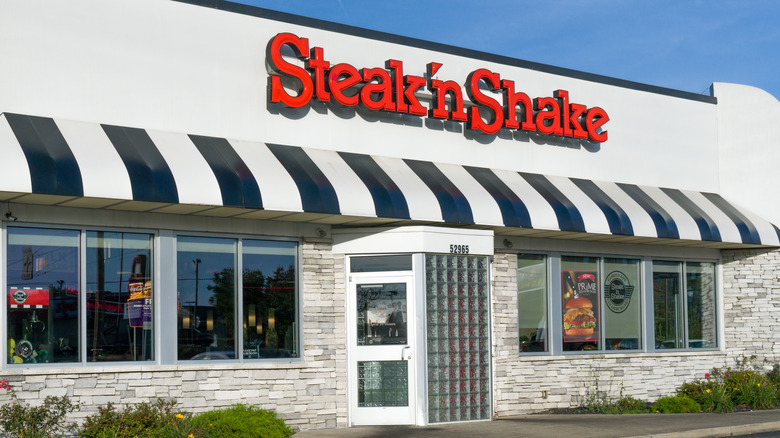
Normal, Illinois may seem, and sound, like a place with a nondescript history. That is far from true. First off, it's the only city or town in America named Normal. Which is pretty neat. Second, it has a number of historic Route 66 landmarks, that most famous of American roadways. But, most notably (and most relevant to this list), the city birthed one of the country's enduring restaurant chains. One that, after close to nine decades in business, has close to 400 businesses operating across the U.S. and the Caribbean. We're talking of course about Steak 'n Shake.
Now known for its steakburgers and beef tallow fries, Gus Belt opened the first Steak 'n Shake in 1934, after converting a gas station and chicken restaurant. Upon Gus' death in the 1950s, his wife Edith took over and supervised the first sale of the company. The chain steadily grew over the succeeding decades into the Midwestern and Southern mainstay that it is today. Steak 'n Shake's burger menu remains one of the very best among popular burger chains out there, with no shortage of delights on offer.
Swensons Drive-In
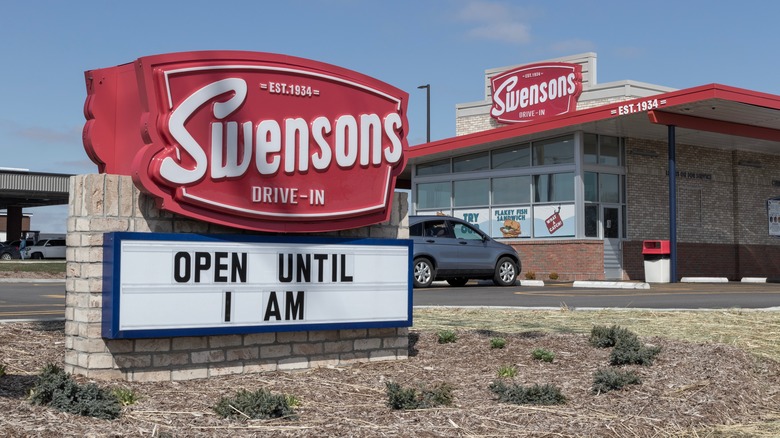
Akron, Ohio in the 1930s was considered The Rubber Capital of the World, as a manufacturing epicenter of the rubber industry. So it's no surprise that meals you can get while on your tires has pioneering provenance in that time and place. Today, Swensons Drive-In has about 25 locations, mainly in its motherland of Ohio. But its legacy is cast bigger than its geographic reach, especially in the form of its famous Galley Boy double cheeseburger, complete with its signature green olive toothpick.
"Pop" Swenson opened the first Swensons stand in 1934, after starting out selling hamburgers at a high school from his station wagon. The original location was the only one until the 1950s, when people started driving more and the national highway system was beginning to ribbon the land. Still, Swensons' first Cleveland location didn't come until 2001, meaning its one of the steadier climbers on this list. Which takes nothing away from its endurance and standing as a nostalgic, active reminder of old Americana.
Friendly's
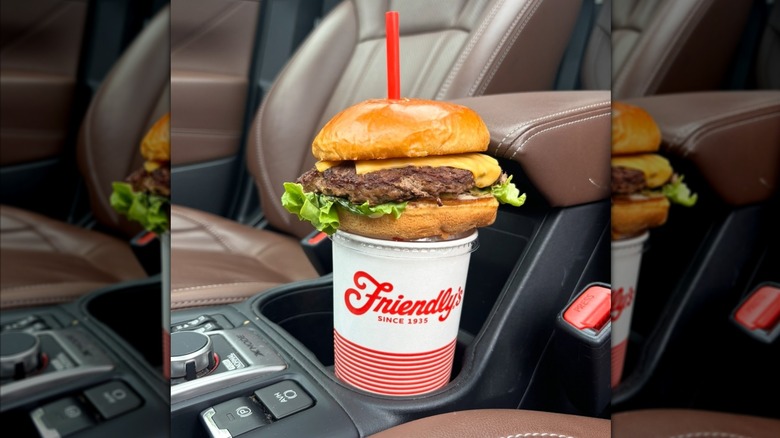
This East Coast burger-and-ice-cream chain has been through a lot in its many years, with one of the more volatile economic histories on this list. Opened in 1935 by two brothers in Springfield, Massachusetts (the same city where basketball was invented), it was originally called Friendly ice cream shop. Although apostrophes were yet to enter the picture, burgers and ice cream were brought together here in a timeless union. In 1950, Friendly's became the first establishment in New England to sell take home half gallons of ice cream.
The company's growth came quickly. In 1951 there were ten locations in Massachusetts. Less than fifteen years later there were 500 locations throughout the Northeast. In 1987 Friendly's began selling its ice cream in supermarkets. Rough times followed for the restaurant side of things, however. Friendly's filed for bankruptcy twice in the 2000s, most recently during the pandemic, and has seen a substantial number of franchises close. But, Friendly's is still standing with over 100 locations, and is in the midst of another possible comeback. Who would doubt this casual-dining Lazarus?
Big Boy
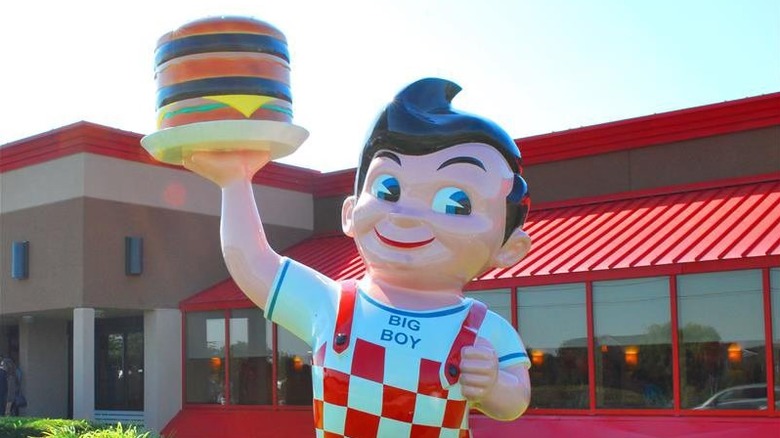
Can a mascot become way more famous than the business itself? When it's been around for going on a hundred years, the answer can certainly be yes. Big Boy, born Bob's Big Boy, has seen its alarmingly cheery little mascot find its place in the cultural ether. This is mostly due to the myriad Hollywood films that have used the iconic LA burger chain as a location or backdrop.
But the restaurant has endured for a reason, and its not just the famed logo. In 1936, Bob Wian bought a burger stand in Glendale, California, calling it Bob's Pantry. A year later, Wian obliged a customer request and created the very first double-decker burger, well before McDonald's. It was a hit and a legacy-maker.
And, although the chain has gone from purely West Coast to international, with locations in Asia, Big Boy has been in something of a downfall since the start of the 2000s. As of 2026, Big Boy is holding on for dear life, down to 55 locations. The vast majority of them are in Michigan, of all places, the site of the restaurant's first formal franchise application.
McDonald's
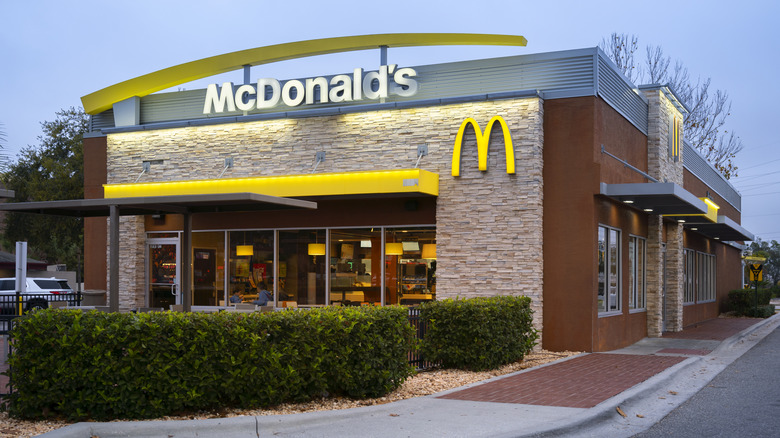
With an origin story almost as well known as its menu, golden arches, and amiable cast of intellectual property characters, McDonald's is by the far the biggest success story on this list. The tale bears repeating: McDonald's began life in 1940 in San Bernardino, California as a barbecue drive-in, run by the eatery's namesake brothers. But it wasn't until McDonald's pivoted to "speedier" offerings, namely burgers, that it attracted the eye of a particular Chicagoan by the name of Ray Kroc.
Kroc was a World War One vet who went from a middling career in music to a job in paper cup sales, among other pursuits. After selling a milkshake machine to that original McDonald's, a business relationship ensued. The first McDonald's in the eastern U.S. was soon opened by Kroc. How did that work out? Well, the fledgling little burger business now has 38,000 restaurants in 100 countries, give or take. Old Kroc did alright for himself, although those popular Chicken McNuggets are truly bizarre.
Dickey's Barbecue Pit
As requested, we've got another famous old American restaurant chain founded by an enterprising World War I vet. It was 1941 when a man named Travis Dickey opened a slow-smoke barbecue pit in Dallas. A charismatic, gregarious Texan, Dickey, who ran the pit with his wife Miss Ollie, at first struggled to make ends meet. But the food was delish and locals kept on coming.
In the late '60s, the Dickey sons, Roland and T.D., stepped in to run the operation. Dickey's Barbecue Pits were opening all over DFW. 1994 was the year Dickey's started franchising and off she went. Today, there is a Dickey's Barbecue Pit in almost every state in the union, close to 400 locations from sea to sea. After eighty-odd years and incredible growth, even leaving an international footprint, the successful chain is still family-owned and all the meat is smoked on site daily.
Hot Dog on a Stick
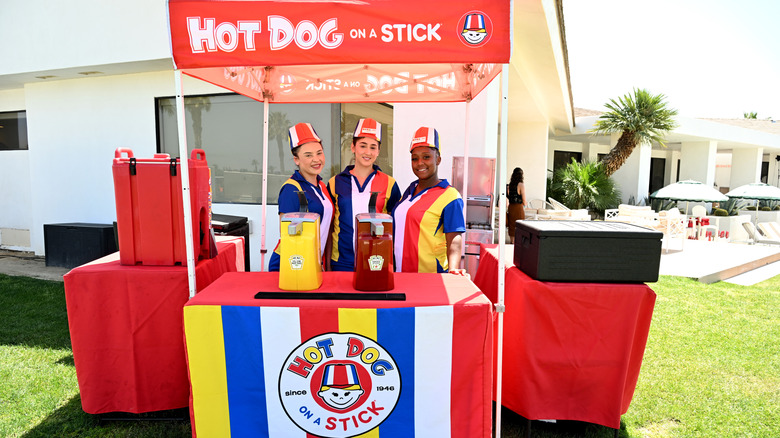
Another California original, Hot Dog on a Stick, opened up beachside in 1946 in sun-kissed Santa Monica. The linear, motley-colored logo and staff uniform would soon become instantly recognizable to Angelenos. But, before all that, it was just a stand called Party Puffs, and it only sold lemonade and ice cream.
Then came the big moment: The founder used his mom's cornbread recipe to create his corn dog, his hot dog on a stick. Nothing would ever be the same. The gospel of the corn dog would be spread far and wide by the multiplying Hot Dog on a Stick locations, helping to popularize the snack across the nation. And, even though the plain hot dog may be the simplest of all pleasures, this was truly God's work. With over 50 current locations across several states, this pioneering corndogger has come full circle, reopening its original stand on the Santa Monica pier in 2023.
Bob Evans Restaurant
It started in a twelve-stool diner in Gallipolis, Ohio. The owner of the establishment, Bob Evans, decided to sell his popular homemade sausages there. This was 1948. That same farm in Rio Grande, Ohio where Bob and his family cultivated and crafted said sausages is now a tourist spot that hosts a wide range of events and gatherings. The biggest one is The Bob Evans Farm Festival, taking place every year since 1971.
Back to the timeline: A restaurant centered on the sausages was opened by Bob in 1962. It was called, appropriately, The Sausage Shop. Still standing to this day, it has been retroactively given the Bob Evans name, as this was the progenitor of all the others to come. This is the same name that adorns a formidable 434 locations across the country. With nearly half of those in The Buckeye State alone, Bob Evans has become a farmhouse kitchen favorite for the hungry Midwest, serving all modes of breakfast-to-dinner comfort meals.