

13 Ways To Save Money Shopping At Whole Foods
We may receive a commission on purchases made from links.
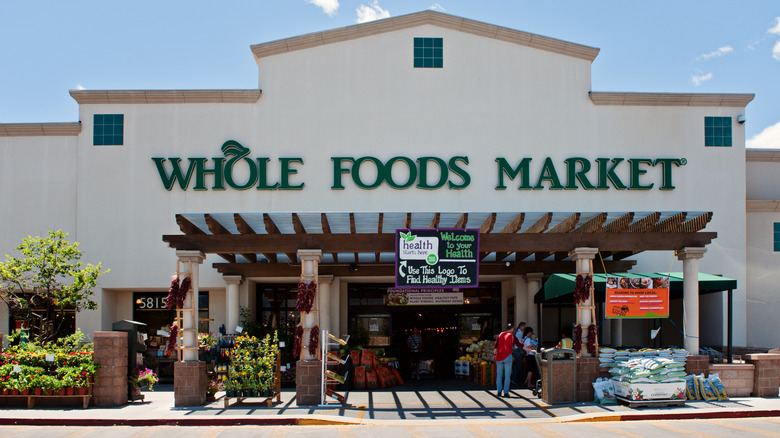
Whole Foods has a reputation for being an expensive grocery chain. Despite a concerted effort to lower prices, especially following the Amazon acquisition in 2017, the perception remains. A 2025 report from Consumers' Checkbook found that prices at Whole Foods were about 5% higher on average than other retailers, and about 30% above its sister brand, Amazon Fresh. But that might not be the whole story. While it ranks in the upper echelon of the Consumers' Checkbook report, Whole Foods has slashed prices on thousands of products and offers an array of promotions and discounts that can substantially lower prices. The savvy shopper can take advantage of these deals to find savings that bring the bill in line with, or below, the prices at competitors.
Prior to the Amazon acquisition, Whole Foods was in a precarious situation. For years, it thrived as a pioneer in the organic and natural foods market, but competitors started offering similar products. In 2015, Walmart became the largest seller of organic products nationwide. Faced with increased competition from lower-priced chains, the company was forced to evolve. The Amazon acquisition provided access to deep pockets and a world-class distribution network, but lowering prices was still a challenge. The cost of groceries has skyrocketed since then, and today's customers are more focused than ever on finding value. Many of the strategies Amazon introduced are in effect now, and by shopping smart it's possible to lower the bill at Whole Foods dramatically.
Plan before you arrive

Before diving into saving money at Whole Foods, let's focus on not falling victim to overspending pitfalls. Having a budget and a plan is essential to managing expenses. It was our top tip to avoid overspending on Thanksgiving, and it's just as important the rest of the year. The grocery store is full of subtle psychological influences and clever marketing that encourages impulse buying. This includes everything from the layout of the store, which is designed to weave shoppers past as many products as possible, to where items are placed on the shelves. It's not coincidental that the most expensive products tend to be at eye level, where they are easy to see and grab. The best defense is having a clear plan before you get to the store and then diligently sticking to it.
Whole Foods masterfully curates displays and end caps with intriguing items that are tempting to toss in the cart, but that impulse purchase can be costly. It requires being vigilant to avoid finding a $12 jar of peanut butter in your cart at the register. A good rule of thumb is to refuse to buy anything that is not on the shopping list. Whenever you are tempted with an impulse purchase, snap a picture instead of dropping it in your cart. This allows you to avoid the impulse purchase and reasonably evaluate it away from the store. If it's still appealing later, incorporate it into a future shopping list.
Use the weekly sales flier
Checking the sales flier is an essential part of planning for a Whole Foods shopping excursion. While the base prices at Whole Foods might be higher than other stores, there is an extensive list of weekly sales that can offer substantial savings. Instead of wandering aisles in search of sales, plan ahead. The flier is available online, making it simple to reference while making a shopping list. New sales are announced on Wednesday's and run through the following Tuesday.
Checking the sale items serves a double purpose. Most importantly, it allows you to plan around them and incorporate as many discounted items on the list as possible. Additionally, it helps avoid turning sale items into dangerous impulse purchases. The items are advertised with eye-catching labels and are discounted by as much as 20% to 30%. If you just stumble across them in the store, it's easy to consider it too good a deal to pass up. While the item itself might be a good deal, adding unplanned purchases to the cart is going to raise the bill rather than lower it, so be prepared. Let the sales work for you instead of inflating the bill.
Join Amazon Prime

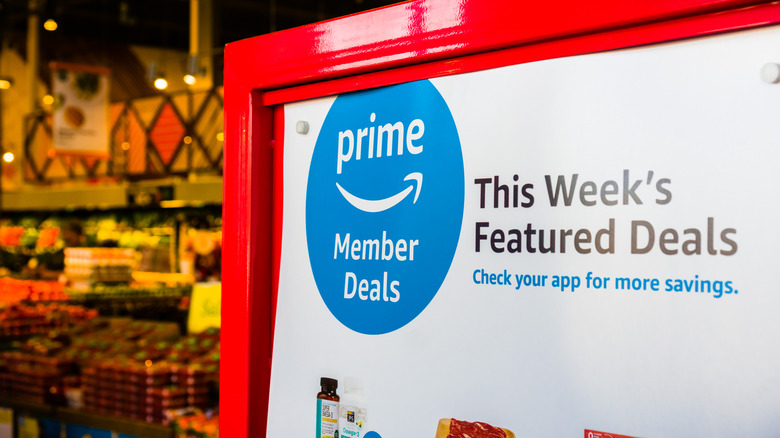
The best deals at Whole Foods are reserved for Prime members. Amazon's goal is to incorporate customers into its full ecosystem. To do this, it has placed Amazon package centers inside many Whole Foods locations so shoppers can pick up and return packages while grocery shopping. It also offers big savings for Amazon Prime customers. For regular Whole Foods shoppers, these savings can quickly offset the $14.99 monthly cost of the membership.
The primary benefit is an additional 10% off all sale items, with the exception of alcohol. This supercharges the savings in the weekly sales flier and makes referencing it even more impactful. Applying the discount is simple. If the customer pays with the same credit card that is attached to the Prime account, the savings are automatically applied when the card is used. Otherwise, customers can enter their telephone number into the keypad. The adventurous can use the Amazon One palm scanner. Customers hover their palm a few inches above a scanner to apply the Amazon Prime discount and make payment. Those opting for this sci-fi-inspired option can download the Amazon One app or visit the in-store kiosk to set up the service and connect a payment method.
Buy 365 brand products
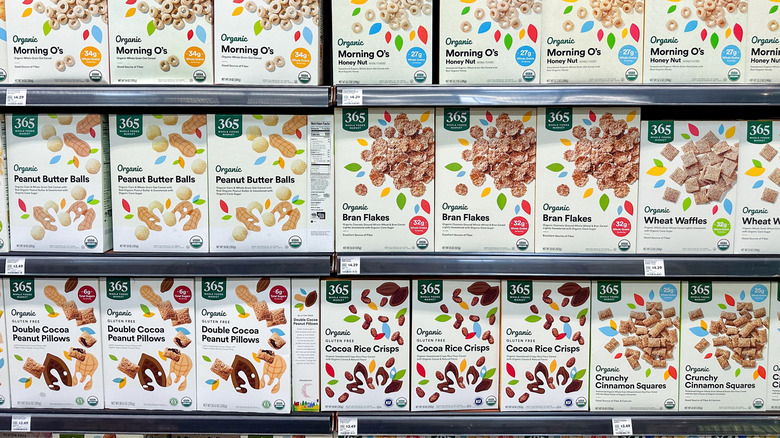
Whole Foods launched its 365 brand in 1997 to put more low-priced items on the shelf. These products were designed to provide value every day of the year (hence the name), and were priced substantially cheaper than comparable items. Following the Amazon acquisition, the private label got a brand refresh and hundreds of additional items were added. Now, the store advertises that it offers more than 3,500 products under the 365 label. The products are in every department of the store and are almost always cheaper than the name-brand items surrounding them.
It's fair to question whether there is a difference between generic and name-brand products. In some cases, they are produced by the same manufacturer but sold under different labels. Whole Foods is tight-lipped about where the 365 brand items come from, but they appear to be a mix of products it manufactures itself and ones made by other companies. All the company is willing to disclose is the products are sourced and produced while adhering to a strict set of standards. While the products are sold at a lower price, they are generally considered to be quality items. A recent review of store brand items conducted by Consumer Reports was favorable to many of the 365 products sampled. Of the 11 products tested, orange juice was the only one included on the skip it list.
Look for the yellow 50% off stickers
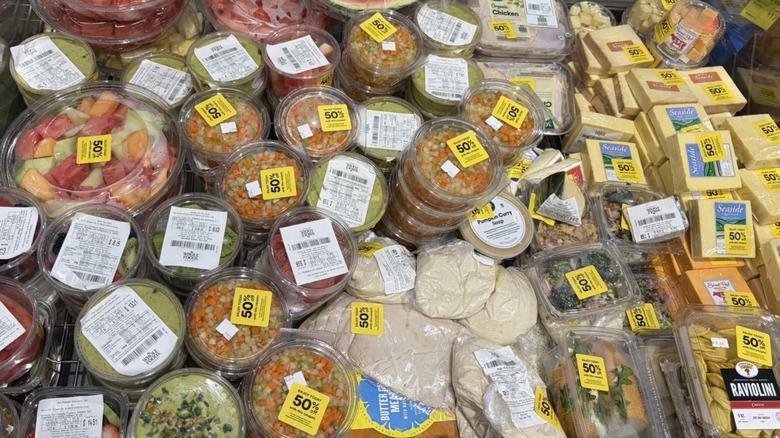
In addition to weekly sales, Whole Foods offers half-price discounts on items that are nearing the end of their shelf-life. These are typically clustered in certain sections of the store, including cut fruit, prepared foods, and the meat department. While the food is still safe to eat, it is nearing the expiration date and should be consumed soon after it is purchase. These aren't items to stockpile for later. The exception is the butcher department. As long as the meat is frozen on or before the expiration date it will remain safe to eat and can be thawed and prepared later, so half-price meat is a good time to stock the freezer.
The half-price deals are daily specials that vary depending on inventory. Since they are unpredictable, they are not included in the weekly sales flier or advertised. The only way to get them is to spot the bright yellow sticker adhered to the container. All the food is checked and stickers added before the store opens, so visit early for the best variety of discounts.
Ask for half portions
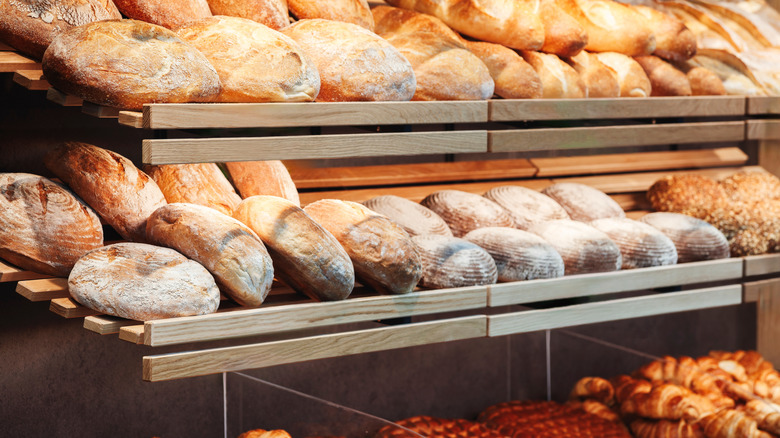
Many customers don't realize that Whole Foods stocks many items that can be purchased in half-portions. This is a brilliant cost-saving strategy for shoppers who aren't trying to feed a crowd. Instead of buying full portions and struggling to finish, or worse, watching it spoil, simply purchase the amount that you require. The baker can slice a half loaf of bread, watermelons can be cut into smaller portions, and the butcher will trim cuts of meat to the needed size. Another potential money saver at the meat counter is to buy bacon by the slice. It's a good option to control costs when you don't need an entire package.
The cheese department is a section of the store where smaller portions can result in major savings. Whole Foods has an extensive selection of high-quality cheeses, and the price on some of them can be intimidating. Having a large wedge cut into a smaller portion is an excellent way to sample a new cheese without committing to the high price. Another hack is to buy Parmesan rinds. Whole Foods sells authentic Parmigiano-Reggiano imported from Italy, but it's not cheap — $20.99 per pound at our location. However, the rinds of the cheese are sold at a much lower price ($8.99 per pound) and add a savory, umami-rich flavor when simmered in a sauce or soup.
Pay with an Amazon Prime Visa
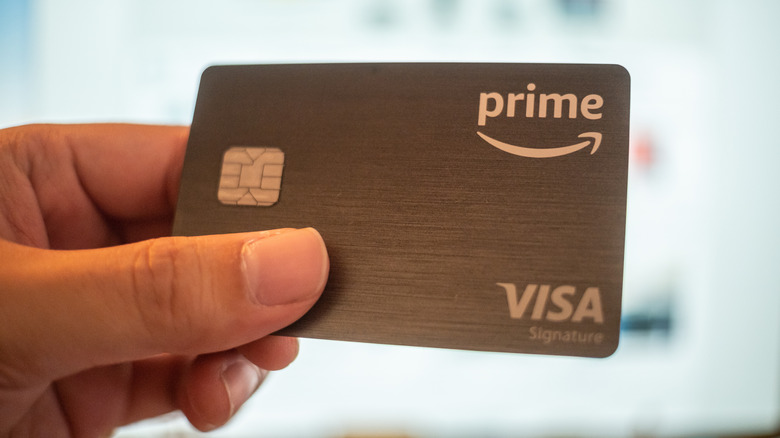
This tip is for specific customers — those who regularly shop at Whole Foods and are able and willing to pay the credit card statement in full each month. If there is any concern about not paying the balance, don't use the credit card. The interest payments will cannibalize the savings and increase expenses rather than save money. However, for those who diligently pay the balance, the card has no annual fees and offers 3% cash back on all Whole Foods and Amazon purchases when paired with an eligible Prime account.
Remember the beginning of the article when we mentioned that Consumers' Checkbook determined Whole Foods prices were about 5% higher than the average of all stores? The cash back payment alone virtually negates that difference and places Whole Foods almost on par with the baseline. Once that is paired with Prime discounts and the other tips in this article, it is easy to see how prices at Whole Foods can be lower than some of its competitors. As an added bonus, the card comes with a $50 Amazon gift card upon approval.
Swap the freezer section for delivery

At the beginning of every year, Whole Foods publishes a list of its projected food trends for the year. In 2026, freezer aisle fine dining made the cut. Things have come a long way since the 1950s style TV dinners and other frozen foods that nobody eats anymore. Instead of soggy cartons of indistinguishable slop, today's freezer aisle at Whole Foods is stocked with an array of global flavors made from high-quality ingredients. Combine this with an incredible surge in popularity of air fryers, and these frozen foods provide restaurant-quality meals with minimal effort.
The COVID-19 pandemic precipitated America's enthusiasm for food delivery, and it's now a regular part of life for many diners. While it's hard to argue with the convenience of food delivered directly to the door, that convenience comes at a cost. Many restaurants charge higher prices for online items to offset the fees delivery services charge them. On top of that, there are fees charged directly to customers. These often include a delivery fee, service fee, and, of course, a tip. One strategy to save money on all these fees is perusing the Whole Foods frozen section. There are options to satisfy almost any craving, and typically at a fraction of the price of ordering delivery.
Buy conventional produce
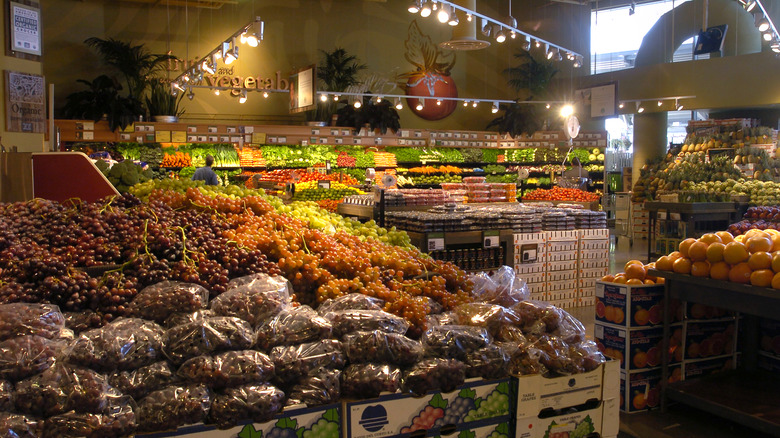
Swapping conventional produce for organic is a surefire way to lower the bill during a Whole Foods shopping trip. While organic and natural foods played a vital role in putting Whole Foods on the map, they also contributed to its reputation as an expensive grocer. There are valid reasons why organic produce is more expensive. To obtain an organic certification from the USDA, the produce must be grown without the use of synthetic fertilizers or pesticides and cannot contain any genetically modified organisms. This typically leads to smaller crop sizes and more labor-intensive farming practices. The increased expense in producing the items is reflected in the price.
However, many studies have concluded that organic produce is not more nutritious than conventional, and the Mayo Clinic recommends that choosing between organic or conventional produce should come down to whichever choice puts the highest amount and variety of fruits and vegetables in the diet. While organic produce does contain lower numbers of pesticide residues, all the food in American supermarkets has met food safety guidelines and is safe for consumption. When lowering costs is the primary goal, confidently add conventional produce to your cart.
Buy seasonal produce
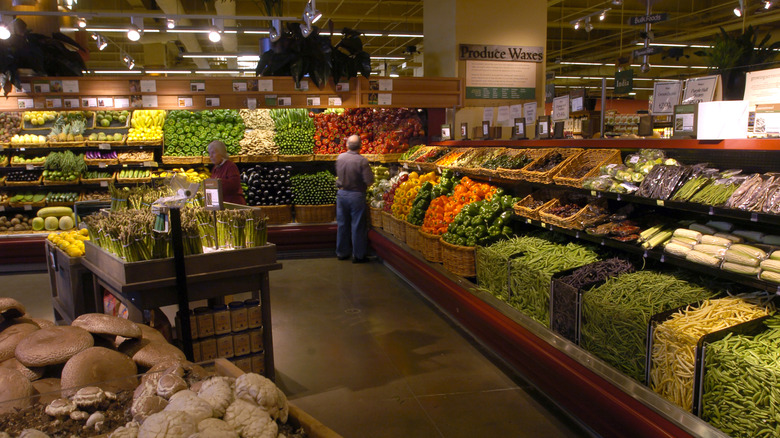
Another way to keep prices in check is to buy seasonal produce. Not only are prices usually lower when the fruits and vegetables are in season, there are many additional benefits as well. For starters, produce tastes best when it is in season and it is packed with vital nutrients. It's also more likely to come from local farmers and often creates less of an environmental strain compared to those grown out of season. There are multiple guides available online that highlight growing seasons, but it's typically easy to identify what is in season by seeing which bins are overflowing in the Whole Foods produce department. This is generally reflected in lower prices.
When buying non-seasonal produce, don't be afraid to check the frozen and canned aisles. These are fantastic options that can offer the similar nutrients, but often at a cheaper price. Many of them also come washed and chopped, reducing prep time. They are also flavorful. Frozen and canned vegetables are usually harvested at peak ripeness and may have richer flavors than the fresh produce that is sold out of season. It's worth reading the label though, some canned items have added salts or sugars that can impact their nutritional values.
Shop on Tuesday's and Friday's
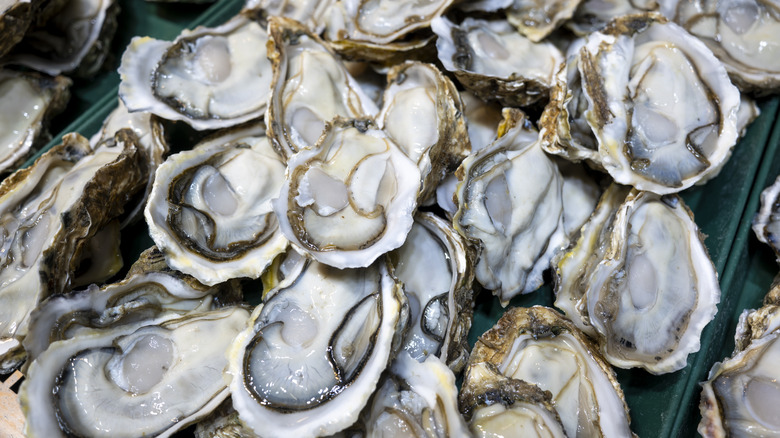
The Tuesday and Friday deals are a Prime-exclusive, but they offer enough value to warrant their own section. Tuesday's specials are focused primarily on quick weeknight dinners. These include $2 off a rotisserie chicken and a host of buy one, get one 50% off deals. Many of the half price deals are focused on ready-to-eat items, like packaged soups and individual meals. However, 1 pound packages of ground beef are included, making it a great time to stock the freezer.
Friday's specials swing towards weekend splurges. The $12, fresh-baked, one-topping pizza is always popular. There are also buy one, get one 50% off specials on packaged sushi rolls and charcuterie packs. Perhaps most famous are the $1 oysters. Whole Foods doesn't advertise how many locations include a beer and wine bar, but a good number of them do. At these locations, Friday date night is much cheaper than most wine bars. The fishmongers are pros at shucking oysters and serve them on a platter of ice that can be carried to the Whole Foods wine bar. There, you can purchase a bottle of wine or Champagne off the shelves for a value-priced happy hour.
Shop the bulk aisle
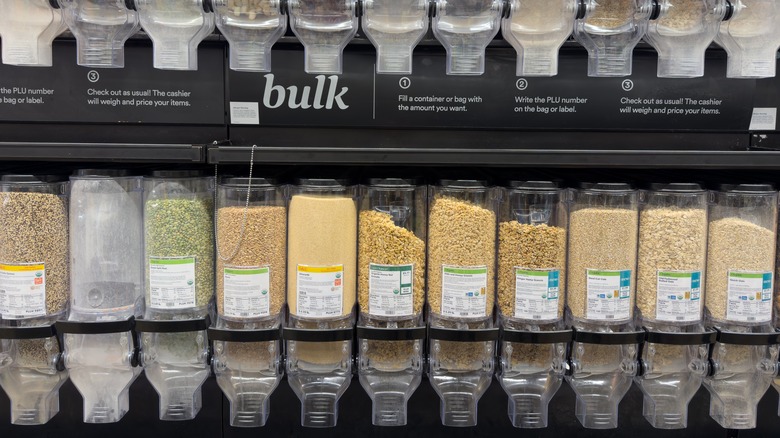
The bulk aisle contains bins of food that customers scoop into smaller containers. While the section is intimidating to some customers, it's a great option to keep prices down. One of the benefits is the ability to buy only what is needed. Much like the half-portions, it can offer great savings to just purchase what you can reasonably use in a timely fashion. At our local Whole Foods, the smallest package of cashews is a 10-ounce bag. That leaves a lot of extra nuts when making a recipe that only calls for a handful. The bulk section allows for scooping out just what is needed for a more economical purchase.
Smaller portions are not the only benefit of the bulk section. While some of the items are comparable in cost ounce-for-ounce, there are others that have a cheaper unit price than the packaged options. This is especially true when it comes to grains and beans, so make sure to check the unit prices before making a final decision. The bulk aisle also contains a nut butter grinding station that is an excellent choice for a cost-effective, additive-free option.
Don't be intimidated and miss out on savings — shopping in bulk is easy. Somewhere near the bins (usually on a shelf beneath them or at the end of the aisle) there are plastic containers, lids, stickers, and pens. Fill the container with what you need, then write the PLU number from the bin on the sticker — that's it.
Avoid pre-chopped produce
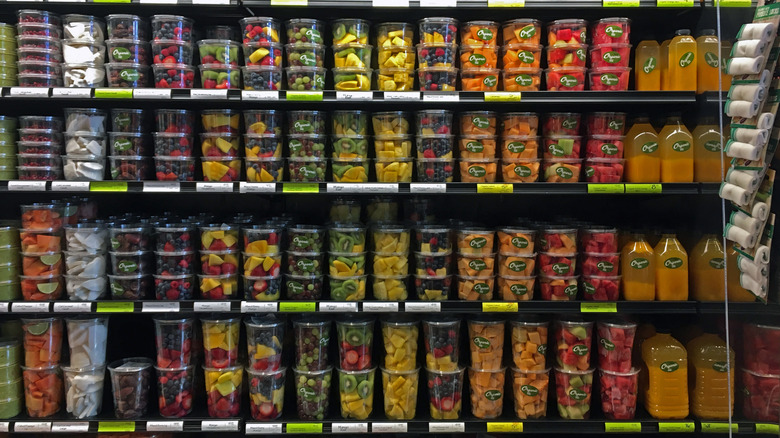
The Whole Foods produce department has shelves full of fruits and produce that are washed, chopped, and ready to use. While these containers of food can be tempting to grab, the juice isn't always worth the squeeze. The markup on these products is about 40% higher than the prices on the whole fruits and vegetables. That's a lot to pay to avoid a few minutes of light prep work that can be expedited by investing in a quality vegetable chopper, like this one from the Mueller brand.
A notable exception is the 50% items discussed earlier. It's common to find half-off discounts mixed in among the containers of chopped fruit. With the discount, the chopped fruit can sometimes be cheaper than the uncut variety. In some cases, such as watermelon, the portion sizes are often smaller and since the rind has been removed you only pay for the part of the fruit you eat. Bottom line: buying pre-chopped produce under normal circumstances will drive prices higher, but with a 50% off deal it can be a budget-friendly solution.