

Leaky Dishwasher? Here's What To Check Before Calling The Plumber

A malfunctioning kitchen appliance isn't just inconvenient –- it can also be costly. But that doesn't always need to be the case. When it comes to something like a leaky dishwasher, flexing some DIY skills might prevent you from having to pay a plumber to perform a simple task you could easily handle on your own. According to a brand management senior analyst at Whirlpool, April Taylor, there are a few specific things you should check before calling a professional to fix the problem in the interest of saving your cash.
Two prevailing issues that could cause a leak both involve the door not closing properly. Fixing one of them should only require a few minutes with the help of a common household tool. "If the latch is loose, use a screwdriver to tighten it," Taylor said. "Bent latches will need to be replaced." Water coming from the door of the appliance could be another issue, and thankfully, that's also an easy fix. "If the latch is not the problem, inspect the gasket to see if it is soiled, loose, or damaged. Loose gaskets can be secured back in place," Taylor said. "If soiled, use mild soap, water, and a sponge to clean it. Damaged gaskets will need to be replaced."
If the door isn't the source of the leak, it could be the water line. You'll need to shut off the power and the water going to the dishwasher before checking this, but if the water line is the culprit, the fix could be as simple as tightening a hose. "Remove the lower kick panel and keep note of its position," Taylor said. "Once the dishwasher water line connection is located, inspect the connection and check for any dampness. If needed, tighten the hose using pliers."
Did you accidentally sabotage your dishwasher?
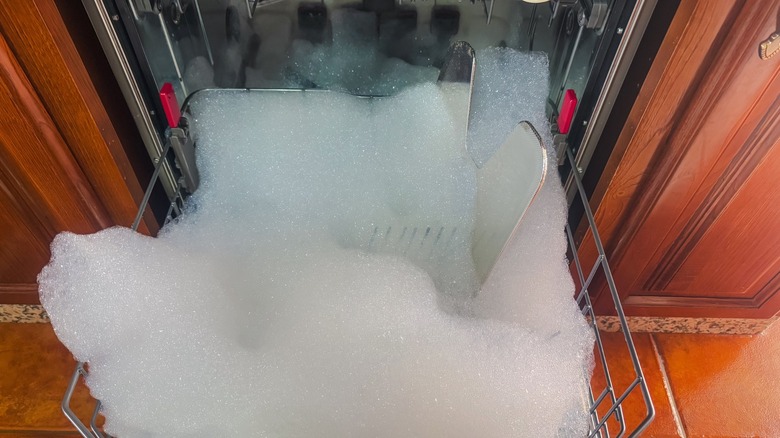
Faulty gaskets and water lines that cause a dishwasher to leak could be chalked up to general wear and tear, but sometimes the problem stems from human error. Not adding enough detergent to the appliance could leave you with slightly soiled plateware, and putting in too much can make your glasses cloudy. However, using the wrong kind of cleaner can cause your unit to start sending a bubbly mess all over your floor.
If you unwittingly put soap intended for handwashing dishes in the dishwasher, April Taylor illustrated how to get your unit back to working condition. "Once the excess suds are noticed, turn off the dishwasher and allow the suds to dissipate. Remove dishes and add ¼ cup of vegetable oil to the bottom of the dishwasher and run a quick cycle with no dishes or detergent," she said. "Repeat as needed if there are still soap bubbles present at the end of the cycle."
Another issue that you can inspect yourself is the drain line connection. "Once the drain hose is located, check to see if it is positioned properly," Taylor said. Your unit's owner's manual should point you in the right direction to find the drain line. One of the other biggest mistakes people make with dishwashers is not cleaning the filter. When it's dirty or clogged, it can give your dishes a funky smell after a cleaning cycle. However, there is another filter hiding in the drain line. If a clog in that filter is creating a leaky dishwasher, it might be time to throw in the DIY towel. "A clogged drain hose may require professional support," Taylor said. Essentially, if initial troubleshooting steps don't fix the problem, it's probably time to accept that a bill from a plumber is coming your way.