

Nestlé's Old-School Lion Chocolate Bar Was Originally Marketed Specifically To Men
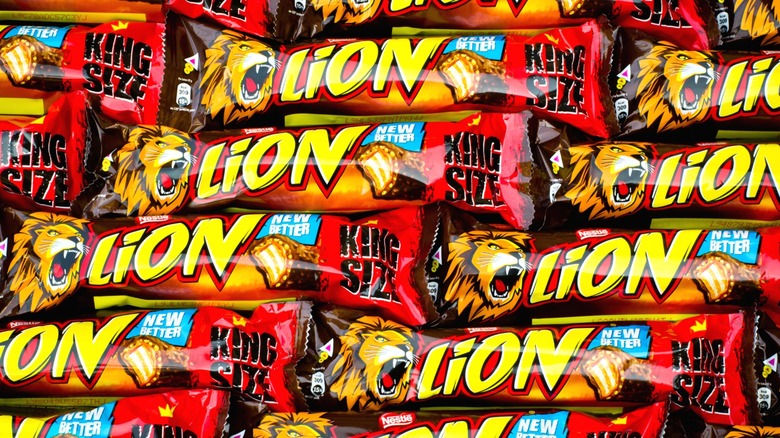
How do you get men to buy your product? You can always take the Axe (or Lynx) route and suggest that your product will make you irresistible to women. You can even take the ill-advised path of Dr Pepper 10 and straight-up say that your product isn't for women. (This is a bad idea for many reasons, not the least of which is that you don't want to alienate half of your potential customer base.) Or you can do what Nestlé did and just put a big, cool, roaring lion on the packaging so men will buy it — an approach which worked for its Lion chocolate bar. For a while, at least.
Mind you, Nestlé wasn't the one who invented the bar. Lion was the product of a British candy company called Rowntree's, a onetime competitor of Cadbury (whose chocolate bar offerings we ranked here), and was first sold in 1976. When Rowntree's was bought by Nestlé in 1988, production shifted from the northern English city of Newcastle to the French city of Dijon (hopefully without any cross-contamination from the mustard factories which make the condiment Alex Guarnaschelli can't live without). The original ads were punchy and irreverent in a late-'70s kind of way, with footage of a leaping lion in the savannah and a gravelly-voiced British man commanding you to "bite it, crunch it, chew it." But as tastes evolved over the years, so too did the idea of what young men considered "cool."
Lion went all out to impress young men
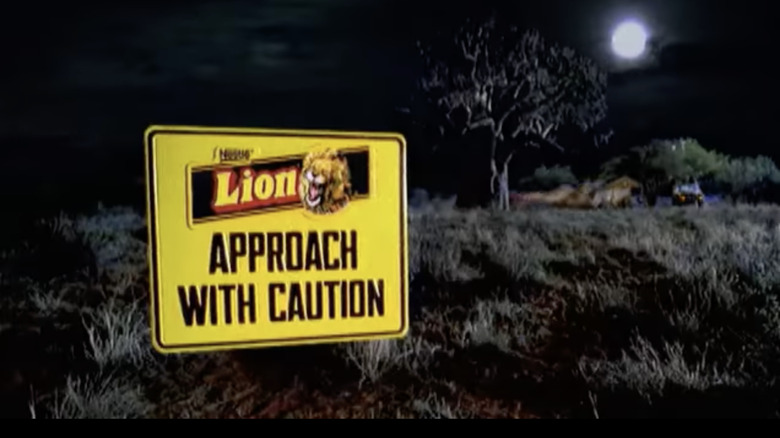
Is it silly to gender-essentialize something like chocolate? Yes, it is. But studies have shown that chocolate is often seen as a feminine product — a notion that gains support when you consider those Godiva ads which are only a step or two removed from perfume commercials. Chocolate is also considered childish, the domain of Bart Simpson or Chance the Rapper. So how do you convince your audience of men (and boys who want to feel like men) to buy your little candy bar? With a bunch of edgy, vaguely nonsensical ads, of course! These spots alleged that taking a bite of Lion could make you do parkour to impress the ladies, or ward off a cobra slithering into your tent at night. It could even turn away a search party hunting you and your friends, for some reason.
In the mid-2000s, Lion further targeted its outreach to teenage boys. They set up displays in shopping centers across the United Kingdom, where people in combat gear would stand around a cage with four openings. Curious customers could reach in and pet what felt very much like lion's fur, whiskers, and even a couple of lion kittens (presumably not real ones) before grabbing a Lion bar. Did this outreach work? Well, sales of Lion bars plummeted over the next decade, but that had more to do with consumer habits trending towards healthier options than anything to do with the ad campaigns. And they still make Lion bars, unlike some other old-school candy bars, so that's a small victory in and of itself.