

Why Microwaves Have That Strange Mesh On The Door
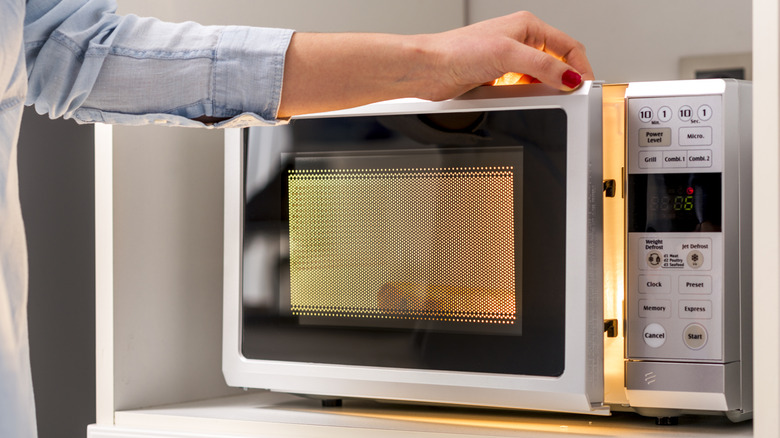
Microwave ovens are a fixture of modern kitchens, used by millions of Americans every day for making movie theater-worthy microwave popcorn and reheating leftovers. However, these mundane yet miraculous devices remain quite mysterious, and frequently inspire questions like, for example, what is the point of that mesh screen on the door? If you've ever squinted through a semi-opaque microwave door trying to ensure that your oatmeal isn't bubbling over, you may have wondered if that mesh actually serves a purpose. It turns out that, unsurprisingly, the strange metal mesh on a microwave door isn't just for decoration — in fact, it's vital for both the safety and function of the microwave.
The metal mesh in the door keeps radiation restricted to the appliance while allowing you to (kind of) keep an eye on your leftovers. Most microwave ovens emit a frequency wavelength of about 12 centimeters — or just under five inches — while visible light has a much shorter wavelength of 380 to 700 nanometers. (For comparison, a sheet of paper is roughly 100,000 nanometers thick). The holes in the metal mesh are small enough that microwaves can't fit through, but light can. This means the microwave radiation bounces off the metal mesh and keeps heating up your food, rather than escaping into your kitchen and cooking things outside of the microwave.
Why the mesh on a microwave door is functional
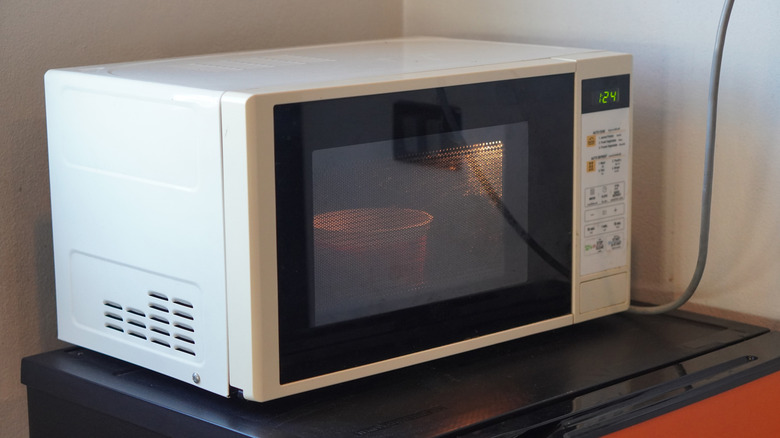
Clearly, the mesh in your microwave door is an important safety feature, but it's also vital for the proper function of the appliance. Microwave ovens work by reflecting microwaves off of the metal-lined walls (that's why you shouldn't put metal in a microwave). These microwaves are absorbed by water molecules in your food, thus heating up your precious leftovers. If one side of the metal structure is missing, the microwaves won't bounce around evenly, and the appliance won't heat your food effectively.
The metal mesh in your microwave door is one of many safety features that keep microwaves inside the microwave oven where they belong. Luckily, even if microwaves do somehow escape, it's probably not as dangerous as you think. Microwave ovens use non-ionizing radiation, which can heat things up but isn't strong enough to remove electrons. In other words, you can rest assured that microwave ovens won't turn your food — or anything else — radioactive. If you're still concerned about microwave safety, there's a much higher chance of you accidentally burning yourself or starting a fire, which is what could happen if you put the wrong things in a microwave.