

The Classic Beverage Brits Couldn't Get Enough Of Before Tea
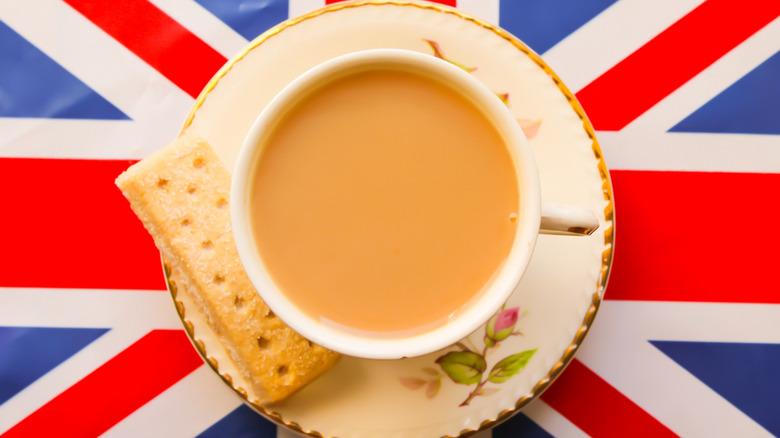
If a hypothetical "Family Feud" question asked you to name something British people like, "tea" would be right at the top of the board, followed by "sausage rolls," "standing patiently in a queue," and "TV shows that only have four episodes a season." Although sales data reported by the BBC suggests that fewer Brits drink tea than in the past, it's still a source of national pride, whether you're brewing a pot of Earl Grey for your afternoon tea or enjoying a cup of English breakfast while eating a full English — which, in sandwich form, is Gordon Ramsay's hangover cure. But believe it or not, there was a time when tea was a distant second to Great Britain's first favorite drink: coffee.
Neither tea nor coffee came from Britain, of course: Tea originated in China before spreading across Asia, while coffee was first cultivated in Ethiopia. Both drinks hit the British Isles at around the same time in the middle of the 17th century, and both made an instant impact — but it was coffee that really caught on. Coffeehouses popped up all over the place, starting in London before spreading outwards and quickly establishing themselves as social hubs. For a while, coffee was even more popular in Britain than ale — and if you know anything about British drinking habits, you know how impressive a feat that is. (Just don't mistake an ale for a lager.)
A revolution, a fungus, and colonialism helped tea triumph over coffee

A few different factors led tea to overtake coffee in popularity among the Brits. The first is that the British East India Company began to import tea directly from China to Britain, allowing the upper crust to enjoy this exotic beverage without a middleman — or with fewer middlemen, anyway. Around the same time, Britain also started to grow tea in its Indian colonies. This tea was then sold around the world, helping establish Britain as the world's dominant empire. In this sense, drinking tea was not only tasty, but downright patriotic. (So long as you're willing to ignore the horrors of colonialism, of course, which the British public was happy to do.)
But this is about coffee faltering as much as it is about the triumph of tea. You see, in the 18th century, more than half of the global coffee supply came from slave plantations in Haiti, where torture was routine and slave owners decided it was good financial sense to work slaves to death and simply buy new ones. Understandably, a revolution broke out, and the rebels achieved victory in 1804 — wonderful news for Haiti, but not so much for the coffee supply chain. On top of that, a fungal disease called "coffee leaf rust" wiped out British attempts to establish coffee plantations in Sri Lanka. By then, tea's victory over coffee was secure.