

The Best Way To Slice Bread Without Crushing It
We may receive a commission on purchases made from links.
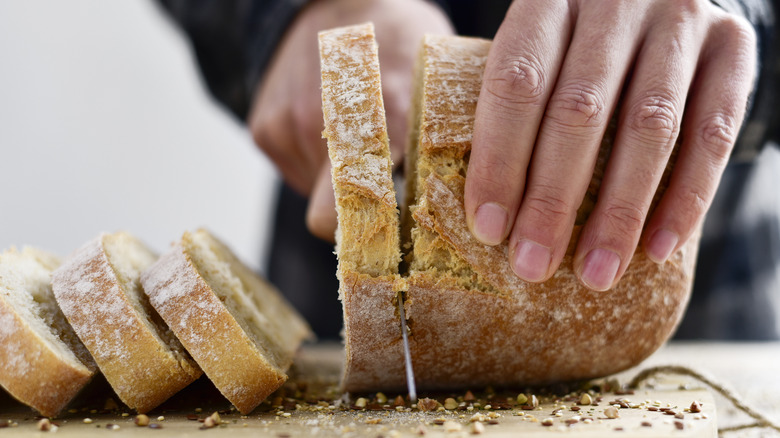
Calling something the "best thing since sliced bread" isn't just an idiom (at least, it isn't to us). Americans apparently consider sliced bread the best thing in and of itself: We eat approximately 53 pounds of bread a year, and if you figure that the average loaf of bread weighs one pound and generates between 16 and 24 slices, we eat ... well, we eat a lot of bread slices. Sadly, your homemade bread or certain gourmet breads don't come pre-sliced like the commercial kinds. And if you've ever tried slicing up bread, you may have also squished it by accident when you pressed in with the knife and the whole loaf sank. Is there a right way to cut bread? We spoke to Shanna Jantz Kemp, knifemaking pro at knifemaking.com, who confirmed that there is indeed a method.
According to Jantz Kemp, you should be using a specific knife with a specific technique: "A long, sharp serrated knife is essential for crusty bread because it breaks through the hard crust before the soft interior gets compressed. Using a gentle back-and-forth motion rather than pressing down keeps the crumb intact and the slices clean." Unlike regular knives, serrated knives have saw-like teeth instead of a smooth edge, and you cut with them exactly as if you were using a handsaw. It's considered the only type of knife you should use for cutting sandwiches, and that's because the unique sawing approach won't place so much downward pressure on the bread.
Saw the bread with a serrated knife
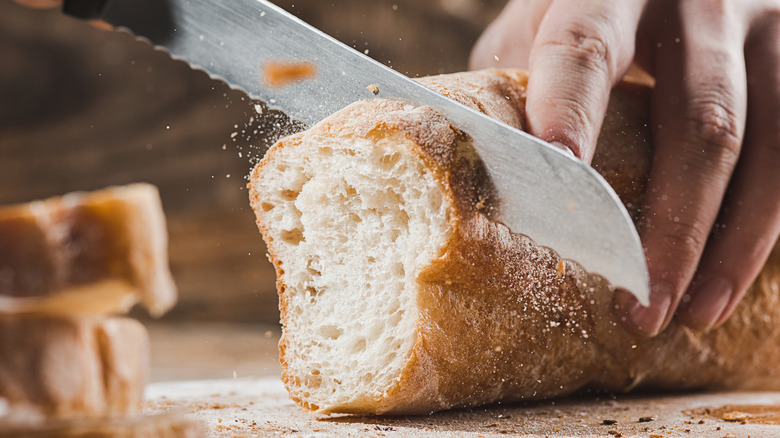
Adding a serrated knife to your kitchen arsenal isn't all you can do to avoid crushing your bread while cutting it. Keeping the bread cool before you slice it, rather than cutting it when warm, can also help preserve the bread's structure, although stale bread will be tougher to slice than fresh bread. According to Jantz Kemp, stability matters just as much as the knife: "Rest the loaf on a non-slip surface and hold it lightly. Gripping too hard or forcing the blade is what causes the bread to collapse before it's fully cut." This non-slip surface can be a towel or a non-slip pad for your cutting board, which won't require you to grip the bread so firmly.
Finally, you can try turning the bread loaf onto its side, or even upside down. According to Jantz Kemp, "Slicing bread on its side can reduce crushing because the pressure from the knife is distributed across the loaf rather than driven straight down into the soft crumb. The side crust provides extra structure while you cut." You'll need to take extra care to hold the bread steady while sideways (as always, keep your fingers away from the knife), but it'll help you use that saw-like cutting method more efficiently. Once you've cut your bread loaf, you have fresh slices for toast (and French toast), sandwiches, bread pudding — you can even clean your kitchen with it (and yes, we are serious).