

The Cut Of Beef You Should Never Pass Up At A Brazilian Steakhouse
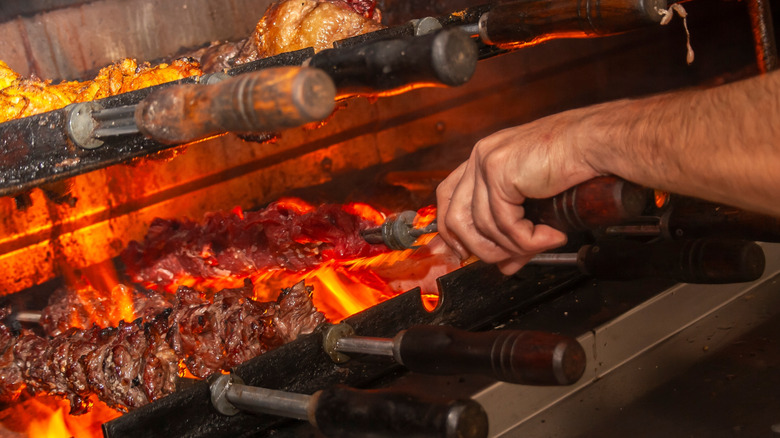
For the uninitiated, a Brazilian steakhouse can seem like an overwhelming experience. From the baskets of bouncy and chewy pão de queijo dinner rolls made with tapioca dough and plenty of cheese to the seemingly endless parade of proteins, I won't blame you if your head feels like it's on a constant swivel. In situations where you're faced with an all-you-can-eat scenario, you're going to have to make some tough decisions, which is why I'm making one for you: Of all the meats at a Brazilian steakhouse, whatever you do, don't skip the picanha.
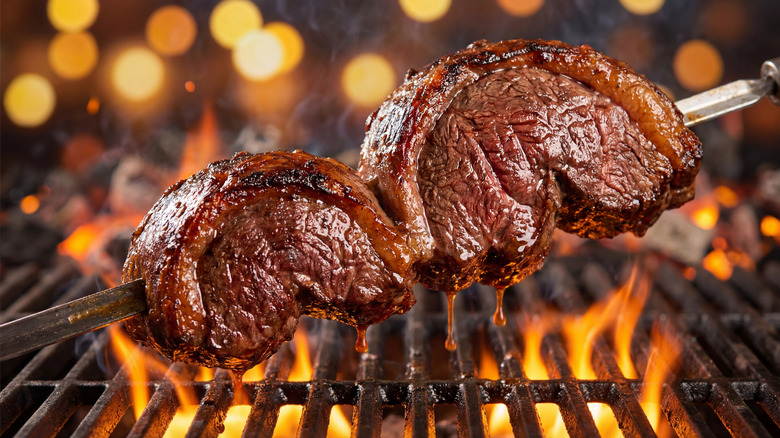
Picanha, otherwise known as the rump cap, is located, yes, by the rear end of the cow, near the tail. If we're getting a little more anatomically specific, it's known as the biceps femoris, aka the hamstring. By nature, this unique cut is lean, but its signature feature at the Brazilian steakhouse is that the fat cap is left on it. You'll know that the servers (known as gauchos or passadores) are bringing along the picanha when you see a roughly half-circle cut of beef, so make sure you flip your indicator to show that you'd like a slice or three. It's one of Brazil's most popular cuts, and when it's cooked properly, you'll be rewarded with a juicy bite along with that coveted bit of fat at the end to balance things out.
Picanha is not a common cut of beef at American steakhouses
For some reason, picanha just isn't that popular in the United States, though these days, if you're looking to cook it yourself, any specialty butcher shop will know exactly what you're asking for. A potential reason why picanha might not be popular is that the majority of the beef itself is lean, and when Americans are after the best steakhouse experience, a flat and marbled cut of beef such as a ribeye is what they'll ask for when ordering steak. Also, in the U.S., the rump is typically divided into other cuts, including the round.
It's also possible that the visibly prominent fat cap on the picanha is a turnoff for some, though when it's skewered and cooked over an open flame like it is at a Brazilian steakhouse, the rendered fat naturally bastes the exterior of the meat, creating an ideal crust. When picanha is served to you, it's always cut thinly, so ideally it won't be chewy. Honestly, I think it's a slept-on cut and definitely worth trying because of its rarity at most American restaurants. There's a reason why an entire country prefers this cut of beef, so jump on it when you see it come to your table.