

Why Walmart's Ice Cream Sandwiches Never Seem To Melt
We may receive a commission on purchases made from links.
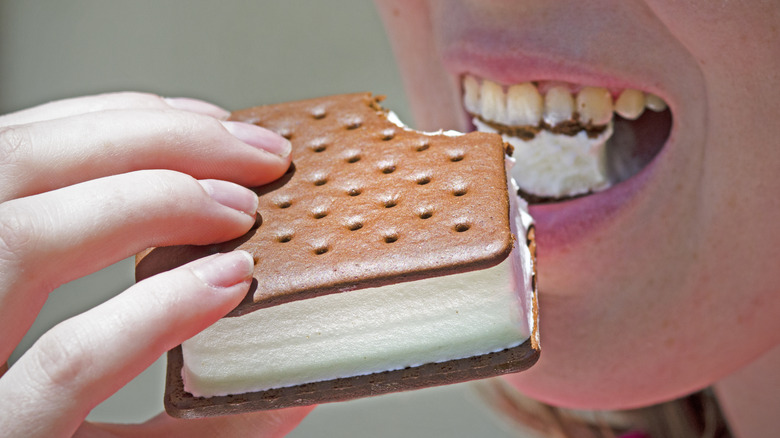
It's been floating around online for years that Walmart's Great Value ice cream sandwiches never melt. They do in fact melt — and not by going to extreme measures like leaving them out in the sun or nuking them in the microwave. They melt just as any other ice cream sandwich does when left at room temperature for a bit. The internet rumor that these sandwiches are "unmeltable" might have started when someone noticed the treat was holding its shape as it began to soften. This is due to two main reasons: the high-fat content in the ice cream and the added stabilizers and emulsifiers, which include carob bean gum, cellulose gum, carrageenan, mono and diglycerides, and food starch-modified (similar to the ingredients you'll find in McDonald's ice cream).
When ice cream contains fat, it melts more slowly, therefore holding its shape longer. So what's the need for stabilizers and emulsifiers? Fat alone cannot provide the amount of stability needed for a commercial ice cream product. Using stabilizers and emulsifiers is common when manufacturing ice cream — the additives hold everything in place, helping the ice cream maintain its structure and preventing large ice crystals from forming (freezer burn). Ice cream products can endure temperature fluctuations while making their way to the freezer section of grocery stores (and from the stores to your freezer at home). The ice cream's higher-fat base, combined with several stabilizers and emulsifiers, creates a product that softens gradually and holds its shape unusually well — giving the illusion that it never melts.
Why stabilizers are standard in ice cream

Great Value's use of stabilizers and emulsifiers in its ice cream sandwiches doesn't reflect its quality. Popular brands like Blue Bell, FatBoy, and Tillamook all include these additives in their ice cream as well. The use of emulsifiers and additives really comes down to maintaining the shelf life of a highly perishable product.
Stabilizers and emulsifiers aren't just unique to ice cream sandwiches either; they appear in a variety of packaged foods, including yogurt, salad dressings, and even baked goods. Despite how common they are, you may want to avoid or limit emulsifiers if the additives don't agree with your digestion, or if you simply prefer to eat foods that are minimally processed and made with natural ingredients. For these consumers, brands like Jeni's avoid the use of artificial stabilizers and instead use ingredients like cornstarch to maintain the ice cream's rich texture. You can also make your own ice cream sandwiches at home, or simply choose products with fewer additives (just avoid our least favorite vanilla ice cream brand).