

The Secret Ingredient To Get More Sour In Your Sourdough
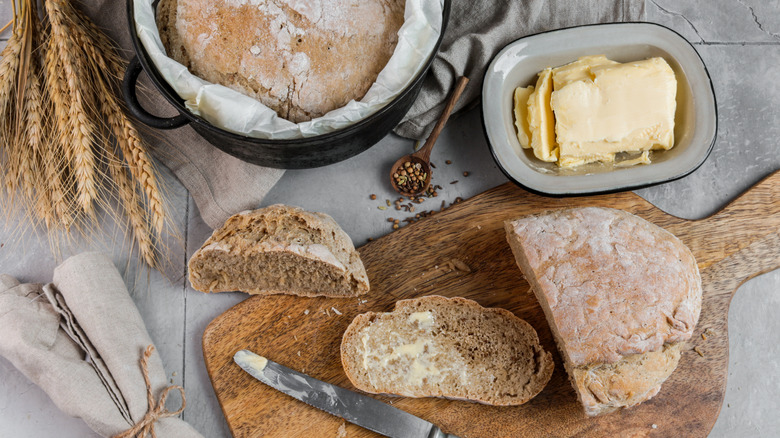
Lockdown sourdough insanity is behind us, but love for the tangy bread never went away. With tradwifery, slow food, and grocery prices all on the rise, making your own sourdough has never been more trendy, and these days it doesn't come with cabin fever. Once you've made your sourdough starter and found a recipe that gets you loaves rather than bricks, though, questions remain. Like, how can you maximize that signature sourdough taste in your bread?
That's exactly what we asked Erik Fabian, co-founder of Sourhouse, a one-stop shop for sourdough baking advice and products. Fabian offered an easy solution for bland bread: rye flour. To get a deliciously sour, San Francisco-style loaf, he suggests that home bakers "try using a mature stiff/dry starter made with rye flour" and then "ferment it slowly at temps in the high 60s."
Fabian also advises using "a significant amount" of rye flour in the bread dough too, as well as whole wheat. Mixing rye flour with whole wheat is a good idea because rye doesn't have a lot of gluten, so it won't hold together for a free-form loaf and will produce dense bread. What rye lacks in gluten, however, it makes up for in the nutrients and microbes a starter needs to thrive, ferment, and produce the compounds that make sourdough taste like sourdough. Once you've made your dough, those compounds need some more time to do their thing, which is why Fabian tells us to ferment it slowly at a similar temperature to what the starter fermented at.
Rye and time are the secret to sour bread, but you can leave your dough too long
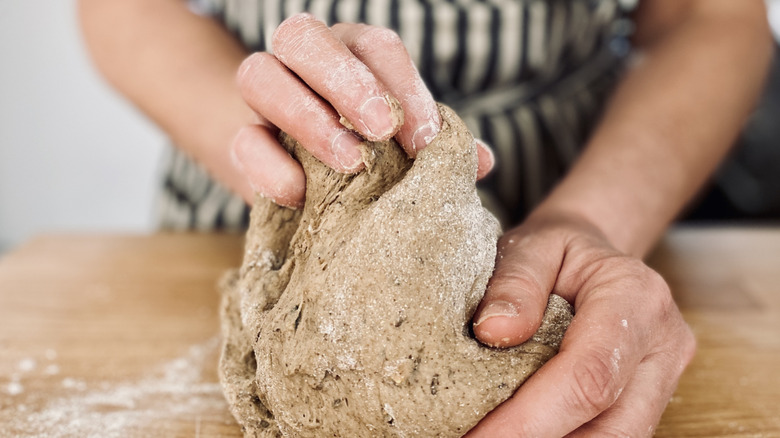
A loaf of sourdough generally ferments anywhere from eight to 24 hours, according to Erik Fabian. And he prefers a slower fermentation at lower temperatures because "the extended time creates deeper, more complex flavors as the carbohydrates break down into simpler sugars and those sugars are fermented." But be careful of leaving it for too long — there's such a thing as pushing it too far.
He warns, "Eventually fermentation will break down the gluten to the degree that it cannot hold the shape of a loaf. It will develop overly sour, off flavors." Unfortunately, there's as much art as science to sourdough, so Fabian believes "the best way to learn is to intentionally push a dough to the extreme and see what happens." Just like learning to feel and see when the level of gluten is right in kneaded dough, you'll start to recognize dough that's perfectly fermented by sight, smell, and touch.
If you want a very slow, set-it-and-forget-it solution to making San Francisco-style tart sourdough, there is one. Fabian says, "Doughs can be held during the second proof in the fridge for ~3 days ... and still make fine bread." Slow food doesn't get much slower than that!