

What You Need To Do If Your Blender Always Smells Like It's Burning
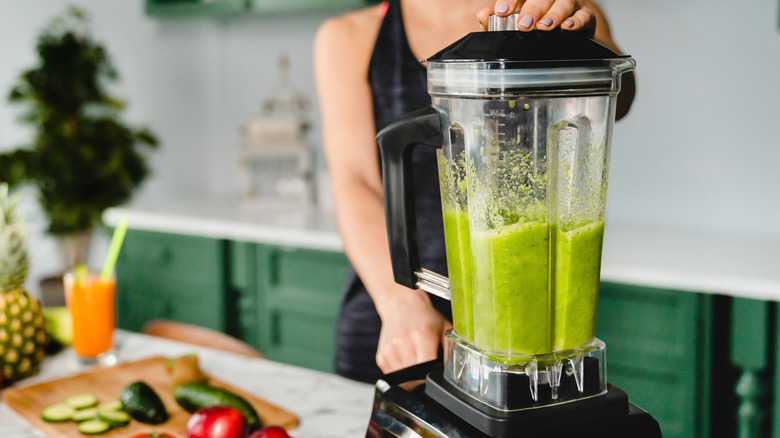
If you're a frequent user of a home blender, chances are you've faced an issue or two that has impeded your ability to operate this useful home appliance. There are many mistakes you can make with a blender which will impact your food, but a blender emitting a burnt odor is something you need to be aware of even if it has minimal impact on the actual taste of what you're blending. We spoke to Megan Scrivner, the culinary director at Chefman, who gave us insight into what you need to do if your blender has a burnt smell. Scrivner told us there are two primary reasons why this happens — overworking the motor and worn-down motor brushes.
As far as overloading the motor is concerned, this usually happens due to a lack of liquid, which causes the motor to work overtime to properly shred the thicker, denser ingredients. Alternatively, dealing with worn-down motor brushes is a much more internal, unavoidable issue. "Blenders rely on brushes riding against a spinning commutator to conduct electricity," Scrivener explained. "Over time these brushes can wear down, which would cause a burning smell." This is concerning as it likely means you'll need to replace the brushes on your blender's motor (if possible) or find a new blender altogether. "If the smell is caused by the density of the ingredients, adjusting the recipe should solve the problem," Scrivener added. "If the smell persists after adding sufficient liquid, it's time to start researching new blenders."
How to prevent your blender from smelling like it's on fire
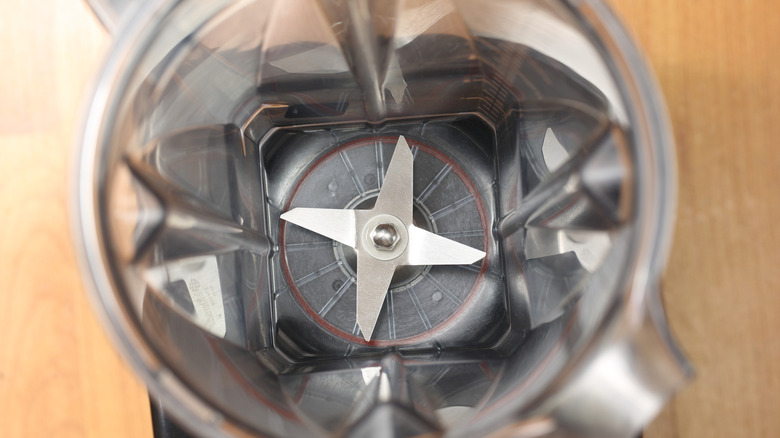
If the blender's motor is in trouble, you can always look for a replacement blender in Costco's incredible small appliance section. However, if your blender is not particularly smelly just yet, there are a handful of strategies you can use to ensure this never becomes an issue in the first place. For starters, the order in which you add your ingredients is key. "It should be liquid first, followed by soft foods and then hardest foods at the top," Scrivener explained. If you need to blend denser items, she recommends using the pulse setting to limit the strain on the motor. However, seeing as blending dry ingredients is the job of a food processor rather than a blender, you should still generally refrain from blending ingredients without enough liquid.
Beyond that, however, the best way to avoid getting this unwanted smell is to buy a better blender, as these are more likely to have more durable motors that are equipped to handle harder-to-blend ingredients. "The motor matters," Scrivener noted. "Invest in a blender with an all-metal drive shaft ... This limits friction, increasing blending power & preserving the life of the motor." She also explained that certain blenders are designed to help keep your motor from overheating. "Look for a blender with overheat protection," Scrivener added. "This will shut off the motor & force a cool-down rather than allowing it to overwork and degrade."