

Dupe Detective: Are Great Value Sweet Hawaiian Rolls Better Than The Real Thing?
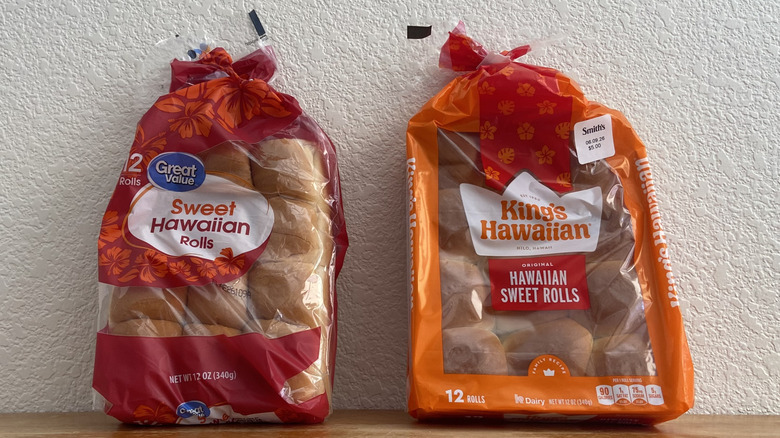
Welcome back to Dupe Detective, a column where I'll be reviewing a name brand food product's competitor product to find out how well it compares to, or even beats, the original.
While King's Hawaiian makes a range of products including seasonings, sauces, and even Minions Shake 'Em Banana Bites, the brand is, more than anything else, synonymous with its Hawaiian Sweet Rolls. The subtle touch of sugar makes it a favorite for everything from savory sliders to gooey cinnamon rolls for the sweet breakfast pastry of your dreams.
It's so surprise that the beloved Portuguese-inspired treat have inspired plenty of competitors including Walmart, which packages its "sweet Hawaiian rolls" under the proprietary Great Value label. But is the behemoth chain able to find to sweet success with its cheaper dupe or does King's Hawaiian reign supreme? I tasted tested the two products in order to find out which version takes the crown.
Taste test: Great Value Sweet Hawaiian Rolls
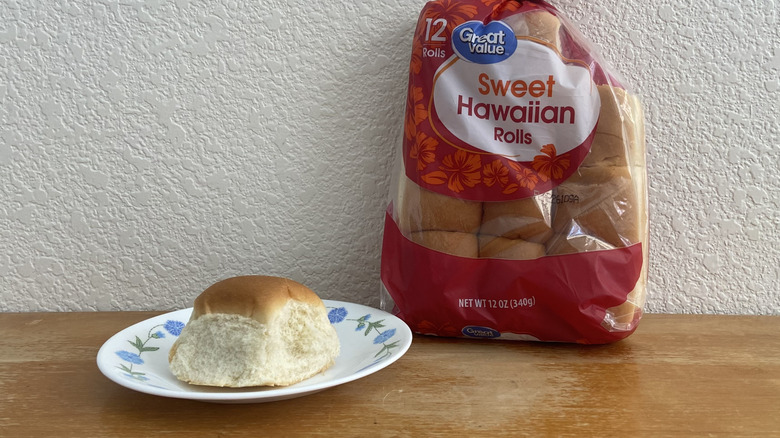
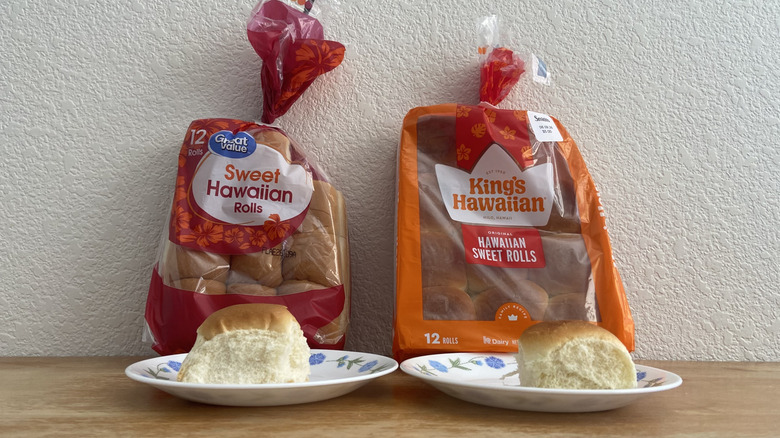
The first thing I noticed about the Great Value Sweet Hawaiian Roll was that it was dry. Due to that texture, larger bites became a little mealy over time. I've never had that issue with a King's Hawaiian Sweet Roll, so that stood out to me as an immediate difference.
In the flavor department, I found Walmart's version to taste more sugar-forward — at the expense of other flavors — than classic King's Hawaiian Sweet Rolls. That said, each Great Value roll has just 1 gram of sugar, thanks to the inclusion of sucralose, whereas each King's Hawaiian roll contains 5 grams of sugar. I tried adding butter to my second roll which remedied the dryness issue but ended up masking a good deal of that sweetness. I really enjoyed that pronounced sugariness in my plain roll, so the ease with which that flavor disappeared with the addition of butter wasn't ideal.
Also of note is the fact that the Great Value rolls are dietarily permissible for vegans for whom yeast isn't a deal-breaker, whereas King's Hawaiian rolls are coated in an egg wash.
Taste test: King's Hawaiian Original Hawaiian Sweet Rolls
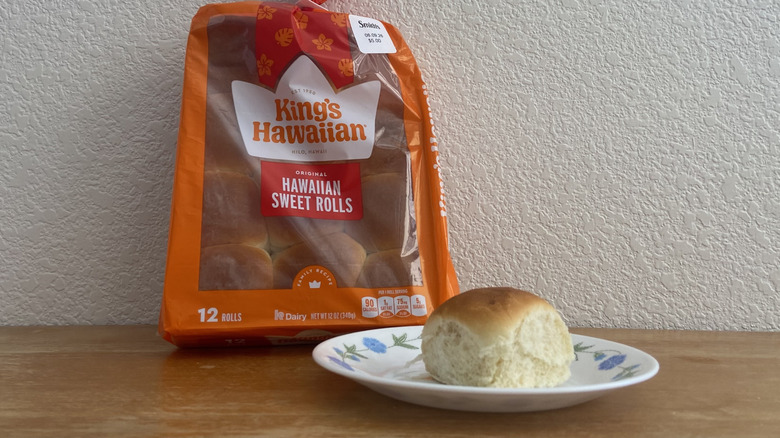
My first King's Hawaiian Sweet Roll was, as expected, quite a bit more dense than my Great Value sweet rolls. Paired with that density was ample moisture, such that each bite was simultaneously weighty and soft. For a sweet bread roll, it was a pretty ideal texture. That difference was even perceptible visually — my Great Value sweet rolls were lighter and paper-ier in appearance, whereas the originals looked richer and fluffier.
I found the flavor of my plain King's Hawaiian roll to balance a few different components, contrasting with the single-mindedly sweet flavor of my Great Value rolls. While enough sugar came through to justify its classification as a sweet roll, I could also taste an identifiable yeast flavor. Also apparent was the lightly sugary, bready flavor of malted barley. In the aftertaste, sugar became more prominent, lingering on my tongue. When I added butter to my second King's Hawaiian roll, each facet of that compound flavor persisted.
Final verdict: Is Walmart's dupe better or does the original reign supreme?
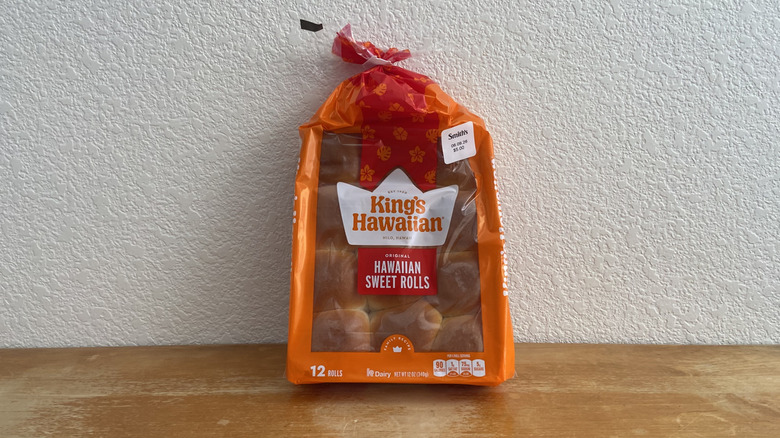
Defining my Great Value Sweet Hawaiian Rolls was a pronouncedly sweet flavor that I really enjoyed, supported by a lower sugar content than their name-brand competition, and even a significantly lower price point. Complicating matters was an inferior texture and the disappearance of that sweetness when I added butter. My King's Hawaiian rolls, meanwhile, were texturally ideal and retained their personality with the addition of butter. However, even if their flavor was more complex, I preferred the simpler, sugary flavor of my Great Value rolls when trying them plain.
Since there were advantages to each kind of sweet roll, a tie might not be uncalled for. But since a tie would feel like a cop-out, I'm giving the win to King's Hawaiian. Even if Walmart's dupe costs less and tastes better plain, I've personally never enjoyed a sweet Hawaiian roll plain outside of this experience. Rather, a sweet Hawaiian roll is typically served with butter at minimum, or perhaps even used as a bun for a slider. They're even occasionally used for the funeral sandwich, a delicious Southern sandwich with a morbid name.
Since the flavor I liked so much disappeared from my Great Value sweet rolls with the simple addition of butter, King's Hawaiian rolls are the superior choice for the majority of situations that call for this type of roll.
How do Walmart's and King's Hawaiian's prices and nutritional content compare?
I purchased a 12-pack of Great Value Sweet Hawaiian Rolls at my local Walmart for the retail price of $2.68. At the nearest Smith's — a brand owned by Kroger, a 12-pack of King's Hawaiian Original Hawaiian Sweet Rolls costs $5 even. Great Value sweet rolls, then, handily win out in the price department.
Nutritionally, one Great Value sweet roll totals 70 calories, 0.5 grams of fat, 130 milligrams of sodium, 13 grams of carbs, 1 gram of sugar, and 2 grams of protein. One King's Hawaiian sweet roll, meanwhile, equals 90 calories, 2 grams of fat, 1 gram of which is saturated fat, 15 milligrams of cholesterol, 75 milligrams of sodium, 15 grams of carbs, 5 grams of sugar, and 3 grams of protein. So, for lower calories, less fat, no cholesterol, and less sugar, the best choice is Walmart's Great Value brand. For significantly less sodium, King's Hawaiian rolls are nutritionally superior.
Methodology
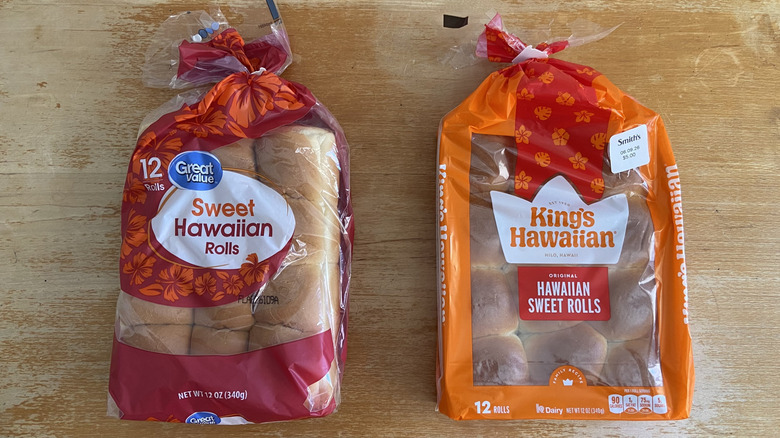
I purchased my 12-pack of Great Value Sweet Hawaiian Rolls from a Walmart Neighborhood Market in the suburbs of Las Vegas. Then, I visited the closest Smith's to pick up a comparable 12-pack of King's Hawaiian Sweet Rolls. Since both products are sold at room temperature, I tried them as soon as I got home with no prior preparation.
First, I ate one of each sweet roll plain, alternating between the two products so I could best compare them to one another. Then, I brought out a tub of butter from Costco and ate one more of each kind of roll buttered. Additionally, I enjoyed a few more rolls with lunches and dinners, which helped me further solidify my opinions. My thoughts on each product are based entirely on this experience, and not any prior impressions I may have had of either product.