

Why Some Boomers Habitually Overcook Their Food
Growing up, I loved my grandmother's slow-cooked, Southern-style green beans. The beans were saturated with bacon fat and melt-in-your-mouth soft. Beans like those are hard to find now. I'm always disappointed when I order green beans at restaurants; tough and leathery is the texture du jour.
Modern chefs might say my grandmother's green beans were overcooked. I disagree, but I'll admit that boiled veggies and steaks served well-done were favorites of my grandmother's generation. I'll also admit that not all foods benefit from hours in the Crock-Pot. Why do so many boomers seem to believe that the best Brussels sprout is a boiled Brussels sprout?
There isn't one single reason why boomers overcook their food, but 20th century cooks weren't just serving up overcooked food for the fun of it. While cultural tastes did play a role, there were practical reasons why older generations tended to cook meat and vegetables until well past the point where 21st century cooks would consider them done. The lives of our parents and grandparents were influenced by the harsh economic realities and health standards of their time, and they adapted their cooking methods accordingly. Overcooked food was a way to keep your family safe and fed, and that trumps a personal taste for rare steak any day.
Overcooking served a practical purpose
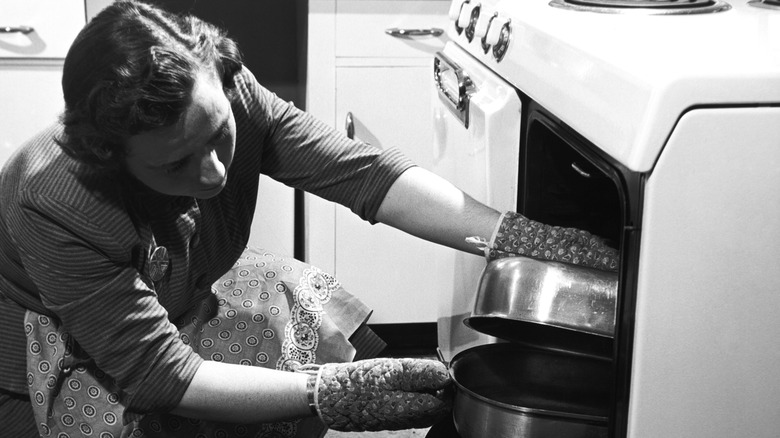
Boomers might not have experienced the Great Depression firsthand, but their parents and grandparents did. Great Depression-era cooks had to stretch food as far as possible, and that meant adding leftovers to stews and casseroles, cooking overripe fruit down into preserves, and slow-cooking tough cuts of meat until they were tender. Old habits die hard, and many cooks passed these techniques down to the next generation.
Overcooked food served another practical purpose: safety. Today, the United States has one of the safest food systems in the world as food safety standards slowly improved throughout the 20th century. In 2011, former President Barack Obama signed the Food Safety Modernization Act, the biggest update to American food safety practices since the 1930s. The act gave the FDA new powers that focused on improved surveillance, outbreak prevention, and response and recovery. It was an enormous success: In 2009, the Centers for Disease Control and Prevention documented 13,800 instances of foodborne illness. In 2022, there were 5,600. It's now much safer to eat raw veggies and rare meat.
Since food safety wasn't always a major concern for the United States government, individuals had to take responsibility to keep their families safe. "Cook" is one of the four Cs of food safety, and the longer food is cooked the better the chances are that you've killed all the bacteria you set out to kill. As just one example, during typhoid epidemics cooks were encouraged to boil vegetables to prevent the spread of disease.
Cooking techniques have changed over time
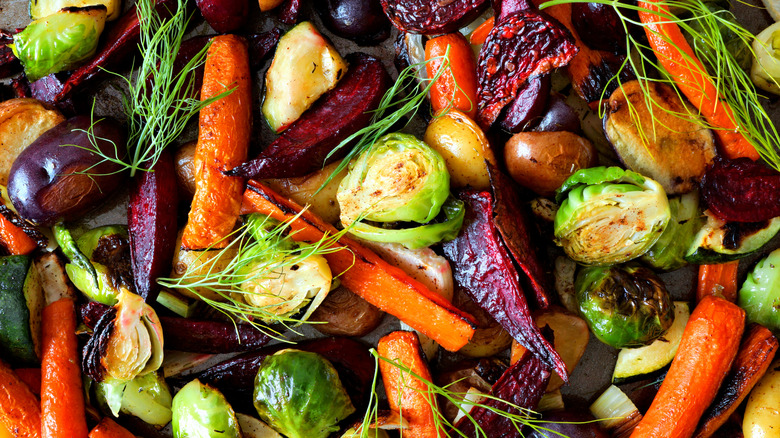
Food safety helps explain why previous generations overcooked their food, but how do you explain their techniques? Throughout the 20th century, boiled vegetables reigned supreme. While boiling has its merits, it's hardly the be-all-and-end-all of food preparation. You'd think those 1950s housewives had never heard of a roasted vegetable before.
It's possible they hadn't, as roasted vegetables are actually a relatively recent trend. In 1993, the New York Times published an article on the novel technique. The Times said that roasting was all the rage among chefs and restaurateurs, and suggested that readers could try roasting vegetables at home. The Food Network launched that same year, introducing millions of Americans to haute cuisine and popular restaurant trends.
Up until then, ovens were largely reserved for cakes, cookies, and oversized cuts of meat. It simply didn't occur to people to try roasting vegetables. Roasting introduced home cooks to crisper textures and more complex flavors, a trend that has since accelerated once air fryers hit the scene.
Some chefs might tell you that roasted vegetables are objectively better, but like it or not our tastes are influenced by culture. Maybe someday our grandchildren will wonder why older generations are so fond of rare steaks and fresh salads, or wonder why it's so hard to find restaurants that serve air fried green beans like the ones Grandma used to make.