

The Carbonated Drink That Glows Blue Under Blacklight
We may receive a commission on purchases made from links.
Let's first move past the idea there is a carbonated beverage that glows in the dark — an ability reserved in most people's minds for deep sea fish and radioactive material. Neither should be associated with drinks, and thankfully neither are the reason why tonic water glows in the dark under the right conditions. The culprit in tonic is, in fact, a natural compound called quinine.
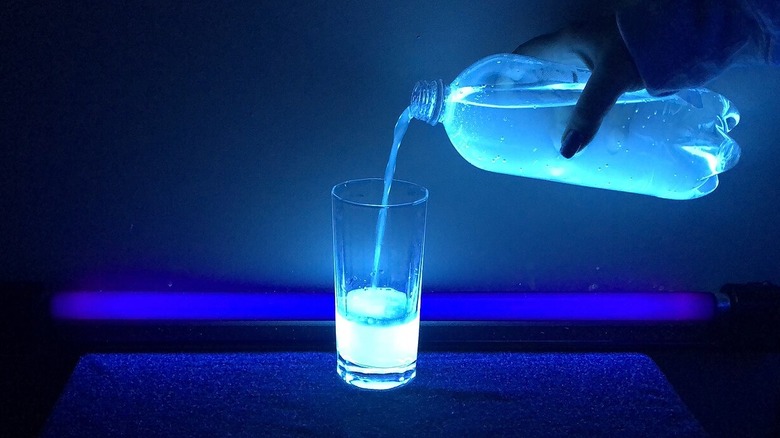
Quinine is derived from the bark of the cinchona tree, a plant native to South America with a long history of medicinal properties and a distinctly bitter taste (which is why tonic differs from seltzer and club soda). Quinine's bitterness reportedly led to the creation of a world classic cocktail, the gin and tonic. British soldiers in tropical regions who took quinine to treat malaria reportedly made it more palatable by mixing it with sugar, soda, and spirits. Intriguingly, quinine also makes tonic glow in the dark when exposed to ultraviolet (UV) light. The molecules in quinine soak up the light, become agitated, and then release a blueish fluorescence.
To experience this phenomenon yourself, simply pour tonic water into a clear glass and place it in a darkened room. Shine a UV black light flashlight on the glass and you'll produce the carbonated equivalent of those cartoonishly trippy black light posters that were all the rage in the 1970s. If you're feeling adventurous and don't mind a little clean up (well, actually a lot of clean up), a 2-liter bottle of room temperature tonic water and a pack of Mentos will create the same thar-she-blows reaction produced when you add the candy to Coke — only this time in a ghostly shade of icy blue.
How to create other glowing colors with tonic water
Blue is all well and good, but can you produce other colors with tonic water? You can indeed, but it requires additional ingredients. Riboflavin (vitamin B2) is also fluorescent, and when seen in UV light it turns yellow-green. If you add a crushed B Complex vitamin or a riboflavin tablet to a glass of tonic water or mix tonic with an energy drink that has a high B2 content the combination will blossom into a ghoulish shade of green that places somewhere on the nostalgic food color spectrum between Hi-C's venerable Ecto Cooler and Gatorade Fierce Green Apple.
There are actually quite a few other liquids that glow under UV light. Some are naturally fluorescent, like chlorophyll (in the form of plant extracts), which turns pink. Meanwhile, due to its riboflavin content, milk will appear bright yellow. Unfortunately, mixing these or other additions to tonic water is more likely to mute the bright blue of tonic water or turn it a murkier, less appealing shade. The results may also be something you wouldn't want to drink.
However, alternating layers of cranberry and orange juices (which separate naturally due to the cranberry's density) added to tonic water will produce a futuristic-looking and entirely quaffable beverage that Jamie Oliver calls a Solar Flare Soda. Of course, you can also add food coloring to tonic water and produce a bright, chemically-toned array of colors, but it isn't particularly scientific and also where's the fun in that? Save it for Easter.