

Where You Can Sample Charles Darwin's Favorite Meat (It's Still A Delicacy)

Americans may be pretty conservative in their protein choices, but what can we do if beef, chicken, and pork are all that supermarkets stock? Perhaps we should be eating more invasive species, but Kroger won't be selling bullfrogs or nutria anytime soon. Still, you never know. Scientists are always engaging in fascinating research studies about food, some of which involve exploring new food sources. Charles Darwin is more known for his hypothesis on evolution, but he didn't just study animals, he also consumed them. On his wide-ranging catch-and-eat list were armadillos, giant tortoises, iguanas, lesser rheas, and pumas. His favorite of all of these was most likely agouti.
Agoutis are large rodents with a range extending from southern Mexico down through Argentina and over into the Caribbean. In appearance, agoutis resemble supersized guinea pigs. This isn't seen as a deterrent, since the guinea pig is another edible rodent that's considered a delicacy in Peru. (Although Pope Leo XIV spent several decades in this country, it's unknown whether he tried the dish, but if he did he's sure to have cleaned his plate.)
Agoutis primarily feed on nuts and seeds, and in turn are eaten by ocelots – and also humans. One reason they're hunted is to prevent them from destroying crops, but they're commonly consumed as food. If you travel to agouti territory, you may need to cultivate the acquaintance of an agouti hunter to get a chance to eat one. Things could be different in the Caymans, though, since an Instagram reel from that country shows agouti stew in a restaurant-style Styrofoam box. This could imply the meat is commercially available there.
Caribbean agouti recipes look rather tasty
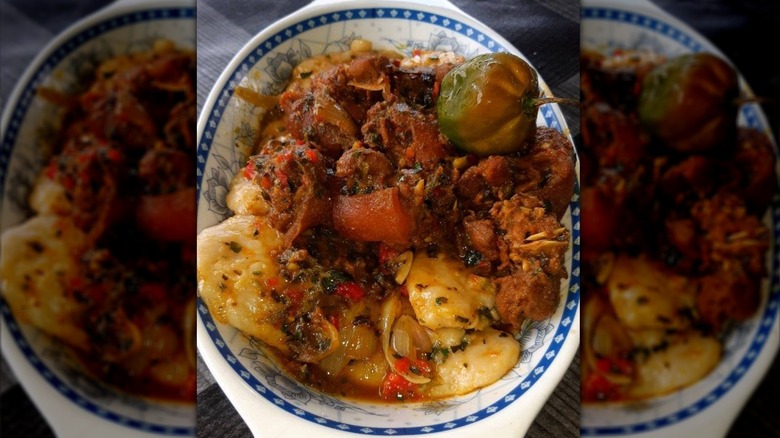
In Charles Darwin's "The Beagle Diary," an entry for September 14, 1832 reads: "To day I shot another deer & an Agouti or Cavy. The latter weighs more than 20 pounds & affords the very best meat I ever tasted." What the diary does not reveal is how the meat was prepared, but the scientist was traveling through Patagonia and probably lacked access to extensive kitchen facilities. It's possible that he simply roasted the animal he'd earlier referred to as the "hare of the Pampas," but think how much more he'd have enjoyed it if it was cooked into a curry as they do in the Caribbean.
In Trinidad and Tobago, agouti is made into a stew with coconut milk and green papaya which is flavored with chiles, chives, cloves, curry powder, garlic, ginger, lemongrass, and onions. Agouti stew from the Dominican Republic is also cooked with curry but has a tomato-based sauce instead of a coconut one and uses vegetables such as bell peppers, carrots, celery, pumpkin, sweet potatoes, and tomatoes in place of papaya. In Guyana, agouti stew is made with breadfruit. Sides served with agouti include boiled or fried yams, rice and beans, and coconut milk dumplings.
No matter how it's cooked, Darwin's not the only one to appreciate the flavor of agouti meat. One Redditor said, "It tastes like a mix between rabbit and wild boar and venison. Really good food." Another commenter enthused, "I have eaten them in the Amazon jungle. Tasty organic free range meat! The best!"