

The US State That Honors Kool-Aid As Its Official Soft Drink
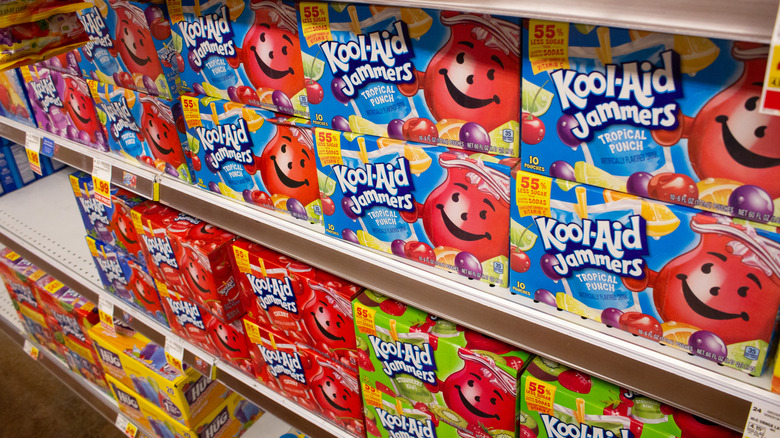
Even now that you can get Kool-Aid in bottles and juice boxes, it doesn't quite detract from the wondrous alchemy of it. All you need to do is take a small packet of powder colored like a poison dart frog, pour it into some water, give it a stir, and hey presto — you've got a delicious, refreshing beverage. And, thanks to its iconic, indestructible mascot, it's got some great PR — enough to make up for being falsely associated with the Jonestown massacre. (They actually used a generic knockoff called Flavor-Aid.) It's small wonder that a state would want to name Kool-Aid its official soft drink, or that said state would be its birthplace of Nebraska.
Now, you'll notice we said "official soft drink" rather than "official beverage." That's because the official beverage of Nebraska, as with 19 other states, is milk, thanks to a lobbying blitz from the dairy industry in the 1980s to get rid of a surplus. (It's also where the "Got Milk?" campaign came from.) But although we're sure many Nebraskans are happy to drink a cold glass of milk with their breakfast, the state is hardly synonymous with dairy. Although they haven't repealed the declaration naming milk its state beverage, the Nebraska legislature did honor Kool-Aid as the state soft drink in 1998, which is far more fitting.
Kool-Aid was invented in Hastings, Nebraska
Kool-Aid was invented by a young man named Edwin Perkins, who became fascinated with Jell-O while working at his family's general store in Hendley, Nebraska, and sought to apply fruit concentrate in other ways. Eventually, he developed a liquid concentrate called Fruit Smack, but was frustrated by the glass bottles it was stored in, which often broke while being transported. By 1927, after a good amount of tinkering in his mother's kitchen in Hastings, Nebraska, he successfully dehydrated the concentrate into a powder, which could be packaged in paper envelopes and sent out to stores.
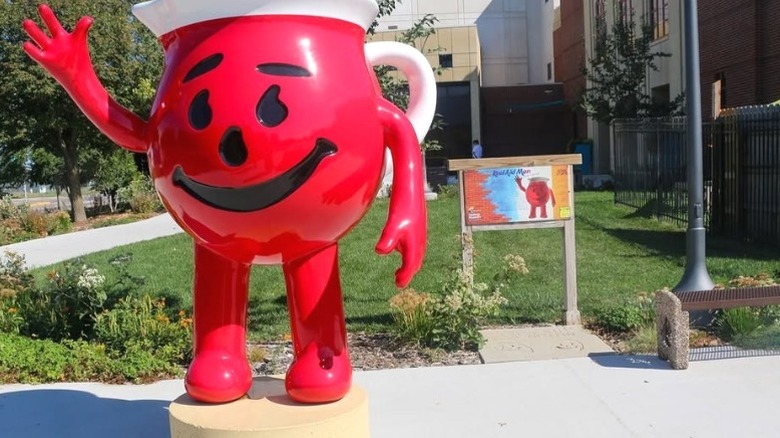
Kool-Aid blossomed in popularity during the Great Depression, where even a struggling family could enjoy a cold, refreshing treat with just a pitcher of water and a 5-cent packet of fruit powder. It made Perkins a fortune, and although he died in 1961, his legacy lives on. The Hastings Museum has a permanent exhibit devoted to the invention of Kool-Aid, as well as the statue of the Kool-Aid Man you see above. Today, Kool-Aid is one of many popular brands owned by Kraft-Heinz, and still colors the tongues (not to mention the hair) of children across America.