

Where Plastic Bags Recycled At Grocery Stores Really Go

Plastic bags are everywhere – you can't go into a supermarket for a loaf of bread without coming out with at least six of them. These plastic nuisances tend to take a roundabout journey from our wastebaskets to our waterways, where they can ultimately be consumed by animals and people, causing harm to both. The World Wildlife Fund estimates that people ingest a credit card's worth of plastic every week.
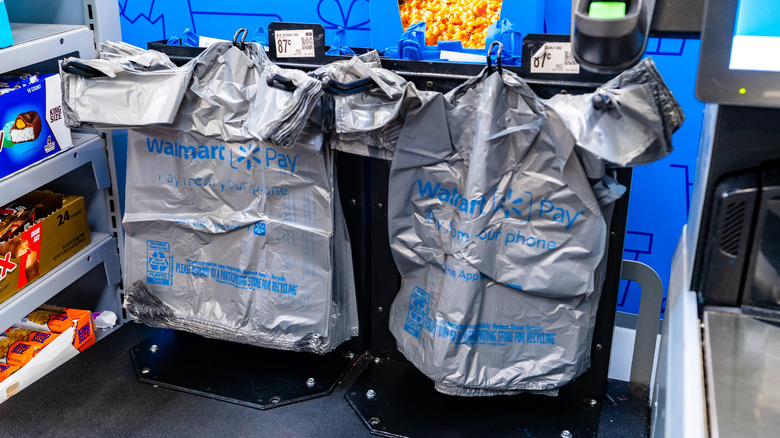
Many stores, such as Target and Walmart, offer on-site bins where you can bring their branded store bags back for recycling ... or so they say. But do they really get recycled, or is that just an empty-plastic-bag promise?
The ABC News investigation team tried to find out. In order to follow the path of the plastic, the team glued AirTags to bags before depositing them in the designated recycling bins at Target and Walmart stores. They then observed the trackers as the bags migrated through various trash disposal paths and arrived at their final resting spots.
ABC reported that of the 46 trackers used, a mere four (around 9%) ended up in facilities that recycle plastic bags. Half of them (23) turned up in landfills or trash incinerators, while seven found themselves at a dead end: in transfer stations that don't recycle or sort plastic bags. Six bags suffered a "failure to launch," never even making it out of the store where they were left. Three bags were whisked away to Southeast Asia, and three others ended up nobody-knows-where (the great trash incinerator in the sky?) because they disappeared without a trace.
ABC's study is not a fluke or a one-off
Rick Gallaher with Faith Alliance for Climate Solutions conducted similar research in Virginia. He tracked plastic bags left at 22 different grocery store locations belonging to seven large grocery chains.
Giant was the recycling hero of the bunch (all three bags tracked were recycled), with Safeway, Harris Teeter, and Food Lion close behind (two out of three recycled). At the bottom of the pile, once again, was Walmart. All its bags ended up in an incinerator or landfill. Target, however, was deemed "uncertain" or "unverified" because the trackers left there soon stopped pinging their location. Gallaher surmises that trackers that stopped working were possibly destroyed during the recycling process, which involves considerable crushing. On the upside, that would mean that they were indeed recycled — possibly good news for the disappearing trackers in the ABC study.
If you're a well-meaning citizen wanting to do right by the environment, you can try bringing your bags back to the store for recycling. But considering that the National Renewable Energy Laboratory says that only 5% of plastic in the U.S. actually gets recycled, going the recycling route might just be a roundabout way of throwing plastic into a landfill. Consider finding clever and handy ways to reuse your plastic bags instead — you can line the trash bin with them or put your wet gym clothes in there. Some particularly creative types have even figured out how to repurpose plastic bags into purses and clothing. Even better, bring a reusable cloth sack whenever you shop and skip the plastic bags altogether.