

12 Regional Names For Sub Sandwiches, Explained
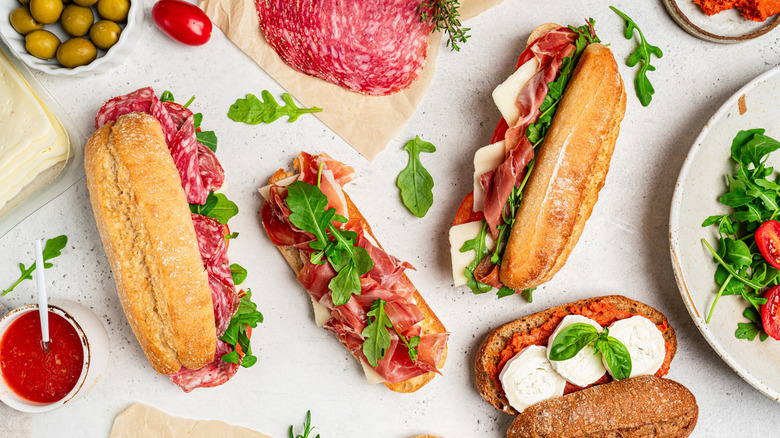
If burgers and hot dogs are indeed sandwiches — an argument better left for social media — there's no doubt they'd sit atop the list of classic American sandwiches. After those, the sub would not be far behind. It's an American icon – not only developed here, but also perfected here. That said, if one were to look for an invention moment or origin point for subs, it wouldn't exist. It seems instead that these sandwiches evolved in parallel along the East Coast, during the second industrial revolution, as a solution for laborers needing a hearty, satisfying meal that was both portable and quick.
Because of this lateral development, a variety of names emerged from regions where the sandwich became popular, many of which remain in use. Submarine, of course, also started as a regional name (see below), but eventually was adopted as the de facto standard nationwide to describe a sandwich on a long roll. One might even argue that nowadays these other versions represent subsets of the broader submarine category, despite minor differences.
Because regional names are often tied to points of pride or nostalgia, the people who use them often do so with fervor. As such, let's take a look at some of the most prominent sub name alternatives, and learn how they fit within the grand scheme of American sub culture.
Submarine (sub)
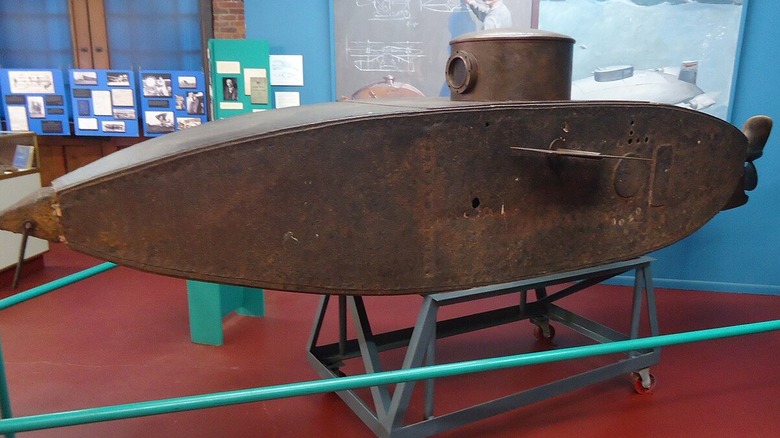
One commonly shared submarine sandwich origin story suggests that the name derives from sandwiches eaten at a submarine base in Groton, Connecticut, during World War II. This story is, amusingly, triply incorrect. Firstly, the term "submarine sandwich" is documented as early as 1931 — long before WWII — and secondly, it was initially used in New Jersey. Lastly, Groton is arguably the epicenter of the alternative name "grinder" (see below).
As for the New Jersey origins, there's a documented association between this term and Dominic Conti, an Italian who emigrated to Paterson around 1910. At his grocery store, Conti served a popular cold cut sandwich on a long, crusty roll. According to Conti's granddaughter Angela, when Conti saw the Holland I — a submarine hull (pictured) that was raised and displayed locally in 1927 — he thought it looked like his sandwiches. From that point on, Conti called them submarines.
From its first usage in a Paterson newspaper in 1931, the trail can be followed south to Wilmington, Delaware, in 1936, Lancaster, Pennsylvania, in 1937, and even Philadelphia in 1939. Despite an abundance of other hypotheses, this evidence creates a compelling case for a Mid-Atlantic origin story. Today, of course, this term is used everywhere to describe any hot or cold sandwich on a long roll, even in places that feature preferred regional names.
Italian sandwich
Being the most generic name here, the Italian sandwich can obviously be used in a variety of ways. It might, of course, include sandwiches with Italian-style ingredients on bread other than sub rolls. Where actual subs are concerned, it's common for a variety of long-roll creations to be called Italian sandwiches. In addition, evidence suggests that the term was used somewhat regularly before sub became the default name for this dish, even in places that eventually developed their own distinct terms, such as Philadelphia or New York.
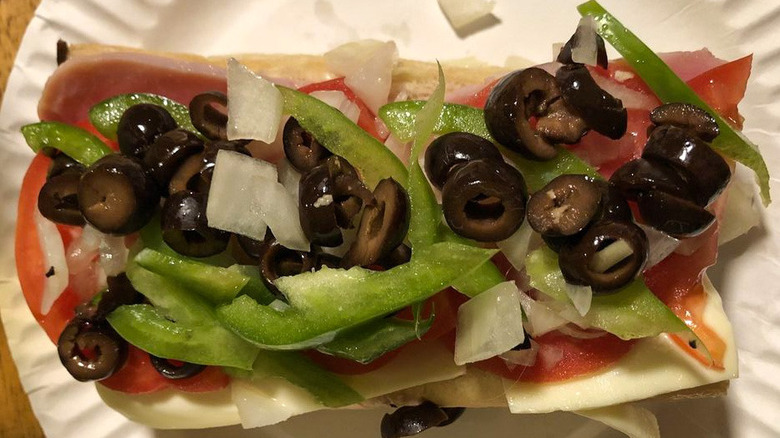
There is, however, a regionally unique sandwich in Maine — particularly in Portland — that also goes by this name. According to lore, this style of sandwich dates back to around 1900, when Italian immigrant Giovanni Amato began selling bread to workers at the docks. Eventually, these workers asked for something more substantial, and the Maine Italian sandwich was born. Stuffed primarily with ham, it distinguishes itself with its unusual toppings, including sour pickles, raw green peppers, and black olives. Though other styles of sub have by now infiltrated Maine, this concept remains strong in Portland and at the Amato's chain, which operates more than 50 locations throughout New England.
Hoagie
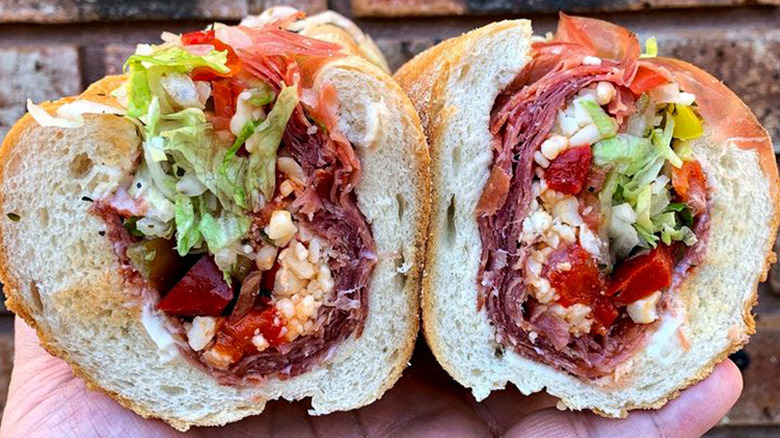
Philadelphians like to claim that hoagies are materially different from subs, often suggesting that hoagies are served on hinged rolls, while sub rolls are cut through, or other similarly convoluted explanations to prove that "hoagie" is anything other than the regional name for a cold sub (It's not). That said, Philadelphia hoagie bread has become a noteworthy specialty product, and is arguably the best sandwich bread found anywhere.
As for the name, hoagie boasts a variety of proposed origin stories, the most popular of which relates to Hog Island, a World War I-era shipyard that was once the region's largest employer. However, because the shipyard closed around 1920 and the term wasn't documented until 1940, there's no concrete evidence of a connection between these two things, other than the story's persistence in city legend.
Perhaps the more likely scenario is the tale of Al DePalma, the self-styled "king of hoggies." That's right: It was originally hoggies — hence the proposed association with Hog Island — which were eventually transformed through the regional accent to hoagie. Throughout his life, DePalma claimed he made up the term after commenting to a friend that you'd have to be a hog to eat a sandwich that large.
Hero
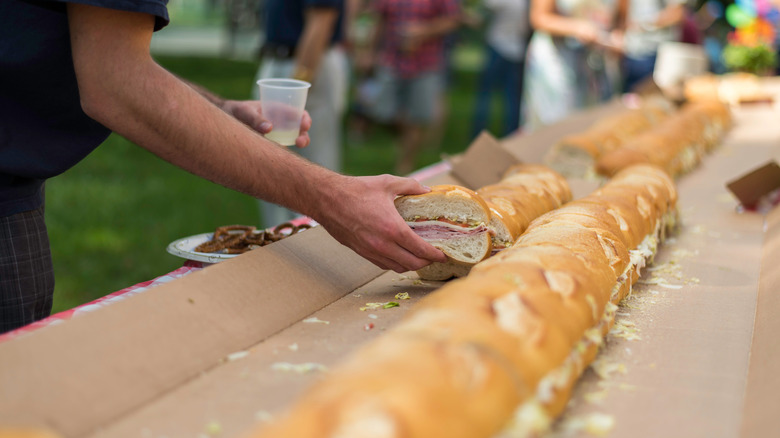
Though "hero" is understood nationally, like hoagie, its primary usage remains mostly confined to New York City and environs. Unlike its Pennsylvanian counterpart — which is more likely to mean a cold sandwich — hero refers to both cold and hot subs, e.g., Italian hero (cold), meatball hero (hot), etc.
Hero first appeared in the mid-1930s, and it is often credited to New York food writer Clementine Paddleford, who supposedly wrote that a person would need to be a hero to eat one. Sounds a lot like Al DePalma's hoagie story, no? As of this writing, however, not a single person who has attributed this quote to Paddleford has produced the text in which she wrote it. Another common hypothesis about the name's origin is that it morphed from gyro, but this idea remains highly implausible due to both the lack of a standard pronunciation in American English and the fact that the Greek dish wasn't documented in New York until around 1970.
It's sometimes suggested that Manganaro's Grosseria Italiana in Manhattan — which opened in the late 1800s, and later spun off a sandwich-focused shop next door — may have invented the hero. Then again, evidence of this shop selling the sandwiches didn't appear until the late 1940s. That said, it's probably safe to say that Manganaro's helped popularize the sandwich, and that they were likely the originator of the six-foot party hero.
Grinder
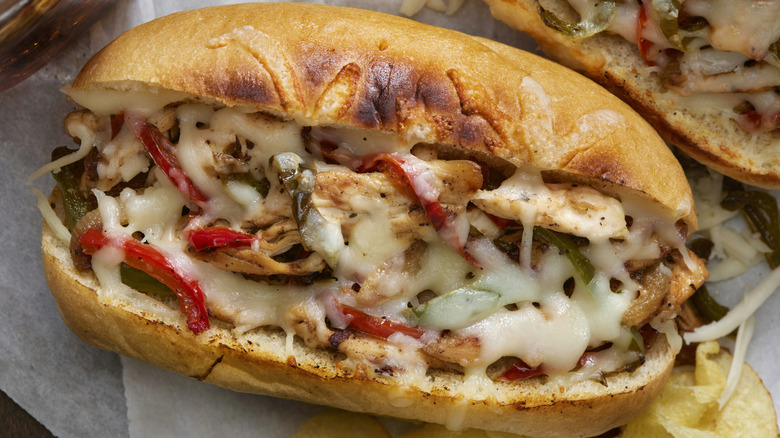
"Grinder" is an interesting term. While it originated as a cold Italian sandwich – and is still used that way in some parts of New England — it's been adopted as a term for a sub that has been heated or toasted in other areas.
Based on the earliest newspaper records, it's highly likely this name originated in central Connecticut, where it is still popular today, though it has also spread to Rhode Island and other pockets of New England. The grinder is often attributed to Benedetto "Benny" Capalbo, who sold the sandwiches at his popular grocery store in New London, Connecticut, as early as the mid-1920s. While Capalbo purportedly named his sandwiches for the fact that one would have to grind their teeth to eat this large sandwich on such a chewy roll, there is, unfortunately, no contemporaneous documentation proving Capalbo's involvement in the naming.
Another popular hypothesis is that the moniker is related to dock workers known colloquially as grinders, which was a nickname given to metal workers who regularly used a grinding machine. This idea, however, also lacks any convincing documentation, and might be another example of retrospective projection.
Po' boy
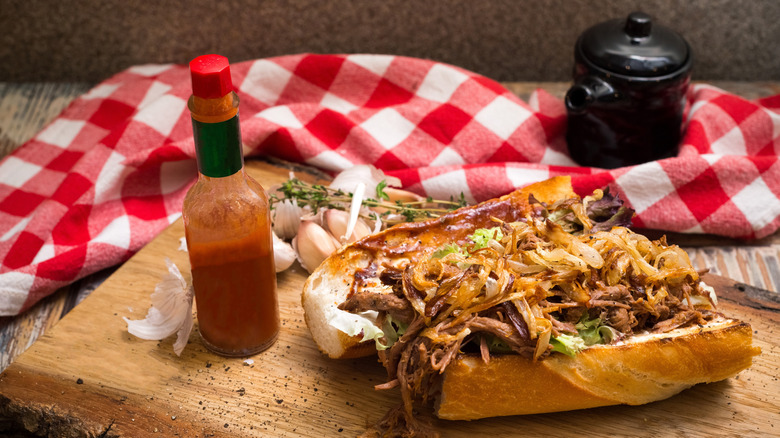
This sandwich (also written po-boy or poor boy) appears to have evolved in New Orleans out of the oyster loaf — also known in the 1800s as the "peacemaker" — a combination of fried oysters and a locally developed long roll called French bread. However, it shouldn't be confused with muffuletta, the region's Italian sandwich, which comes on a large, round roll.
Though the name's origin is buried in oral history, these sandwiches were likely popularized by the Martin Brothers, whose restaurant opened in 1922 and made a name for itself with filled loaves featuring a variety of ingredients, particularly pot-roasted beef with gravy and potatoes. As the legend goes, the Martins offered to support a 1929 streetcar workers' strike by giving participants free sandwiches. Supposedly, an approaching striker would trigger the phrase "here comes another poor boy," and the rest is history. Though many swear by this story, and there is indeed evidence of the Martins giving workers sandwiches, there's unfortunately no documentation that definitively links the strike with the name.
Today, the term is regionally generic for a sandwich on a long roll, and can include just about any type of filling. The bread, however, is what distinguishes a po' boy from other subs. This so-called French bread, optimized for the Martins by local baker John Gendusa, offers a crisp crust that crackles but doesn't resist a bite, and is balanced by an open, airy crumb.
Wedge
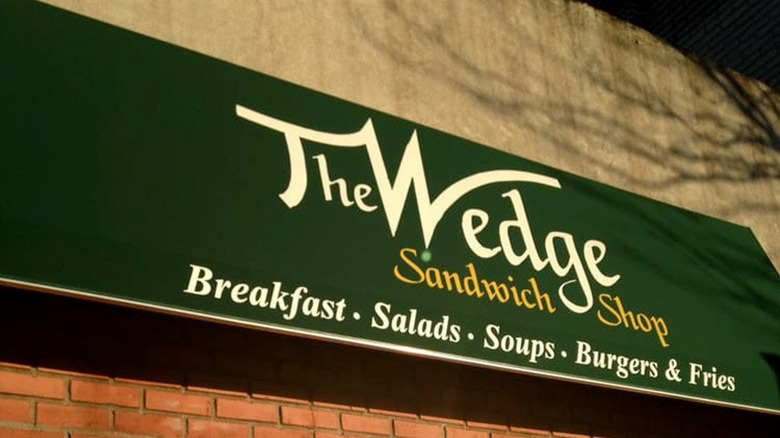
This one brings us into the section of hyperlocal alternative names for sub, with "wedge" almost entirely confined to Westchester County, New York. However, it may occasionally be used in the nearby Putnam, Dutchess, and Rockland counties of the lower Hudson Valley. The name probably emerged in Yonkers in the 1950s, and people from that city often state with confidence that it originated at Landi's Deli, in the Park Hill neighborhood. Frank Landi's wife, the legend goes, had a thick Italian accent, and when she tried to say "sandwich," it always came out "sang-wedge." It was eventually shortened to "wedge," and locals would regularly line up down the block to get a wedge from Landi's.
Others have proposed etymological explanations related to the wedge's construction: Either the way the sandwich was cut — diagonally — made it resemble wedges, or that all the ingredients were wedged into the roll to make the sandwich. Today, this unique name persists in and around Yonkers, but it hasn't traveled too far. Some online sources do claim that it's also common in Fairfield, Connecticut, but we couldn't find any verification of that.
Spuckie
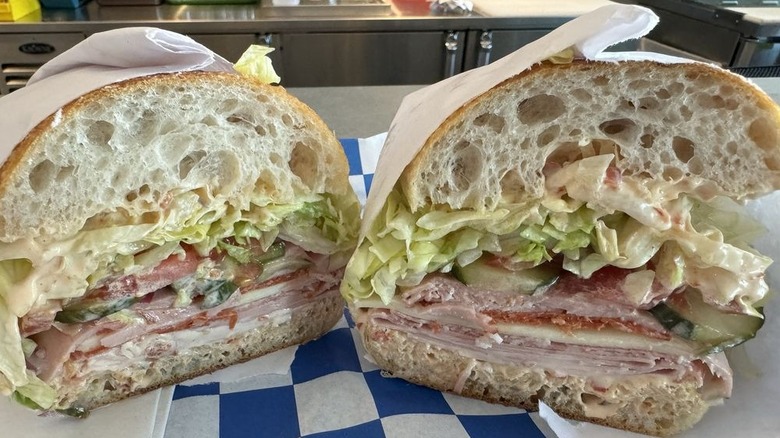
The old school term "spuckie" — including its plethora of spelling variations — apparently derives from "spuccadella," an Italian American word describing a sub roll developed in Boston. Though this word doesn't exist in actual Italian, it's likely either dialectic or a bastardization of "spaccatella," which can refer to the split in a loaf of bread that forms when it bakes, a small roll with a similar split, or even a pasta shape that's split down the middle. (Spaccare also means to split.)
In Boston today, "sub" has mostly taken over as the term of choice for sandwiches on long rolls, and spuckie is, sadly, at risk of extinction. That said, there are still some old timers who use it, and plenty who remember the term from growing up in one of the city's Italian enclaves. A few spots are even carrying the torch, in a way. Spukies'n Pizza, a longtime Dorchester shop, uses the term proudly on its sign, yet refers to most of its sandwiches as subs on the menu — the confusingly named "spicy spukie sub" at least tries. Vinal General Store in Summerville takes a similar approach, using subs to describe the category, but calling their vintage Italian sub a spuckie (pictured). Hopefully, these small nods to the spuckie will catch on, and the term will live to fight another day.
Torpedo
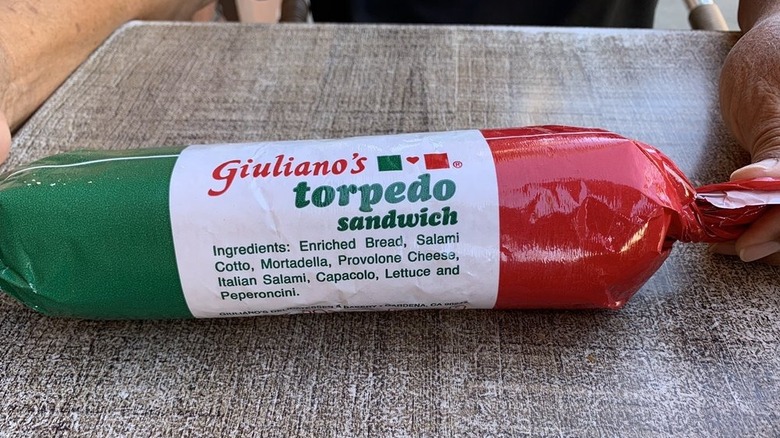
This one likely emerged as a synonym in the mid-1900s in the Northeast U.S., for obvious reasons. Though it never really challenged sub as the dominant name for these sandwiches, a 1967 survey of names showed "torpedo" in an odd array of places, including Manchester, New Hampshire, along with San Antonio, Reno, and Gary, Indiana. It's not a commonly observed term in the Northeast today, though there are vestiges of it having once existed — including the rare sandwich shop that prefers it, or its occasional use to describe a long roll.
Meanwhile, torpedo has found an unlikely home in Southern California, where instead of being used to describe a category of sandwiches (e.g., subs), it refers to a specific sub defined by its ingredients — in this case, the hams and salami of a classic Italian. The origin of this anomaly likely originates from Giuliano's in Gardena, California (near L.A.), which began serving its now famous torpedo — featuring mortadella, salami, and capicola — in 1952. Though the shop eventually expanded its menu to include sandwiches of many different types, only this original version goes by the name torpedo. This concept eventually spread down to San Diego, where it is also common to find shops that serve a variety of subs, yet still call the traditional Italian a torpedo.
Blimpie
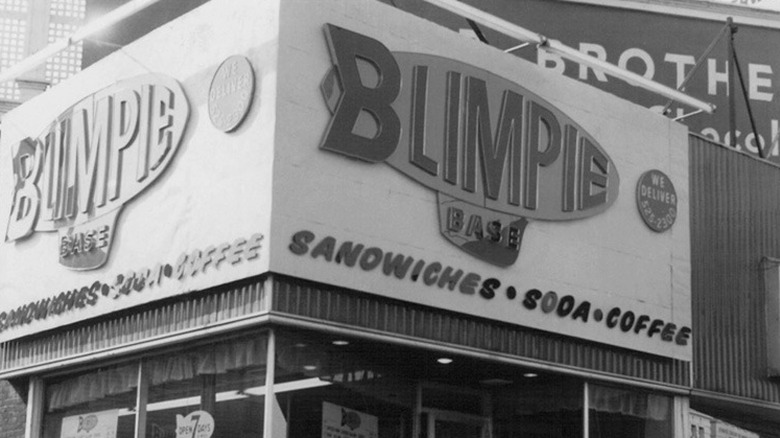
An interesting addition to the sub alternative name canon, "Blimpie" is the one term on this list that's almost entirely linked to a specific sandwich chain. Opened in Hoboken, New Jersey, in the 1960s, the three friends who created the shop were looking for a word that would differentiate their sandwich from other subs, and eventually landed on Blimpie. However, a name variation does not change the foundational fact that these sandwiches still exist within the general category of subs.
Though Subway and Quiznos would eventually surpass it in the sub sandwich chain genre — Blimpie did hold on to the third spot for many years — the Hoboken store was actually first out of the gate. Within a year of their launch, Blimpie created its first franchise location, and by the early 1980s had expanded to 150 stores. By 2001, they had over 1800 stores and were averaging over $300 million in sales. Today Blimpie is owned by Kahala Brands, a fast-food franchising company, and is a shadow of its former self, with only 95 stores in the U.S.
Zeppelin (zep)
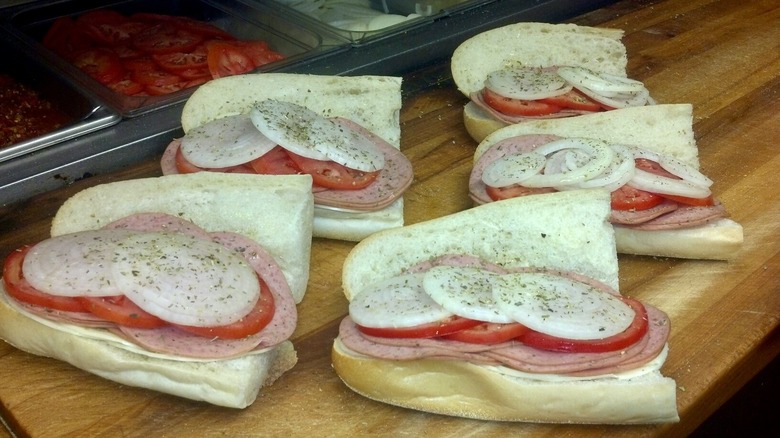
Considering the other names derived from the roll's shape, it's almost surprising that "zeppelin" didn't become more popular. (Then again, perhaps people in the mid-20th century didn't respond to something that recalled the Hindenburg.) Alas, the name "zep" persists today in Norristown, Pennsylvania, a small city in the Philadelphia suburbs, and a few nearby towns. Though zeps are essentially a regional variation of subs, they do have specific rules and practices that differentiate them.
Firstly, the most unbreakable rule of zeps is that no lettuce is allowed. It's unclear why zep makers are so staunch about this — some won't even allow lettuce in the building — though early recipes for hoagies in the Philadelphia region also lacked lettuce. Another rule of zeps is that only one meat is allowed, unlike other Italian-style subs. The classic meat is a type of salami, though nowadays one can also get ham, turkey, etc., as long as it isn't a mix. Another important element of a proper zep is the especially thick slices of raw onion and tomato, which drip juices onto the meat and bread, creating a unique flavor profile. Lastly, zep bread has its own style: For one, the rolls used for zeps are slightly wider and longer than standard hoagie rolls. Also, small zeps can be ordered on round rolls, an option rarely seen in the broader sub world.
Cosmo
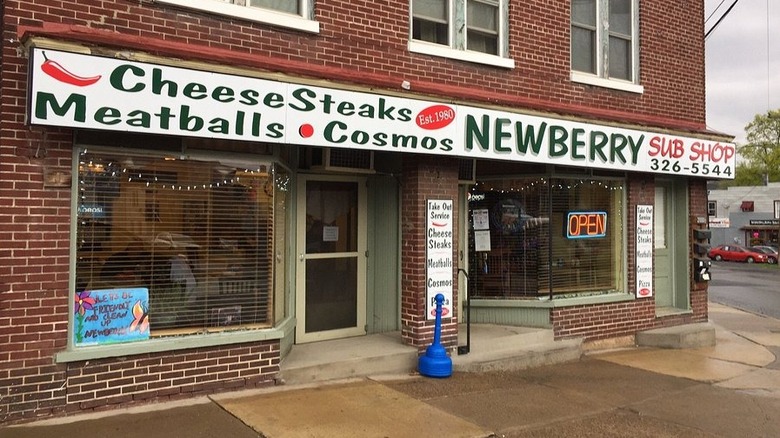
Though "cosmo" is yet another hyperlocal synonym — in this case, specific to Williamsport, Pennsylvania, home of the Little League World Series — the cosmo has a few notable differences. In particular, cosmos are always toasted, so the roll becomes crispy and crunchy, and the cheese melts tantalizingly over the fillings. Unlike other terms that can mean either a hot or cold sub, such as hero, or that typically refer only to cold subs, such as hoagie, cosmo always includes this heating instruction. Cosmos also come in a cheese-only version without any meat, though typical sub vegetables are usually added.
While several places in the region still offer cosmos, the most likely origin comes from the now-defunct Cellini's Submarine House in Montoursville, Pennsylvania, just east of Williamsport. According to legend, a Cellini's worker named Cosmo always liked his subs toasted, hence the moniker that launched a new branch of local (if dubious) lore. Confusingly, even in Williamsport, the use of cosmo is not standardized. On the menu at both Cellini's and the Newbury Sub Shop, for example, cosmos live alongside both subs and grinders. At Mileto's Sub Shop, they're called "cosmo hoagies."
Others
Before wrapping up, there are several sub-adjacent terms so rare or outdated that they don't warrant a full exploration, but at least deserve brief mention. These include shape metaphors like "rocket," of which newspaper records from the 1950s and '60s show was occasionally used in various locales. Another shape-related term is "bomber," historically common in upstate New York (e.g., Buffalo, Ithaca, Binghamton). Today, this name is still occasionally found in these areas, though, like torpedo (see above), it typically refers to a specific specialty sub rather than the broader category.
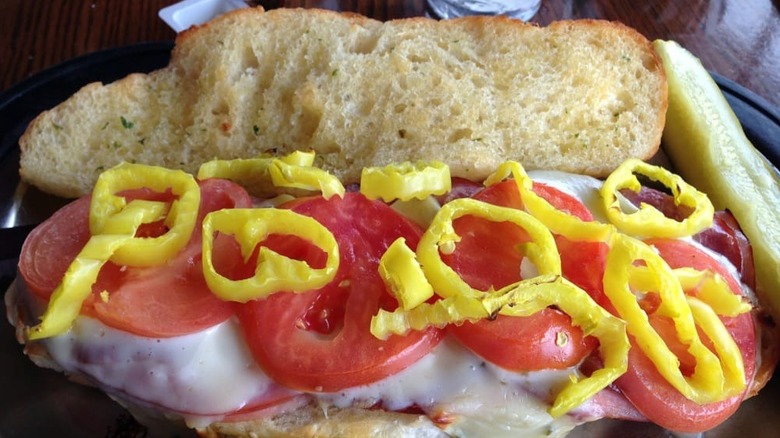
Another interesting example is the Garibaldi (pictured), the signature sub served at Paisan's restaurant in Madison, Wisconsin, since 1957. Though it's unclear whether anyone else ever used this name, the sandwich — featuring ham, salami, and spicy cheese — became famous enough to be mentioned in several lists of sub synonyms. Other terms that have occasionally appeared are "gondola" and "jawbreaker," though little evidence exists that these were ever widespread. Lastly, Cuban sandwiches are occasionally grouped into the broader sub family, but since these include both unique ingredients (e.g., pickles) and are always pressed, we consider them to be a distinct category.