

A Bakery Pro Explains Why You Should Press Your Cake
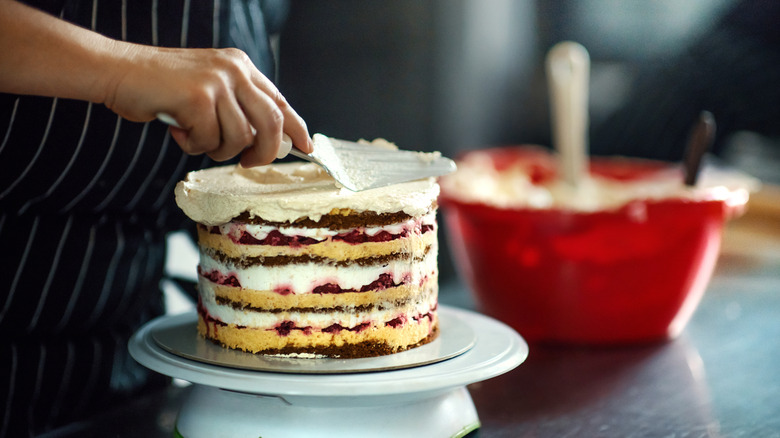
Making a cake is something that every aspiring baker will do at some point on their journey, and the process can be daunting if you're a beginner. From using the resting trick for fluffier cake to baking with room temperature ingredients whenever a recipe calls for them, there are many key variables to keep in mind. When it comes to building a layer cake, ensuring that each level of the dessert is firmly in place and united is one of the important considerations. This is why professional bakers, such as "The Cake Girl" Kristina Lavallee, advise pushing down gently on each layer of your cake to make it as uniform and beautiful as possible.
Lavallee — who is well-known for making incredible cakes for the likes of Cardi B, Tom Brady, Jason Momoa, John Travolta, and Guy Fieri, among others — explained the reason why it's so important to press down on your cake periodically as your creation takes shape. "When assembling the layers, you are looking to do a light, even press to help eliminate the air pockets between the layers. By eliminating the air pockets, you are helping to reduce the chances of any shifting, bulging, or uneven slices later on in your process," Lavallee told The Takeout.
Beyond that, the technique also helps stabilize your cake, which is a vital part of producing a satisfying end result. "Think of this as you are locking everything into place so it behaves the way you want it to later on," Lavallee added. For similar stability-related reasons, many recommend "gluing" the cake to your cake board to prevent a sliding cake ruining a frosting job.
How to press down on your homemade cake properly
While Kristina Lavallee clearly believes in the importance of pushing down on each layer of your cake when assembling it, there are a lot of instances where you might be overdoing it or are using the technique when it isn't necessary. Lavallee said that gentleness is key, and being too forceful can be a massive mistake. "It has to be controlled; I do not think of it as a 'squish.' I think of it more like setting the structure," Lavallee noted. "Where bakers go wrong is applying too much pressure during this step. If you overdo it, you are going to compress the crumb of the cake, push the filling out, and lose the beautiful texture that you worked so hard to create." This is especially true with soft, delicate cakes, such as chiffon.
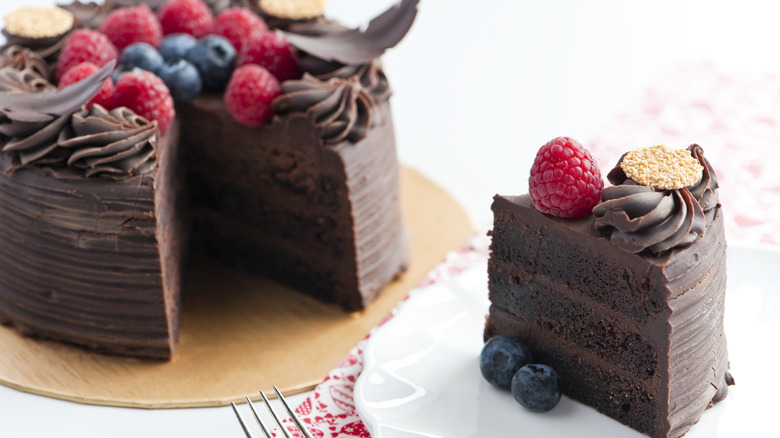
However, Lavallee noted that denser cakes – which often contain more sugar, fat, and a higher flour-to-liquid ratio — can usually handle more pressure than lighter cakes. In fact, denser cakes, such as chocolate and carrot, benefit when you press down on them harder than their fluffier alternatives.
This discrepancy, Lavallee said, is present with every cake you'll ever make, so patience is key to figuring out the optimal amount of pressure to apply. "This step is all about awareness," Lavallee added. "Every cake responds a little differently, so you want to watch how it reacts to your touch. You can then adjust your pressure in real time, applying just enough to support the structure without compromising the integrity."