

You Can't Judge Olive Oil By Its Color — Here's Why It Varies
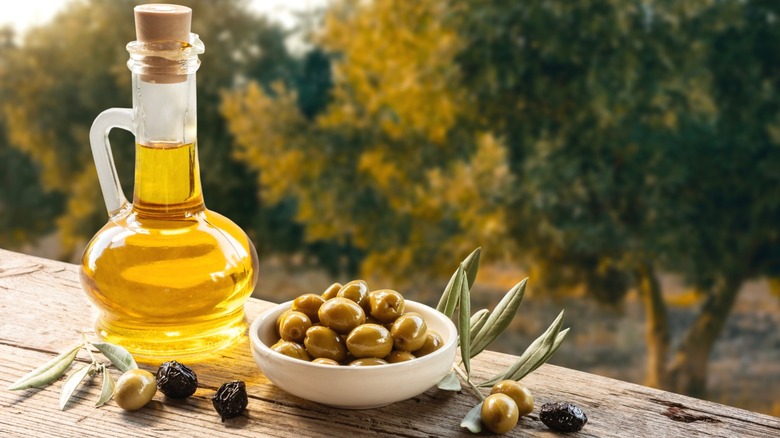
There are some foods you can judge with a glance, taking careful notice of its color to make sure it's good quality. Beef, for instance, is ideally healthy and pink and not-so-ideally grey and pallid. You'd think something as simple and pure as olive oil would be easy to judge from its color, too. But according to Patrick Miller, the owner and miller at Frantoio Grove in San Martin, California, it's not quite so straightforward. In fact, you can't really judge olive oil's quality by its color at all.
Why is that the case? Well, it helps to know what makes olive oil a certain color. "The main pigments in olive oil are carotenoids and chlorophyll," Miller explains. "The carotenoids give the olive oil that distinct yellow color, and chlorophyll gives it [a] green color." These pigments have very little to do with the quality of the olives or its oil; at most, Miller says, it could indicate freshness. "If you do see an oil that is green, it is likely an indication that it was harvested earlier and may be more pungent and grassy, but this doesn't necessarily mean it's a better oil than a yellow olive oil." The bread you dip into your oil won't care if it's yellow or green, after all. (Although maybe your hypothetical Italian hosts might care, as they don't dip bread in olive oil.)
Don't be afraid to taste your olive oil
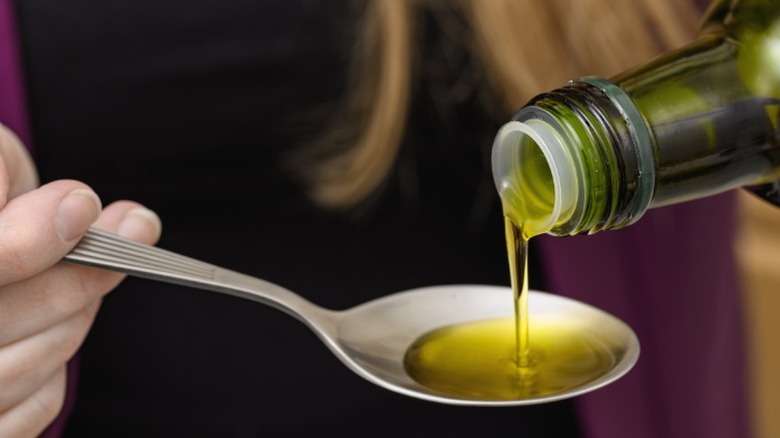
So, if you can't ascertain the quality of olive oil just by looking at it, how can you tell if it's good or not? It's pretty simple, says Patrick Miller. "Taste! When you get a new olive oil, pour a little bit in a spoon or a small cup and take a sip." He adds, "You don't have to take a big sip, just enough to coat your mouth." You can tell a good quality olive oil pretty easily from just a sip. "You should be looking for intense fruit flavors, either green, grassy, pungent early-harvest flavors, or mellow, round, sweet, aromatic flavors of a riper harvested olive," Miller says.
By contrast, if your oil has gone off, you'll be able to tell quickly. "If you can describe the oil as heavy, waxy, greasy, or if it smells like crayons, it's likely a sign that the oil is old and rancid," says Miller. Now, "rancid" is a pretty scary word, but in this case it's not dangerous — though certainly not ideal. "It won't kill you to cook with [it], but it's certainly not necessarily an extra virgin olive oil at that point," Miller says. (Pro tip: If you're using olive oil for more than cooking, extra virgin is a good idea.) Once you know what you're looking for, you can tell a good olive oil from a bad one blindfolded.