

How To Find The Best Microwave Wattage For Your Kitchen
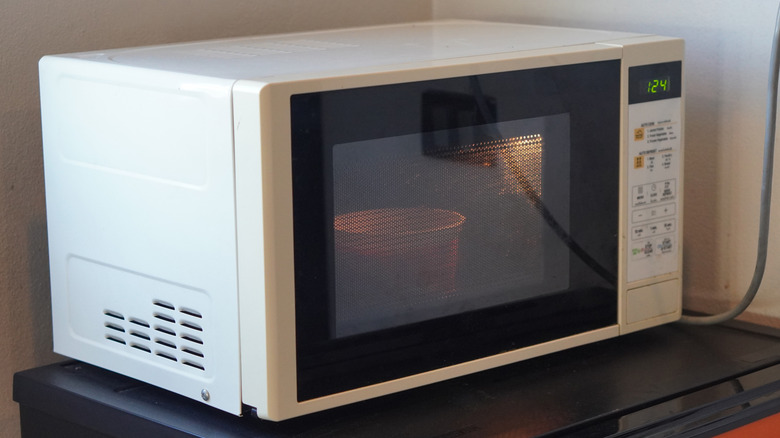
You notice quickly when the new place you've moved into lacks a microwave. Even if you don't technically need a microwave, they're undeniably convenient and take way less time than reheating food in an oven. If you're looking to buy microwaves, keep an eye out for the microwave's wattage. It'll be a number between 600 and 1,700, and it's a measure of energy used per second which makes a difference in how powerful your microwave will be.
The average microwave wattage is 1,000 watts, and most instructions on the back of frozen food packaging assumes you're working with a 1,000 watt microwave. Smaller, cheaper microwaves are more likely to hover around 700 watts, and even though they'll easily cook frozen dinners and reheat your tea, they use less power and often take longer to heat up food. Microwaves can go much higher, although it's hard to find normal microwaves which go higher than 1,250 watts. These models tend to have more settings for complicated foods. For example, there are dos and don'ts for thawing meat in the microwave, where a lower wattage microwave will struggle to fully defrost meat compared to a higher wattage microwave (which will often have dedicated buttons for defrosting).
If you're on a budget, go for a smaller wattage; and if you've got lots of mouths to feed quickly, go ahead and splurge on a higher wattage microwave. If you just want an ordinary microwave, a 1,000 watt model should do everything you need.
The average microwave is 1,000 watts
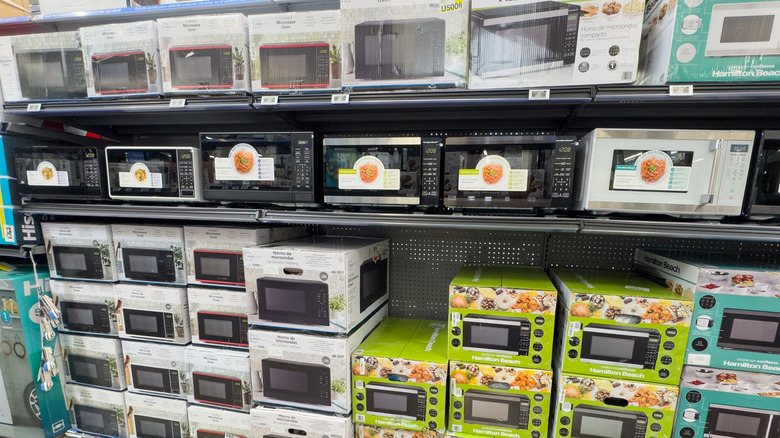
You should never confuse wattage with a microwave's power level, because they're two different things. Power level refers to how much the microwave is using the magnetron tubes which cycle energy and heat up your food. High power on a high wattage microwave is stronger than high power on a low wattage microwave.
Because most food instructions assume you're using 1,000 watts, you might be wondering if you need to adjust how you cook your food if your microwave has a different wattage. The answer is yes, you should be messing with power settings before microwaving food in that case. There are online calculators and apps to help you do the math, but you don't need them with a 1,000 watt model.
Ideally, you're checking the microwave's wattage before you buy it. However, if you never got around to asking or if the microwave came with your kitchen and you're not sure, it's good to check. You can usually find the wattage number written on the inside door of a microwave. If it's not there, you can determine wattage by placing a cup of cold water into the microwave and checking how long it takes to boil; it should take about two minutes in a 1,000 watt microwave. If it takes shorter or longer, you might want to think about whether that much (or that little) power is what you need in your kitchen.