

Apple Farmers Have An Important Message About The Produce You Find At The Supermarket
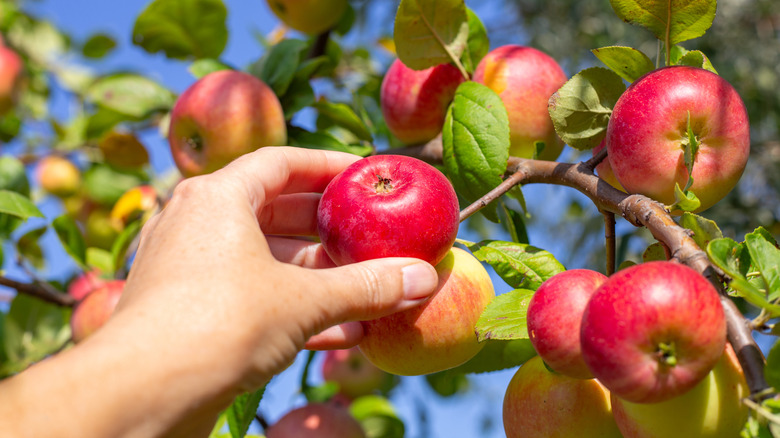
Apples are among the most popular fresh fruits in the United States, and while there are many unique types of apples to try and cook with, one thing that they all have in common is that they are all seasonal. This fact is often forgotten by consumers since they are seemingly always available to purchase at your local supermarket, but only because some apples you buy from the store have been stored for months beforehand.
We spoke to Amy Nassisi, one of the "Apple Ladies" at Curran Apple Orchard in University Place, Washington, who set the record straight on the true freshness of the apples you find at large grocery stores and supermarkets. She reminded us that apples are only harvested from August through November in North America. "Because apples have such a short growing season ... , it is common for apples to be on the shelf up to 9 months after they are picked," Nassisi said. "So, commercially, apples are closely managed to preserve them for year-round availability in the grocery store."
This means that just about any apple you buy for a refreshing spring or summertime snack is likely one that was actually picked months prior. Understandably, this leads to major confusion among many apple lovers. However, while your knee-jerk response may be to exclusively buy your apples from orchards in the last few months of the year, apples that are preserved for several months are perfectly safe to eat and often taste just as good as those you pick directly from the tree.
How are apples preserved for so long before they're purchased?
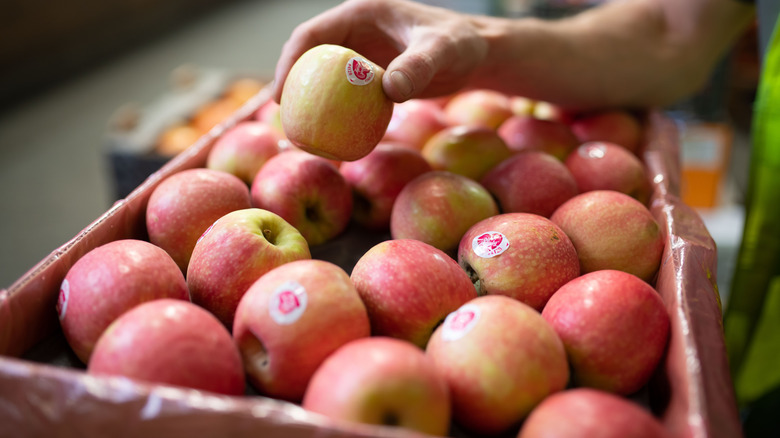
So, if the apples at your local supermarket were farmed months in advance, how do they retain their taste and freshness when you finally purchase them? Well, Amy Nassisi gave us an in-depth explanation of the preservation process as far as apples are concerned. "They are often treated with a gas to impede ripening," Nassisi revealed. The gas in question is typically 1-methylcyclopropene (1-MCP), a compound that blocks ethylene — the gas that causes apples to ripen and degrade in the first place.
However, the gas isn't the only factor in keeping apples in good shape; temperature also plays a major role in our ability to enjoy apples all year long. While we know it's important to keep apples in the refrigerator to keep them fresh at home, farmers take things even further to maintain the fruits' freshness long-term. "Most people are surprised to learn how apples are preserved in cold storage [...] [They're] kept in warehouses at a temperature close to freezing to keep them as fresh as possible," Nassisi shared, noting that the warehouses in Washington State alone (which produces about 60% of all apples found in the United States) house millions of pounds of apples at any one time.
So, when it comes to buying apples at the store, how do you know what to look for as far as freshness is concerned? Well, even though apples are so well-maintained before they arrive at the produce aisle, it's still important to detect signs of aging if they're present. "To find the freshest apples, look for firmness," Nassisi advised. "Any softness is a sign of aging [...] And look for any spots, bruising, or wrinkles that might signal aging or poor handling."