

Julia Child's Trick For Perfect Pizza Can Be Found At A Home Improvement Store
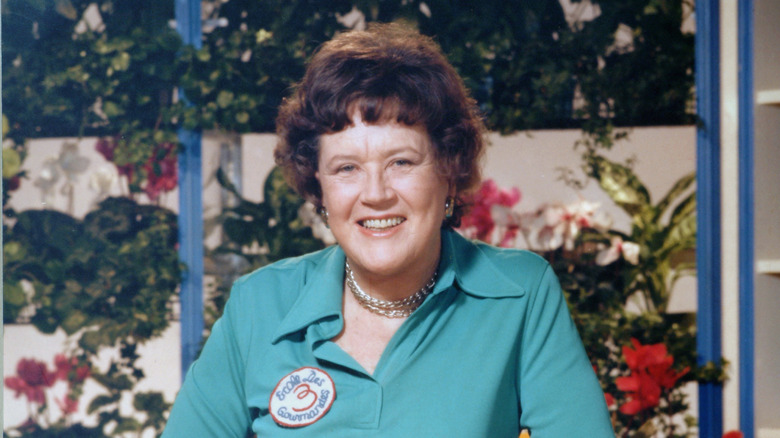
If someone invited you to go shopping for a tool that Julia Child liked to use in her kitchen, you'd probably be surprised to end up at Loewe's or Home Depot; but in the case of Child's favorite pizza technique, those stores are the right place to be. On her cooking show, despite the show being called "The French Chef" and her famous love of French cooking, Child demonstrated how to cook an Italian favorite in the episode, "Pizza Variations." In it, as the title suggests, she made pizza. One technique she demonstrated for making pizza with a crisp, satisfying base calls for placing tiles in the oven to serve a similar function as a pizza stone.
The tiles Child used aren't pizza-specific, but get the job done when it comes to, as she put it, "Doing pizza variations without soggy bottoms!" She recommended using "tiles or fire bricks" to turn an ordinary convection oven into a de-facto pizza oven. In the episode, Child notes that traditional pizza ovens, like you'd see in a restaurant, have tile bottoms that the pizza goes onto directly, but that ceramic quarry tiles and fire bricks are good substitutes. The important thing, Child says, is that the tiles or bricks heat up to very high temperatures. You'll leave them for an hour in a 400-degree Fahrenheit oven and cook the pizza dough quickly to avoid the dreaded soggy bottom.
Try Julia Child's French pizza, but don't forget a baking tile
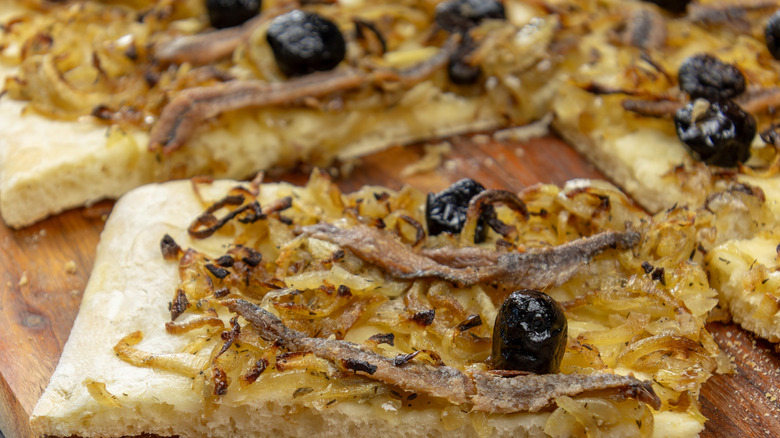
The "Pizza Variations" episode of "The French Chef" wasn't exclusively devoted to heating ceramic tiles, or even the other improvised tool she recommended "a cedar shingle or the old bottom of a drawer," to serve as a pizza paddle. In fact, one of the major focuses of the episode was introducing viewers to a version of pizza that was, appropriately, French-inspired. Niçoise-style pizza, also known as pissaladière, is from Nice, which is in France near the Italian border. Pissaladière toppings, as seen on "The French Chef," include a thick layer of caramelized onions (you can use a little water to cook caramelized onions faster), a sprinkling of kalamata olives, Bobby Flay's favorite flavor booster of a few fresh anchovies, and finally, Parmesan cheese.
As with Italian pizza, a pissaladière is best cooked on tiles or a pizza stone — and that's not merely Julia Child's opinion, it's traditional and has scientific backing. Pissaladière recipes call for a "baking stone" similar to the quarry tiles recommended by Child. It's all about porousness and heat. Unglazed ceramic tiles, baking stones, and pizza stones are all porous because porous materials absorb heat better than non-porous materials. This means they can reach those high temperatures needed to properly cook a crispy crust pizza, pissaladière, or any other dishes you want to experiment with.