

The Red Flag To Watch Out For When Buying Frozen Seafood

Seafood requires consumers to be ultra-critical of quality. Some people assume freezing protects it from bacterial contamination, but that's a bunch of hooey. Freezing doesn't eliminate bacteria; it simply slows bacterial growth to the point where they can't proliferate. Frozen seafood that's been mishandled somewhere along the supply chain still poses a safety risk that shouldn't be ignored.
Dora Swan, founder of fin — your fishmonger, revealed an easy way to tell in two seconds if a product you're eyeballing in the grocery store has been temperature abused. "Ice crystals on frozen seafood is likely a sign of thawing and re-freezing, just as it would be with other frozen proteins or vegetables and fruits," she said. "This means that the seafood was not always kept at an appropriate temperature, which is a safety issue." If frozen seafood enters the temperature "danger zone" (between 40 and 140 degrees Fahrenheit), it can wake dormant bacteria, allowing them to reproduce and increasing the risk of incurring a foodborne illness.
Despite some people thinking that food cooked to a proper temperature is automatically safe, that's also bogus. Not all bacteria die off after cooking. For example, Staphylococcus aureus and Clostridium botulinum (both of which can be found in mishandled seafood) aren't always eradicated with high heat.
That means if a package of frozen seafood from Aldi or some other grocery store is teeming with ice crystals, it's not as safe as it could be and won't taste as good. Still, a little ice formation isn't necessarily something to panic about. "A light ice glaze over the whole product is a fine thing," Swan said. "Loose ice crystals, not-so-much."
Frozen seafood can be tainted by poor packaging
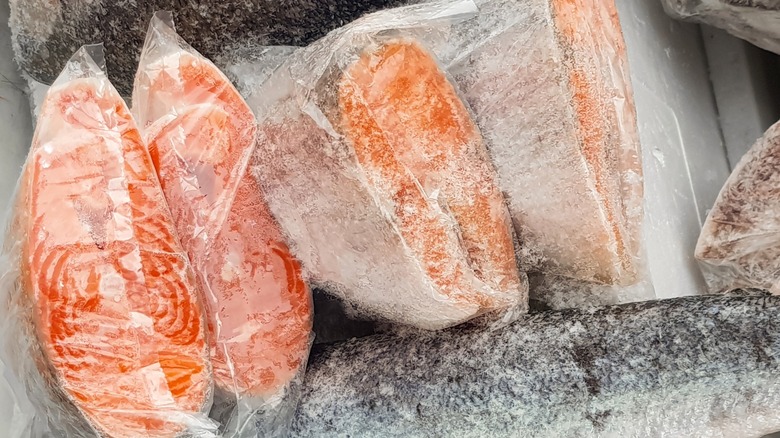
Rather than worrying about purchasing fish from the grocery store on a Monday (another seafood myth), shoppers are better off checking for loose ice crystals inside the package of their go-to frozen aquatic delights. Although temperature abuse can be the culprit, Swan warned that an icy coating could signify another problem with the product. "Sometimes, ice crystals form when the packaging seal has been broken and moisture escapes the seafood," she said. "That'll lead to dried-out, gray patches that won't taste fantastic. The packaging for frozen seafood should be tightly sealed and have little to no frost."
Some seafood recalls have affected millions, so it's best not to tempt fate with a product exhibiting ice crystals and just walk away. Of course, if you're concerned that other shoppers aren't aware ice crystals on frozen seafood is a safety risk, you could go the extra mile and inform an employee about what you saw. The truth is, they may not be aware of the issue yet. They can only work to remedy the problem once they realize it's there. As Swan put it, "It might also be a kind gesture to make the department or store manager aware, as it could mean that the freezer they are being stored in lost power at some point (and came back on, restoring the space to normal temp), which would place all of the product in that freezer in jeopardy."