

The Brewery Red Flag You Should Never Overlook

You should be able to rely on a brewery to deliver a top-quality selection of beers, but not all breweries are created equal. It's not immediately easy to spot the inferior ones – most look pretty legit, housed in trendy buildings with brewing operations that you can see from the bar. When visiting a brewery, sometimes you don't know it's missing the mark until you take that first, less-than-awesome taste. Luckily, there's a way to judge the quality before you even take a sip. In an interview with The Takeout, Jeff Patten, co-founder of Flatiron Wines & Spirits, said you can decipher the quality of a brewery based on whether your beer gushes when you crack it open.
Gushing is when beer foam explosively projects out of the top when the can is opened or pumps out of the tap when a beer is being poured. It's also known as fobbing, beer eruption, or foam overflow, and it happens when gas is built up and quickly escapes. There are two types: primary and secondary gushing.
Primary gushing can indicate the brewery used sub-par raw materials in the beer-making process, particularly malted barley that has certain strains of fungi. Secondary gushing can indicate other issues with the brewing process. "There are two things that almost all gushing points to," Patten said. "Over-carbonation caused by a rushed or miscalculated fermentation process, or microbial contamination within the can (usually wild yeast or bacteria that continued to ferment after the can was sealed)." Both these instances yield too much carbon dioxide but point to distinct brewing issues.
What gushing means for a brewery
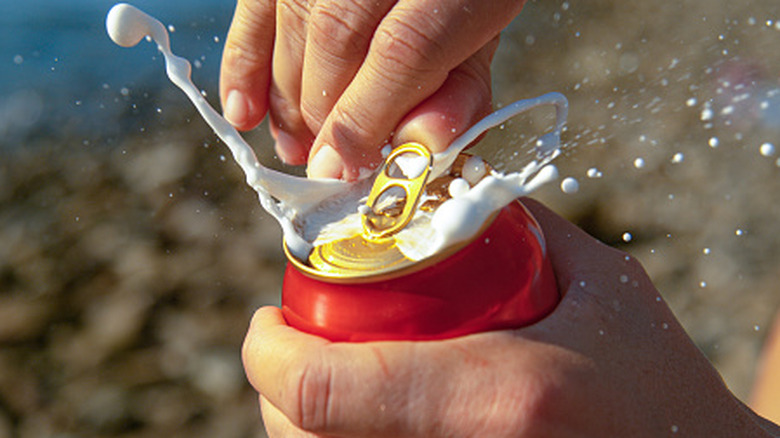
Over-carbonation, Jeff Patten said, points to procedural problems. "The brewer either put too much priming sugar in, failed to complete full fermentation before canning, or miscalculated the amount of carbonation volumes for this given style of beer," he shared. This can be more likely with new breweries that are still fine-tuning processes.
Gushing caused by a contamination issue could mean that brewing equipment wasn't cleaned well enough between batches. "Contamination is wild yeast or bacteria that get introduced during the production that keep feeding on residual sugars inside the sealed can, thus building pressure over time," Patten explained. "That pressure has nowhere to go until you crack the tab, and when it finally does, it goes fast and it goes everywhere."
Gushing is less likely in commercially produced products, like grocery store beers made by massive companies, as processes are very exact and batches are rigorously tested for quality. But occasional issues can happen even at the best breweries in every state. "From the exterior of an unopened can, both types of issues appear to be identical. This is what makes gushing so difficult to catch before it happens," Patten explained. Breweries that care about the details of the product will be sure to get you a fresh beer and pull any sub-par brews off the shelves.