

Yes, Your Poached Eggs Will Explode In The Microwave (Unless You Do This)
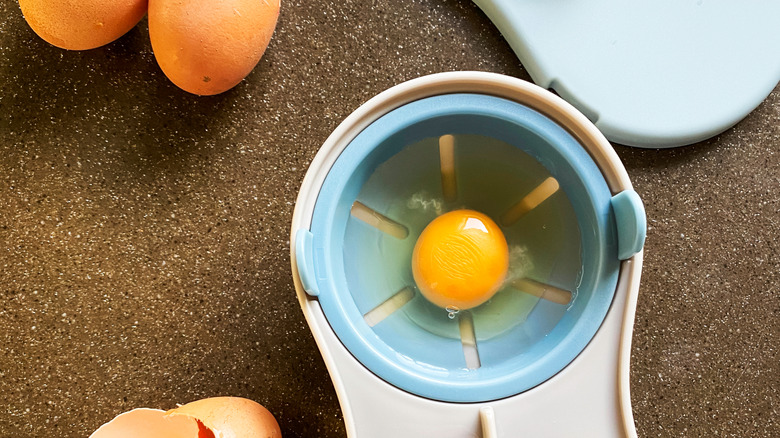
Poaching eggs on a stovetop can take a little bit of practice, so you might be pleased to learn that you can, in fact, poach eggs in the microwave as well. It's not quite a set-it-and-forget-it situation, though. There's a few things you'll need to do differently before you hit start. If you're not mindful, the yolk may actually explode (this is unfortunately not an exaggeration). There's one key thing you need to do before you start the cooking process to avoid this.
We spoke to Nelson Serrano-Bahri, chef and director of innovation at The American Egg Board, about how to prevent disaster while poaching an egg in the microwave. He explained to us that microwaves don't heat food as evenly as you'd imagine (this is why microwaved food can sometimes be cold in the middle), which means steam can build up in the egg faster than it gets let out. "If the yolk or white heats too rapidly — especially if the yolk membrane is intact — pressure can build and release suddenly. That's what leads to splattering or the occasional 'egg explosion,' either in the microwave or right after cooking when the egg is disturbed. The risk increases if the egg cooks too long at full power, if the water overheats, or if the yolk isn't pierced to allow steam to vent." So, you'll want to pierce the egg yolk (not necessarily rip it open) by using something like a toothpick or the tines of a fork before you start.
The shape of the cooking vessel helps, too
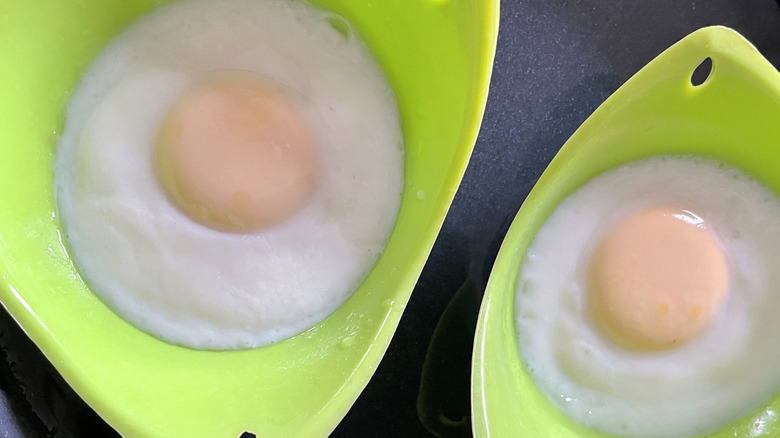
There's a few mitigating factors to consider when poaching eggs in the microwave, and one is the shape of your cooking vessel. Serrano-Bahri says, "A wide, shallow, microwave-safe bowl or ramekin is generally a better option than a tall mug. The wider shape allows the water to heat more evenly and gives the egg room to sit in a single layer. That reduces hot spots and lowers the chances of superheated pockets forming in the water."
Following that advice, microwave-safe ramekins, specialized egg poaching dishes, and shallow glass bowls are all good candidates for the job. Serrano-Bahri says that gentle cooking is key as well. Once your egg has been covered with water by about ½ an inch, pierce the yolk and cover the cooking vessel loosely with a microwave-safe plate or vented lid (this'll help prevent any potential mess).
Cook at medium power starting with 30 seconds and adding 10 to 15 seconds as necessary until the egg's done to your liking. Let the egg sit for 30 more seconds to allow carryover cooking to finish, remove the egg from the water, gently blot it with a paper towel, and you're all set. Serrano-Bahri noted that stovetop poaching is still preferable for the ideal poached egg, but these tips should get you a microwave poached egg that's cooked and intact, no explosions necessary.