

11 Beers With Pretty Gross Origin Stories

When you think of beer, there are many adjectives that may come to mind — words like "refreshing," "crisp," and "hoppy," for instance. One description rarely mentioned alongside America's favorite brew is "gross." Yet, here we are. Though most of us prefer to close our eyes and picture our preferred beverages being magically created on some pristine mountaintop — with master experts incorporating ingredients like barley, yeast, and maybe some fairy dust — we hate to break it to you, but some beers have ingredients that are anything but sparkly and ethereal.
Some beers throughout history, and even some today, have been straight-up weird. We might even go so far as to call them stomach-churning, complete with backstories you just wouldn't believe — unless you had them verified. That's what we're here for: to bring you some of the wildest brews that are indeed real, and well documented. In some cases, they're even award-winning.
Before we get into it, we must note that "gross" is entirely subjective. What's too out-of-the-box or even off-putting to some sippers might be absolutely fascinating — dare we say delicious — to others. While these beer origin stories may shock you, don't knock them till you try them (which you might be able to; some of these are still being brewed). Without further ado, here are 11 beers with pretty gross origin stories or ingredients. Scroll and see which ones you might like to find at the grocery store chains with the best beer selection.
1. Mikkeller: Beer Geek Brunch Weasel
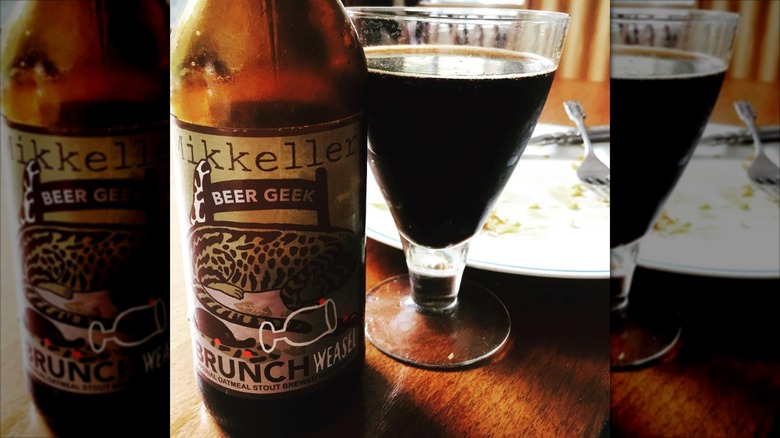
Guinness beer pairs well with ice cream, chocolate, and caramel, so marrying stout and coffee isn't much of a stretch. But in the case of Mikkeller's Beer Geek Brunch Weasel, an imperial oatmeal and coffee stout, there's a catch. The twist is that, during the manufacturing process, the coffee beans are passed through a civet's stomach. Yes, you read that right: This beer is infused it with Kopi Luwak.
Kopi Luwak is an Indonesian coffee made from beans that have already been eaten, and then .... um .... excreted by Asian palm civets. Basically, the animals — picture a mammal cross-bred with a big cat, a mongoose, a ferret, or even an otter — poop out pre-digested coffee beans, and then those eventually find their way into your bottle of beer. Yummmmm. But there's a science behind all of this. Apparently, enzymes in the civet's digestive tract — the ones that break down the beans — are instrumental in making a beverage that is more smooth, and less bitter.
The resulting brew by Mikkeller was almost pitch-black, and it reportedly had a rich, mocha head. It was crafted at Nøgne Ø in Norway by the Danish brewery, which was founded by Mikkel Bjergsø, who turned his experimental streak into a full-time venture in 2009. Shockingly, this particular beer is no longer being produced, though Mikkeller's original Beer Geek Breakfast Stout remains a core offering.
2. Wynkoop Brewing Company: Rocky Mountain Oyster Stout
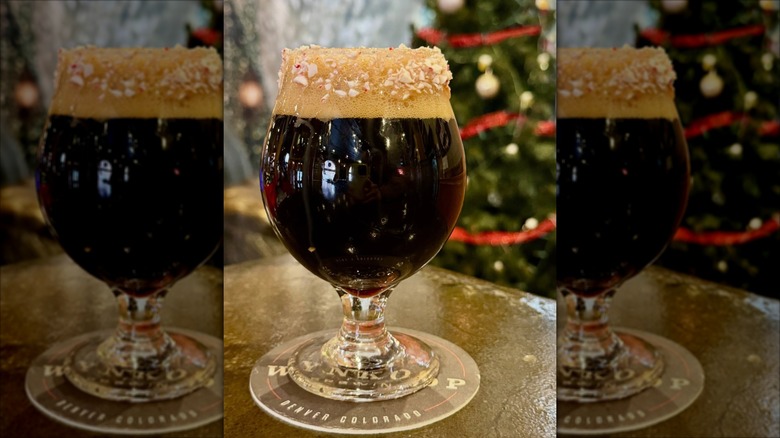
While some people in Colorado eat Rocky Mountain oysters, using them as a beer ingredient could arguably be called a bit much. But yes, adventurous drinkers can try the most iconic snack in Colorado in their brew. Wynkoop Brewing Company is still actively brewing and selling its Rocky Mountain Oyster Stout, which means that it must have a loyal following somewhere, somehow.
This decidedly weird beer includes Rocky Mountain oysters, which — despite what the name implies — are not seafood. They are battered and deep-fried bull testicles, a regional delicacy in Colorado ranching communities. When Wynkoop Brewing Company in Denver decided to incorporate the snack into a brew, fans took notice. What started as an April Fool's Day joke in 2012 quickly became real when people demanded to try it. The brewery leaned in, debuting the stout at the Great American Beer Festival. Thanks to its popularity there, it became a staple.
Rocky Mountain Oyster Stout is prepared (yes, still) using 25 pounds of bull testicles per batch. The beer is a foreign-style stout that pours nearly black, with a tan head. Its aroma is said to feature strong notes of chocolate and toffee, while the body is thick and creamy, with flavors of espresso and caramel.
3. Dogfish Head: Chicha
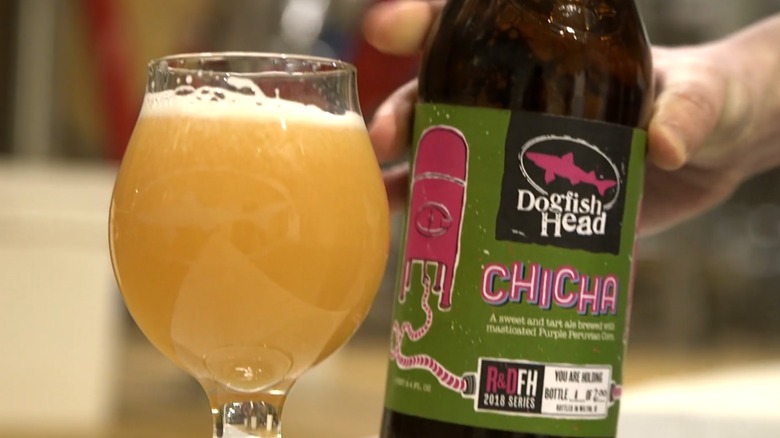
While all of the beers on this list certainly push boundaries, this next pick goes beyond them. In fact, you could say that it took any limitations, chewed them up, and spit them back out — literally. We're talking about Chicha from Delaware-based Dogfish Head, a unique brew whose origins were gleaned from an ancient Peruvian tradition. As such, Chicha was brewed using corn that was chewed before fermentation. (Yeah, we know — what is it with this pre-digested rigamarole, right?) It's weird, but keep reading, because there's a reason behind what could be perceived as madness.
In traditional communities, spit was known to aid in breaking down the starches in maize (corn), thus starting the fermentation process. It makes sense when you think of it like that, and Dogfish Head agreed, which is why it sought to recreate this phenomenon by having workers chew purple Peruvian corn for the brew. The chewed corn was then combined with malted corn and barley. And don't worry, the wort was fully boiled and sterilized before fermentation. So if you're feeling beyond grossed-out at this point of reading, maybe you can get some relief by knowing that nothing went into the final beer without being thoroughly cooked first.
Chicha was brewed in 2009 as part of Dogfish Head's Ancient Ales series. Strawberries were blended into the brew, which reportedly featured fruity, spicy aromas. Chicha was originally released as a limited offering, and it is no longer in regular, active production.
4. Right Brain Brewery: Mangalitsa Pig Porter
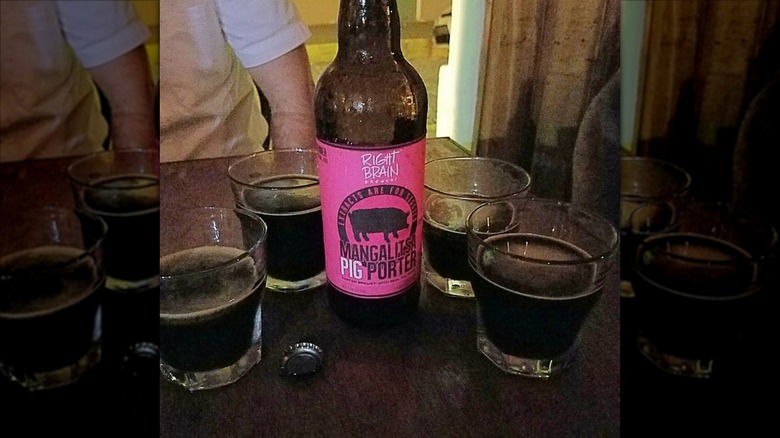
When was the last time you took a sip of the beer you'd been dreaming of all day, and stopped to think to yourself that the only thing missing — the integral ingredient that would make this specific brew sing — was a little more pig? Never? No hands raised? That's not surprising, as it does sound pretty gross. But at least one out-of-the-box thinker at Right Brain Brewery disagreed. They had a different idea, and they ran with it.
The brewery's Mangalitsa Pig Porter is made using real, smoked pig heads and bones, which are wrapped in cheesecloth and steeped right into the beer like tea. So when you're taking that first sip of it — breathing in the deep, smoky, savory scent — you can know that it came directly from the source: Babe, or one of his descendants.
Mangalitsa Pig Porter is described by the brewery as being a specialty porter with rich, chocolatey notes — and, of course, as being decidedly not suitable for vegans or vegetarians. It's brewed on a limited basis with a sporadic, seasonal release — and when it drops, fans pounce. But don't be misled into thinking that this is a flash-in-the-pan, gross gimmick. Mangalitsa Pig actually won the title of Best Experimental Beer at the 2011 Great American Beer Festival. It seems that bacon-adjacent brewing has the potential to win blue ribbons with swine-inspired swag.
5. Rogue Ales: Rogue Beard Beer
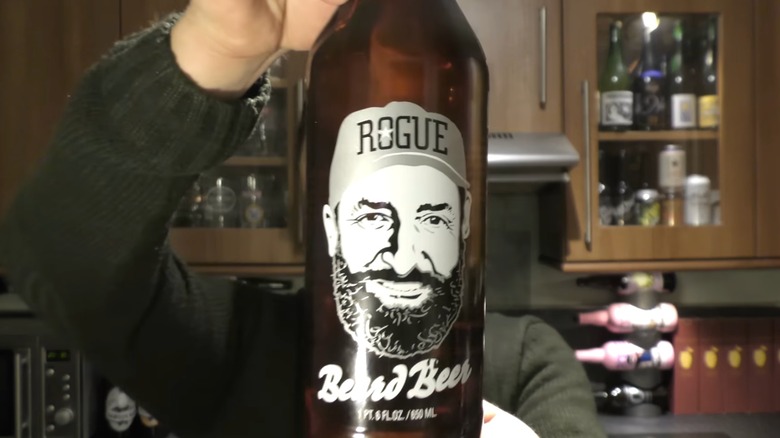
While some might assume this next beer is too gross to even consider swigging, others may jokingly fall upon the pun-inspired assertion that beer genius hides in plain sight — right under our noses, in fact. It's all about the beard at Rogue Ales brand, at least when it comes to its Rogue Beard Beer. Though this too-bristling-for-many beer is no longer in active production, Rogue Ales did indeed brew a beer made from wild yeast that was harvested directly from the beard of its legendary brewmaster, John Maier. Yep, the beer was made with strands of hair from the dude's actual beard.
This story starts when Maier, who hadn't shaved in decades, cultivated a unique blend of yeast on his own facial hair. Maier plucked a few beard hairs on a lark, then promptly sent them off for culturing. Long story short, Rogue Beard Beer was born during this bizarre series of events. And the resulting brew has been described as a Belgian-style ale with faintly fruity notes, a honeyed sweetness, and a slightly sour bite.
Now, before your gross-out meter hits fully maxed-out tilt, rest assured, this beer wasn't made by sticking the brewmaster's beard deep into the brew kettle and swirling it about. Instead, the yeast was first isolated, then grown in a lab, all before it got near the batch of beer that was brewed into happy hour pints.
6. Jester King: Snörkel
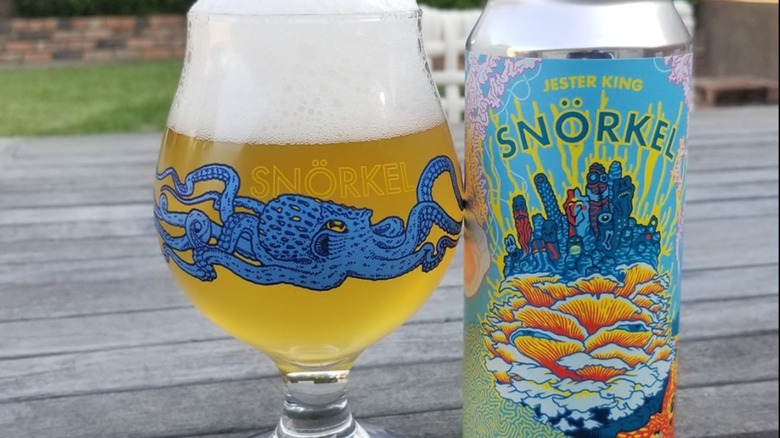
Next on our list of beers with gross origin stories is a quirky creation from the best brewery in Texas, Jester King. The brand's Snörkel beer proves it isn't afraid to think outside the box — or even deep beneath the sea. The ocean-inspired farmhouse ale is brewed with oyster mushrooms and alderwood smoked sea salt for a magical meeting of earth and sea, created to delve (or dive?) deep into a savory, umami-esque territory that most brands don't dare to conjure (much less sell to customers).
Inspired by a classic German gose, Snörkel has a 4.5% ABV and a tart flavor with a dry finish. Far from being the too-salty, seaweed-filled stew some drinkers might fear, Snörkel is said to be quite enjoyable to drink. Fans have complimented its layers of brightness, pleasant acidity, and savory (but not in an over-the-top way) flavor profile. As for those mushrooms, they themselves are locally grown, sometimes via spent grain from previous Jester King brews. They're a key ingredient that's added during the boiling step in the process to give the beer the earthy, musky character it's known for. While not officially discontinued, Snörkel appears to only be available for sale intermittently, which lowkey adds to its mystical allure.
7. Nørrebro Bryghus: Pisner
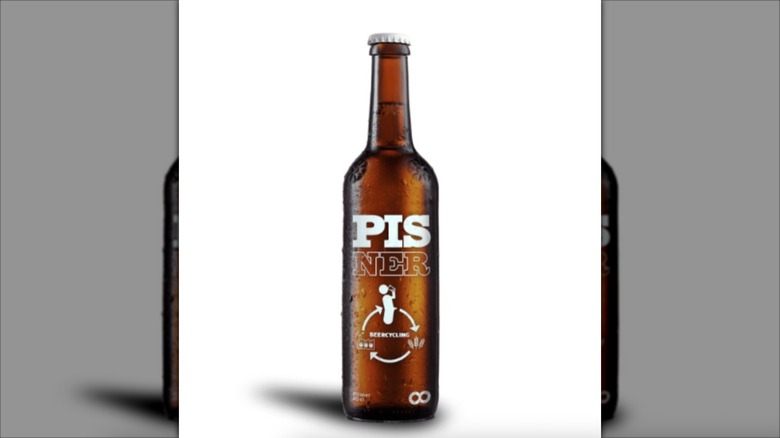
We've all come across ideas that we've written off as p*ss-poor excuses for inventiveness, but this next beer takes that phrasing (quite literally) and turns it on its head. It comes to us by way of Danish brewery Nørrebro Bryghus, and it's the Pisner. Read that name again, and you'll see the lack of the letter L that would make it say "pilsner". That's no oversight. This beer was purposefully named to reveal that it was made with barley fertilized by more than 50,000 liters of human urine, specifically from those who emptied their bladders at the Roskilde Music Festival.
Before you recoil in disgust, note that the pee itself never actually enters the beer. Rather, it's used in the fertilizer for the malting barley, replacing the more traditional animal manure via a sustainability initiative cheekily dubbed "beercycling." Interestingly, this specific concept has really taken off, and it was even supported by Denmark's Agriculture and Food Council as part of a bigger push for improving circular economic practices.
Now, back to that music festival that was held in 2015. Attendees there chose to use designated urinals, fully knowing that they were producing the liquid "food" for the barley fields that would eventually yield sufficient grain to brew roughly 60,000 bottles of Pisner. While this origin story is definitely gross, you have to hand it to the brewery for its inventiveness and big-picture thinking. Also, the fact that Pisner remains in production and distribution speaks volumes.
8. Brugghús Steðja: Hvalur 2
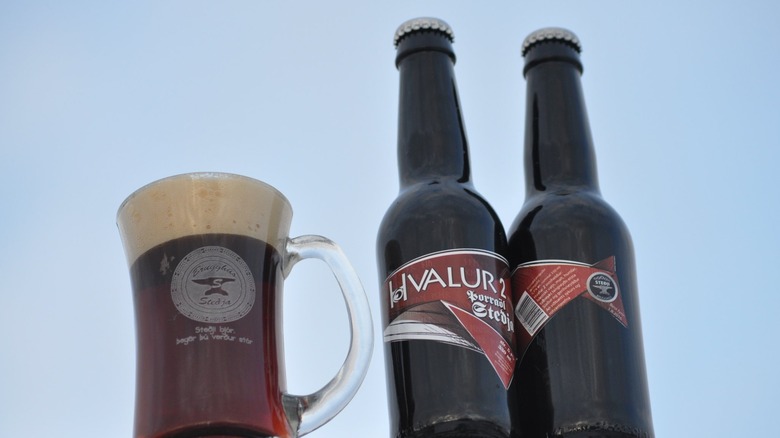
If the idea of bull testicles in beer wasn't enough to send you reeling, pull up a seat because this next beer brings a new set of balls to the table. It might sound nuts, but when it launched, Hvalur 2 — an Icelandic smoked ale brewed by Brugghús Steðja, or Stedji Brewery — made global headlines thanks to its incorporation of cured fin whale testicles. But wait, these testicles weren't just cured; they were also smoked in dried sheep dung, following a centuries-old Icelandic tradition.
This particularly gross origin story starts in 2015, when Hvalur 2 was invented for the midwinter festival of Þorri. For this celebration of Norse history, wherein the country's food heritage is highlighted, the ballsy brew was a perfect fit. Why? Because in Iceland, things like fermented shark, cakes of sour ram's testicles, and other preserved delicacies are considered to be traditional foods. Within that culinary context, the idea of adding whale parts (testicles in particular) to beer isn't outlandish.
Each batch of Hvalur 2 included an entire smoked testicle that was salted and prepared before being tossed into the mind-boggling mix mid-brew. While some sippers likened it to a Scottish-style smoked ale, others balked. What's more, the beer was mired in controversy as anti-whaling activists criticized it heavily, though the brewery swore that the whales involved were legally harvested under Icelandic regulations. Regardless, the debate is now rendered moot, as Brugghús Steðja is no longer in business.
9. The Order of Yoni: Bottled Instinct
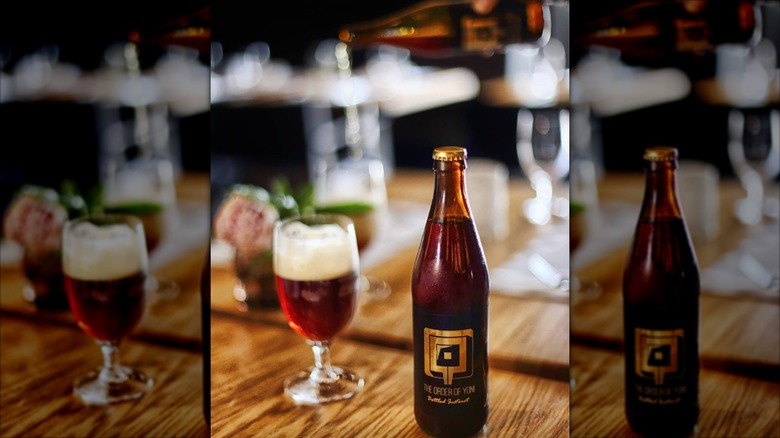
We're gonna approach this next beer with a gentle touch. At the center of Bottled Instinct from The Order of Yoni is an ingredient that's considered unmentionable by many. What could possibly be so hush-hush about this Polish brewery's beer? How about the fact that it is (loudly and proudly) marketed as the world's very first "vaginal beer"?
The production of Bottled Instinct relies on lactic acid bacteria that is isolated (under medical supervision) from the vaginal microbiome of volunteer models. Translation: The brewers take some of the stuff that would otherwise stick to ladies' undergarments, and whips it up into a sippable brew. The brainstorm behind the storied beverage was sparked after the brewmaster learned that the same type of bacteria responsible for sour beer's tart flavor also naturally occurs in the human body. The Order of Yoni decided to have samples collected by a gynecologist, sent to a laboratory, and cultured using various microbiological techniques. The bacteria cultivated via this mad scientist-esque wizardry was then used to make a wheat-based ale brewed with champagne yeast, orange peel, and other flavors.
Unsurprisingly, when this beer hit the scene, it drew everything from outrage to fascination. Presumably, plenty of bemused head scratching ensued. But while questions of hygiene understandably circulated, the brewery maintains that all safety protocols were followed. The beer is still sold in limited markets, though it is far from having mainstream distribution.
10. Sankt Gallen: Un, Kono Kuro
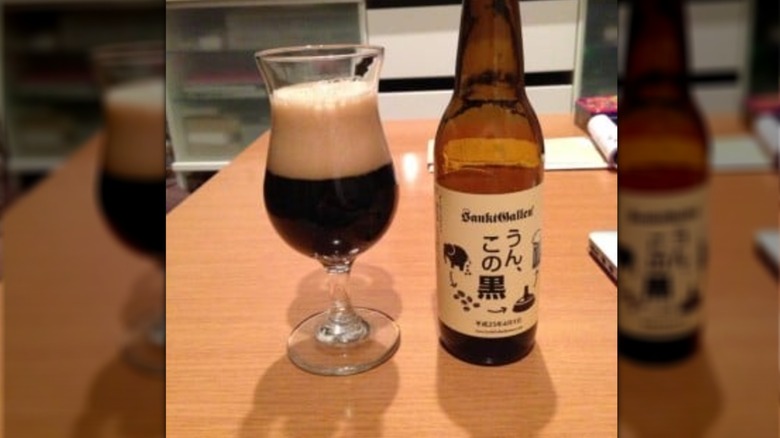
Just as you've wrapped your head around the idea of a beer made with coffee beans passed through civets, Japan's Sankt Gallen Brewery arrives on this list to rock your world with Un, Kono Kuro, a limited-edition stout that was brewed with coffee beans that passed through elephants. Yes, a pretty sh*tty pattern is emerging in the world of craft beer.
The name Un, Kono Kuro was itself a play on words — particularly "unko", the Japanese word for (you guessed it) poop. Un, Kono Kuro's main ingredient was Black Ivory Coffee, an ultra-premium coffee made from beans that are consumed and naturally fermented inside the elephants at Thailand's Golden Triangle Elephant Foundation. After the beans are properly digested by Dumbo, they're collected, thoroughly cleaned, and roasted. The process is so inefficient that it boggles the mind, with wild amounts of coffee beans required to produce just one tiny serving. Hence, as you would imagine, the coffee itself is super expensive.
Sankt Gallen took this pricey, poopy coffee and incorporated the beans into a dark stout to create Un, Kono Kuro. And despite its questionable origins, reviews of the beer are surprisingly positive, with some noting a refined quality in the initial bitterness that gives way to subtle sweetness. Another fact that might surprise you: This beer sold out almost immediately upon release, with kegs reportedly priced as high as $1,100.
11. Topsy Turvy Brewery: Magicicada Buzz
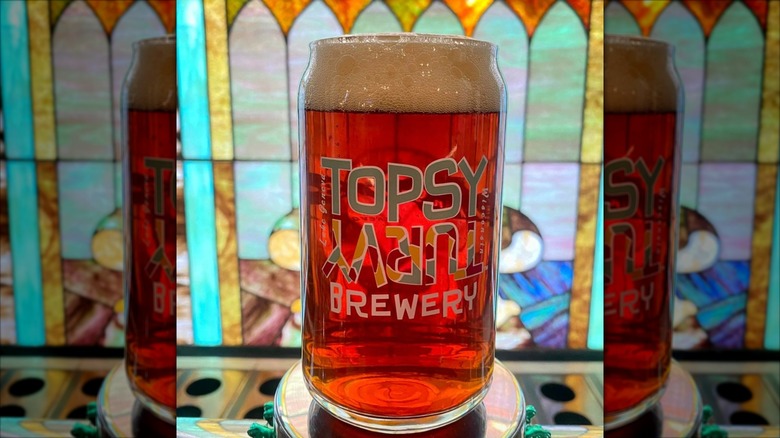
Are you wondering, what's the best beer to choose for your home brew? You probably haven't considered cicada beer, but maybe you should. The intrepid brewers behind Topsy Turvy Brewery and its Magicicada Buzz beer did, and it paid off.
The story starts when cicadas did what they're wont to do in Wisconsin every 17 years or so: They swarmed up a storm. And while most people would run — or at least reach for the swatter — the good folks at Topsy Turvy Brewery grabbed a pen and paper instead, and got to devising a new beer recipe. The result of this recipe was Magicicada Buzz, a limited-edition nut brown ale filled with dehydrated, ground cicada carcasses. Mmmmmm.
The Topsy Turvy team saw an opportunity for creative brewing, while others only saw annoying cicadas to smash by the several. The experiment was weird, but it paid off. Following several passes and much tinkering, and even a few dismal disasters, Topsy Turvy found what worked: dehydrating the cicadas, grinding them into a powder, putting that powder into a mesh bag, and steeping it in brown ale like a tea infusion. As for its staying power, Magicicada Buzz was always meant to be a novelty, as it was specifically tied to the temporary insect emergence. But it's worth noting that it did sell out quickly. A few small batches followed, crafted during later cicada cycles. Sippers have called it light and slightly sweet.