

Why You Shouldn't Store Cheese In Plastic Wrap — Use This Instead
We may receive a commission on purchases made from links.
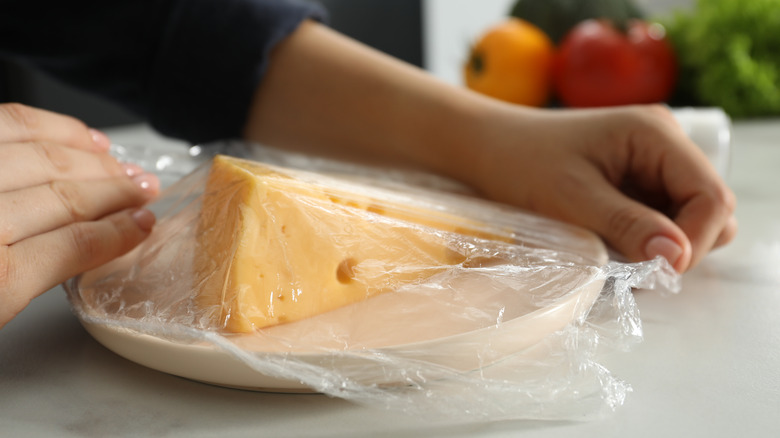
Have you ever spent the entire afternoon daydreaming about the cheese in your fridge, only to finally bite into it and find that its texture and taste are ruined? It's a tragic scenario that can happen when you leave the product in its plastic wrap. To make sure that our readers don't suffer such a fate, The Takeout spoke with Shannon Bonilla, cheese specialist at Wisconsin Cheese, about the proper way to store your fromage.
"The plastic used at the store is mainly for short-term packaging and transport, not long-term storage in your fridge," Bonilla explained. According to the expert, this happens because " ... cheese is 'alive.' It continues to change and age, and it needs the right balance of moisture and airflow. When you re-wrap cheese tightly in plastic at home, you trap moisture against the surface. That creates the perfect environment for mold to grow faster and can lead to unwanted texture and flavor changes." Yuck.
So, what can you do? "My top recommendation is cheese paper, or even better, cheese paper bags ... " Bonilla stated. She added that these bags allow cheese to breathe, yet keep it from drying out and touching other foods. But fear not if you don't have cheese paper on hand, as Bonilla suggested alternatives: Wrap the cheese in parchment paper and store it in a ziploc, plastic wrap, or closed container "to create a suitable micro-climate for storing cheese."
How to properly store different types of cheese

Not all cheeses are created equal. Some are fresh, some are aged; some melt better than others, and some are hard and sturdy. It makes sense, then, that each variety should be stored differently. Shannon Bonilla broke it down: "Hard cheeses (e.g. parmesan ... ) have less moisture to lose and can safely be stored for up to six weeks (or more) after opening." Though cheese paper is preferred, resealable bags are also an option. As for semi-hard cheeses like cheddar and gouda, they can last for about four weeks if stored well after opening. "Depending on the rind, you'll want to use cheese paper ... but for rindless varieties, plastic wrap/bag will work great," Bonilla advised. Cheese paper or parchment in a ziplock is also appropriate for soft-ripened cheeses with rinds such as brie and camembert. Bonilla claimed that these will last up to two weeks.
Although cheese paper works with most varieties, Bonilla pointed out one big exception: high-moisture fresh cheeses like mozzarella and burrata. (And no, those Italian cheeses are not the same.) Bonilla recommended eating these cheeses as soon as possible after opening them. "If you must, these cheeses are best stored in the containers they were sold in." Another way to store fresh mozzarella is to place it in a container with an airtight lid. "Proper storage ensures your cheese maintains the quality and flavor that cheesemakers work hard to achieve," Bonilla concluded.