

How Walmart's Low Prices Ended Up Benefiting Whole Foods

Yes, you read that correctly: Walmart, known for its "Everyday Low Prices," influenced Whole Foods Market, the supermarket company which earned the unflattering nickname "Whole Paycheck" due to its not-so-low prices. At least, that's what Whole Foods co-founder John Mackey said in a recent episode of David Senra's self-titled podcast.
According to Mackey, the connection began in the late '80s, when Walmart started selling groceries at lower prices than its mainstream competitors. He explained that other grocery chains made a significant mistake by attempting to compete with Walmart's low price by prioritizing cost-cutting measures, such as using cheap lighting and employing minimal labor. As a result, the overall shopping experience in these stores suffered. "And Whole Foods, we just were going in this different direction," stated Mackey. He knew Whole Foods couldn't compete with Walmart on price. Instead, it leaned on its own: quality, service, and a diverse array of product offerings.
As a result, many middle- to upper-middle-class shoppers, and women in particular, turned to Whole Foods for a one-of-a-kind shopping experience they couldn't get at other grocery stores. "They wanted to come into a store that was pretty, that was beautiful, with people that gave them good service, that took their groceries to their car, that was nice to them, that answered their questions," said Mackey. "And they didn't get the products that Whole Foods sold. But what they got was our produce was beautiful, and it tasted good." Ultimately, this selling strategy propelled Whole Foods Market's growth, leading to nationwide expansion and subsequent acquisition by Amazon in 2017 for $13.7 billion.
How Whole Foods and its shoppers continue to benefit
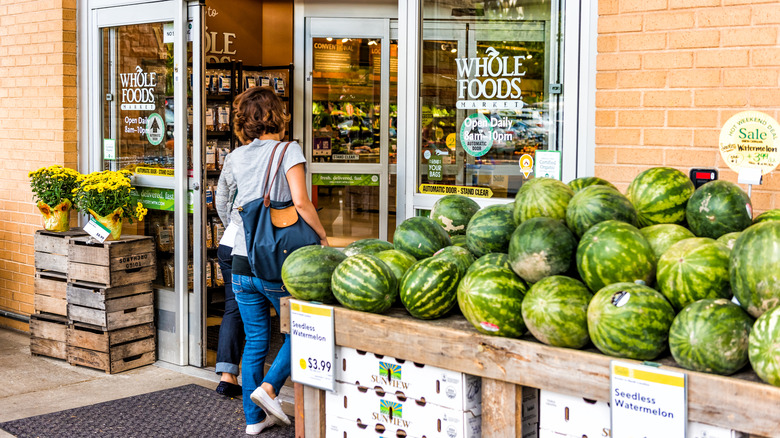
While Walmart may be America's biggest grocery store chain, and consistently dominates grocery sales and annual revenue, Amazon's acquisition of Whole Foods Market has given it a competitive edge. Whole Foods now implements price cuts across all departments, and helps Amazon Prime members save big through special daily and weekly discounts and other perks. This strategy has attracted consumers who might otherwise have shopped elsewhere due to price constraints. Now, they can find comparable or higher-quality products at Whole Foods while also enjoying a pleasant grocery shopping trip. In 2025, Amazon surpassed its previous annual revenue record, exceeding $700 billion, and is projected to surpass Walmart's annual revenue in 2026.
More is in store for Whole Foods shoppers in the near future as Amazon focuses on growing its grocery sector. In late January, the company announced plans to establish more Whole Foods locations — including many of the 72 Amazon supermarkets set to close, which will be converted to Whole Foods stores — and to increase foot traffic . This initiative is aimed at reaching a broader demographic while also being able to provide free same-day grocery delivery and two-hour grocery delivery for Prime members through Amazon Fresh or Whole Foods. As Whole Foods stores and services evolve to more broadly serve customers, shoppers will continue to have access to the same premium quality items with even more affordable prices and deals. They will also enjoy the Walmart-inspired grocery shopping experience that helped set apart Whole Foods in the first place.